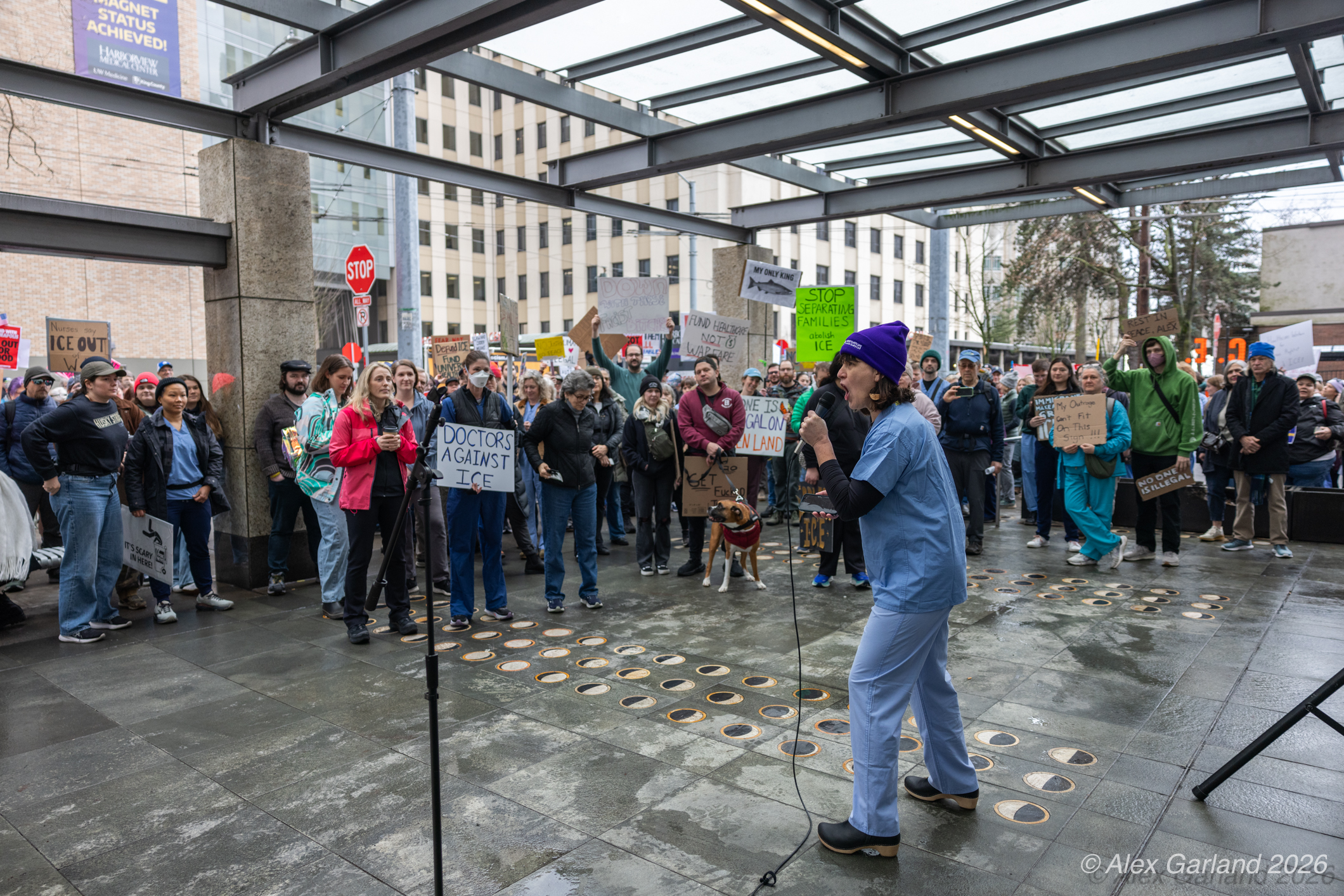
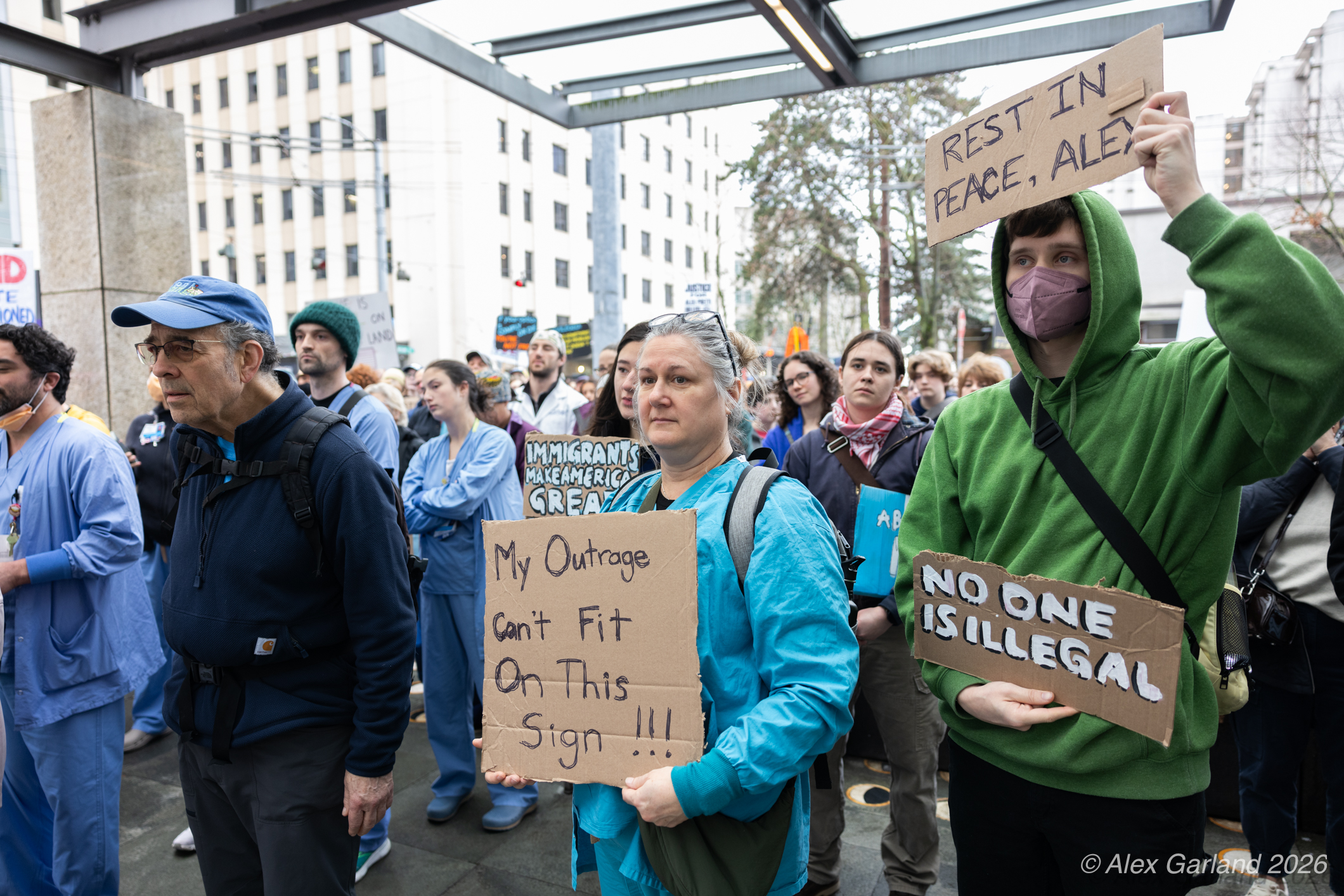
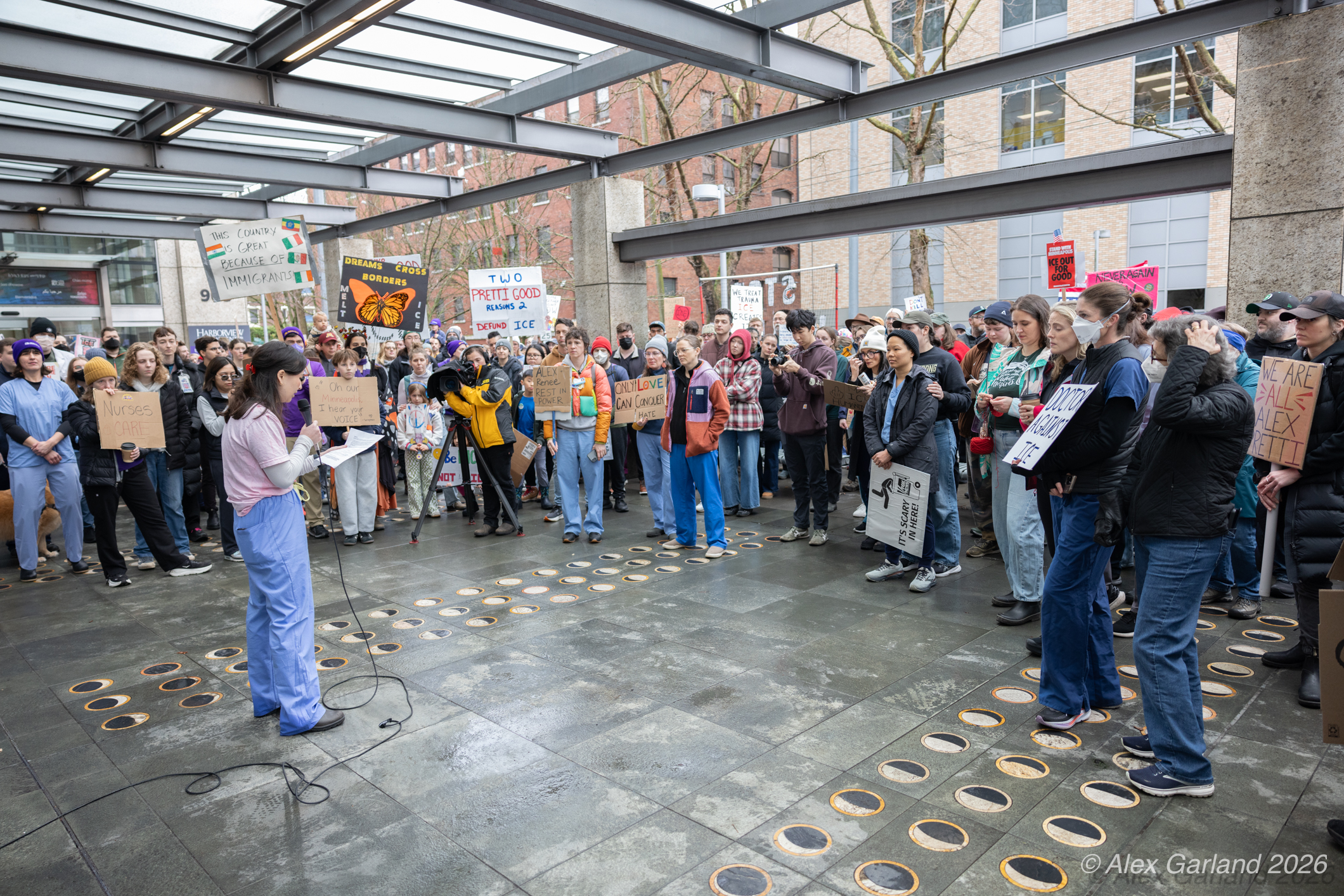
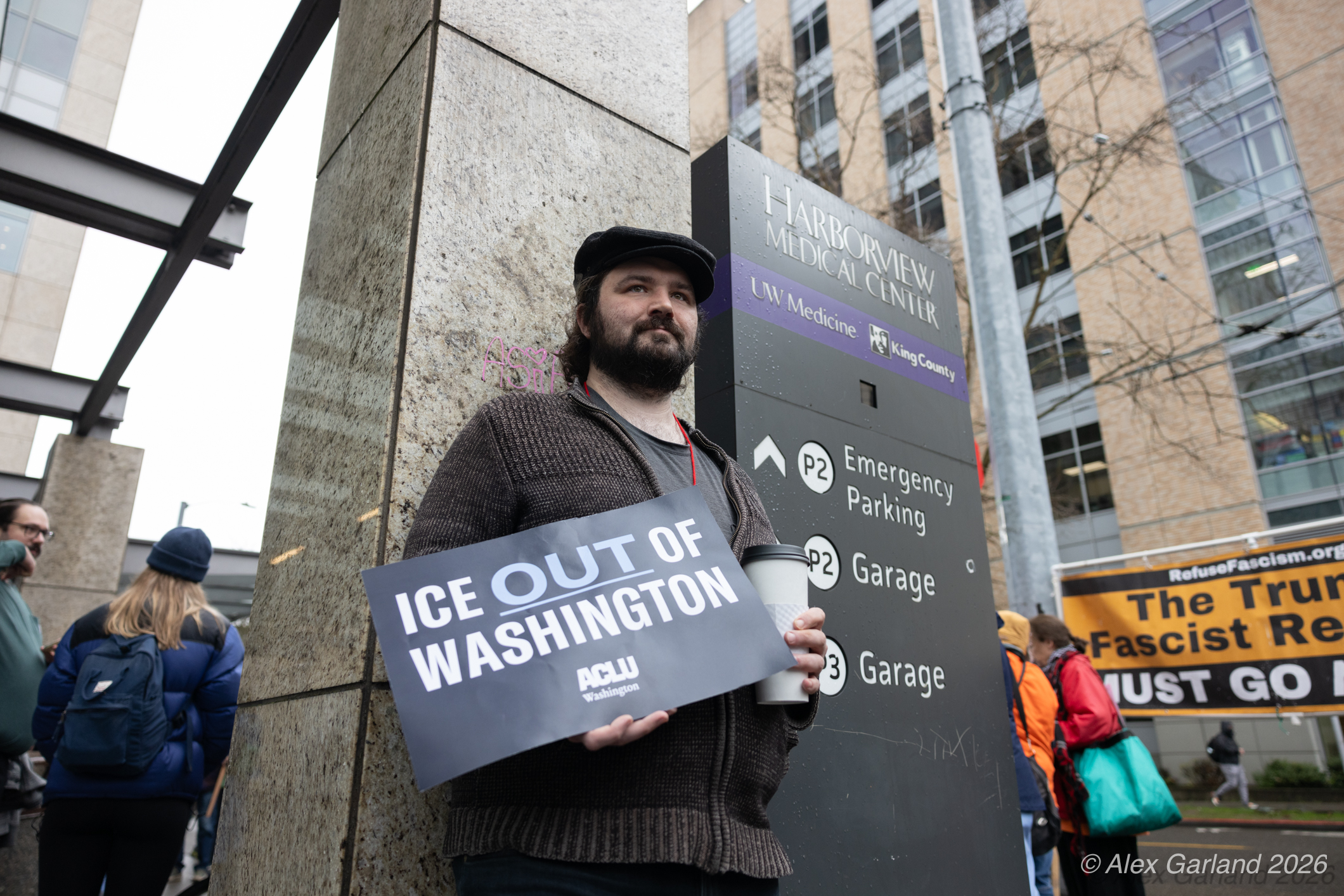
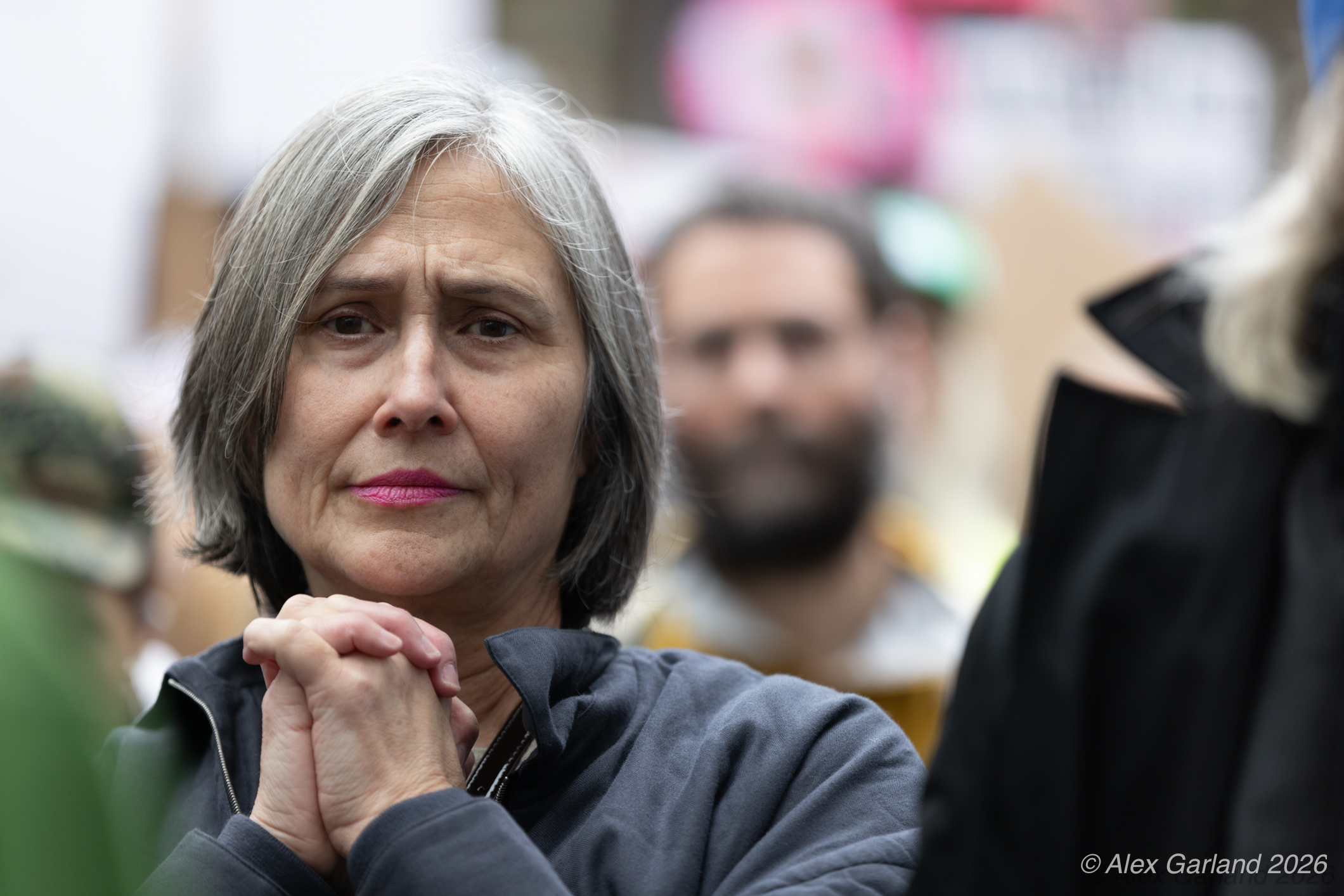
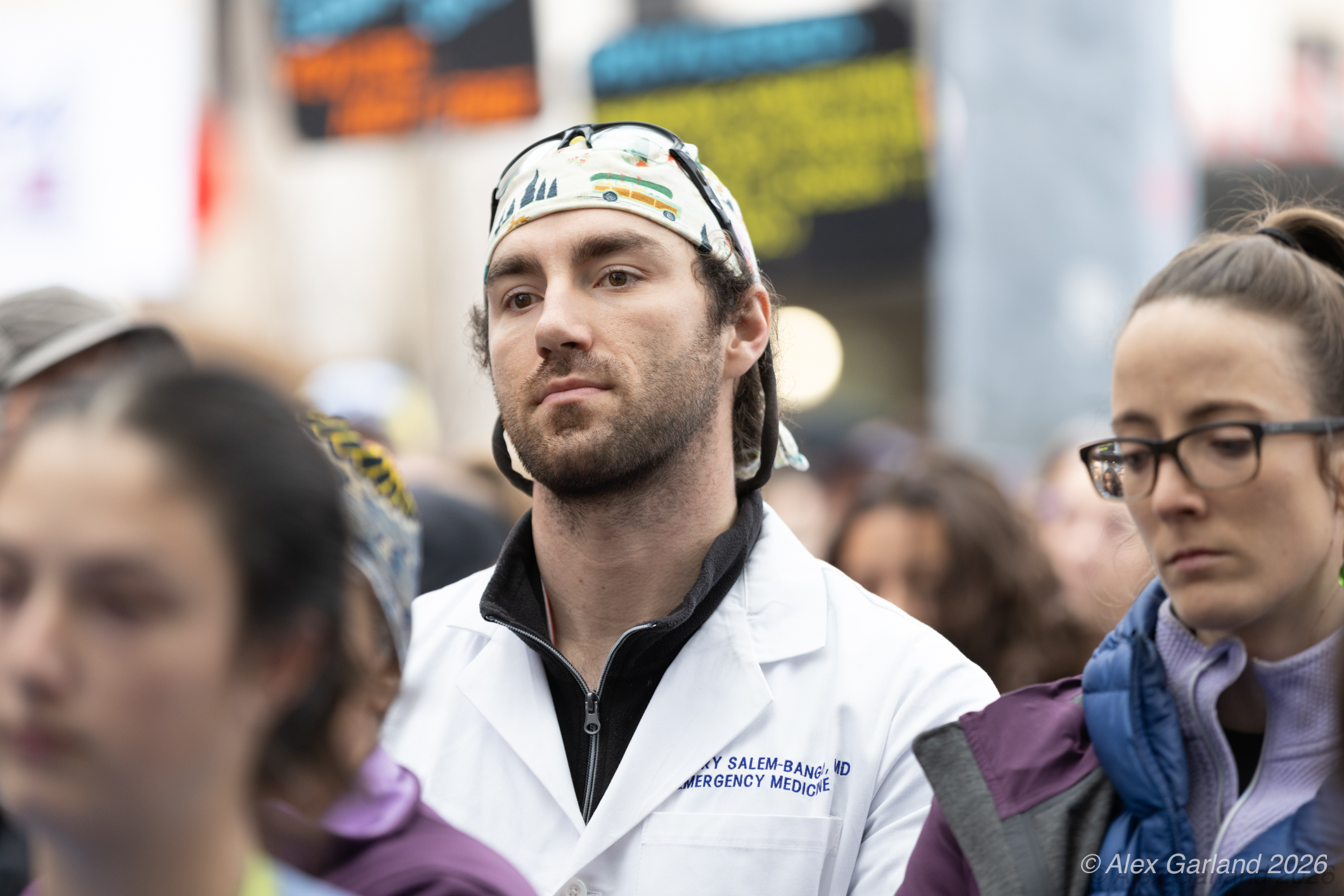
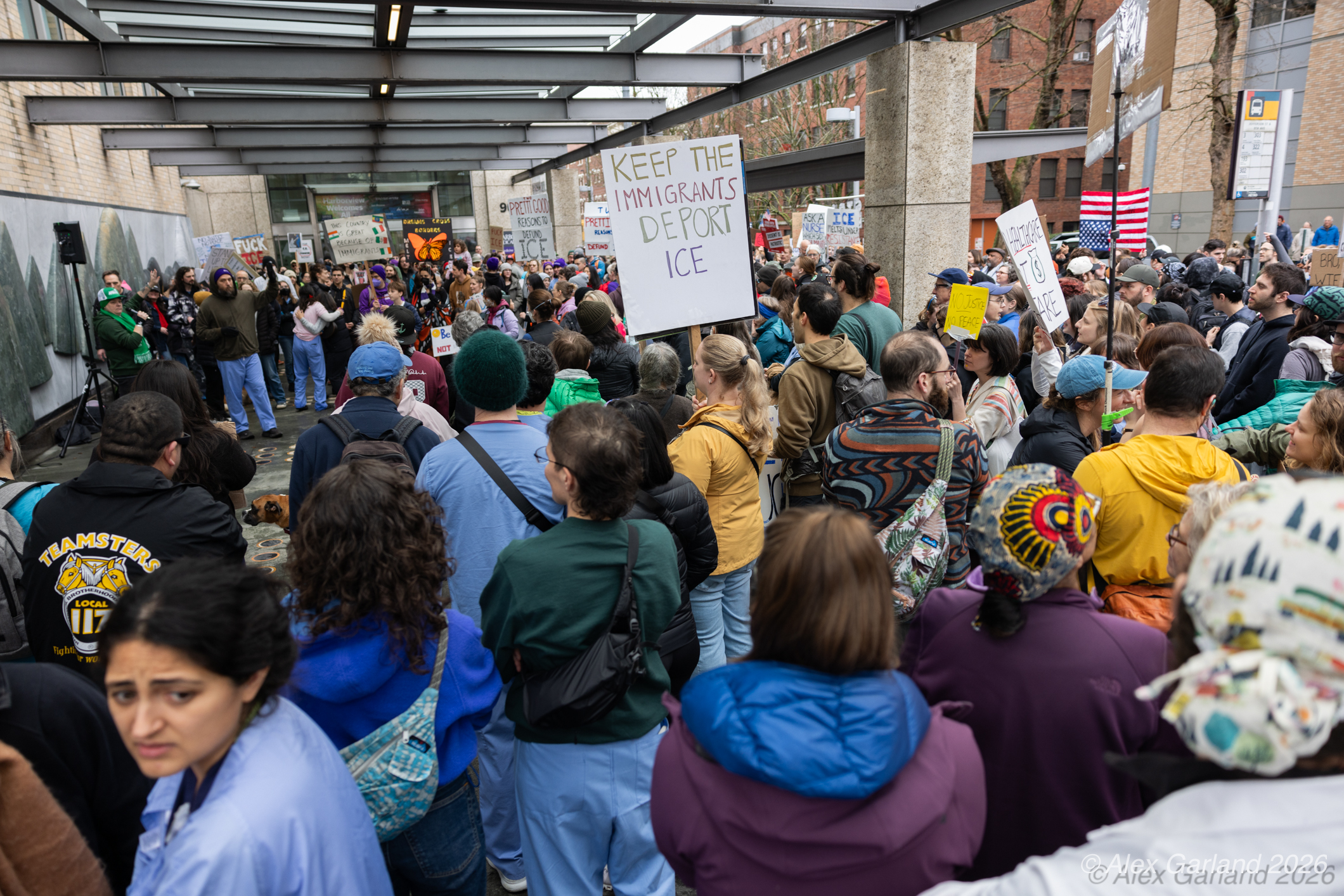
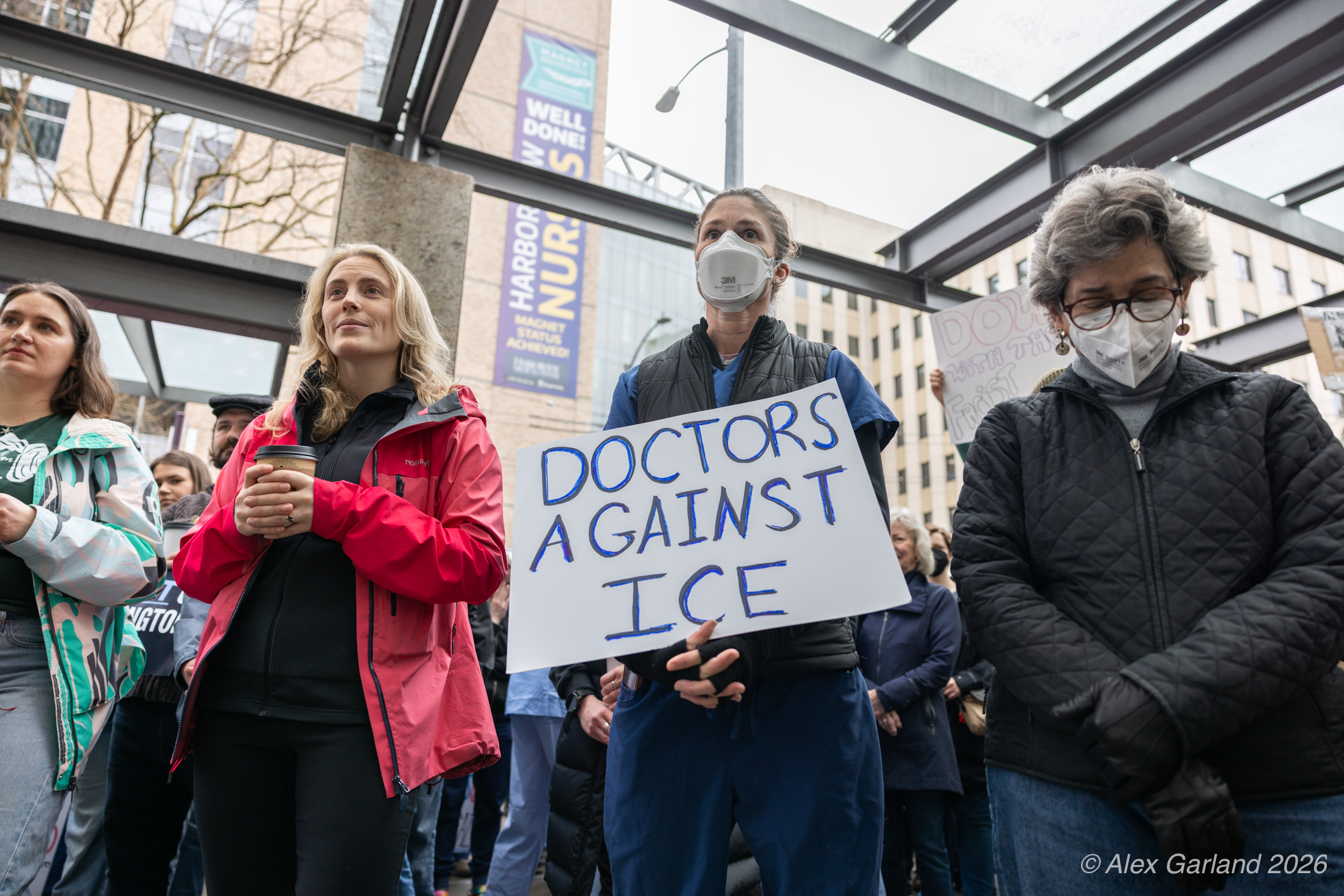
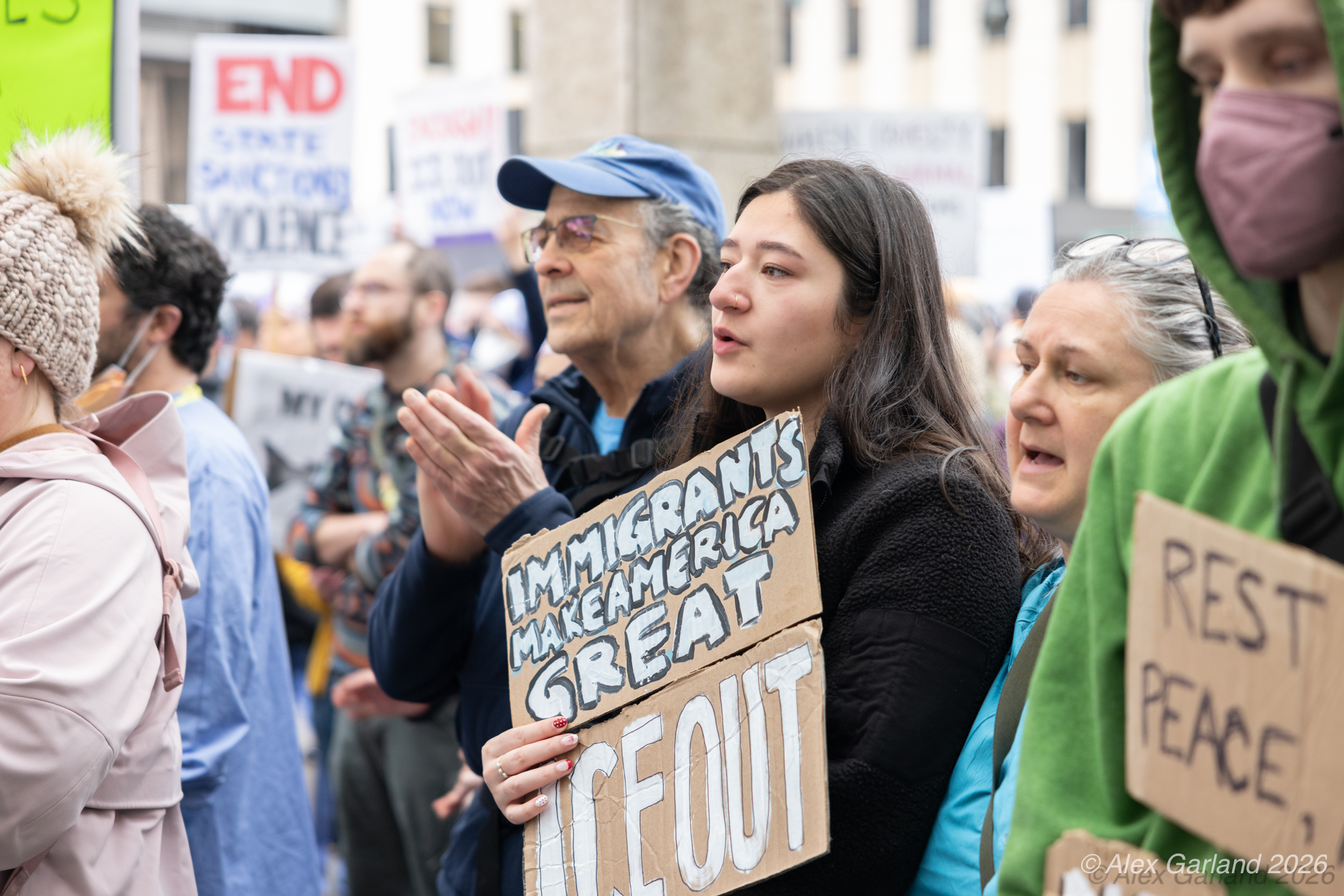
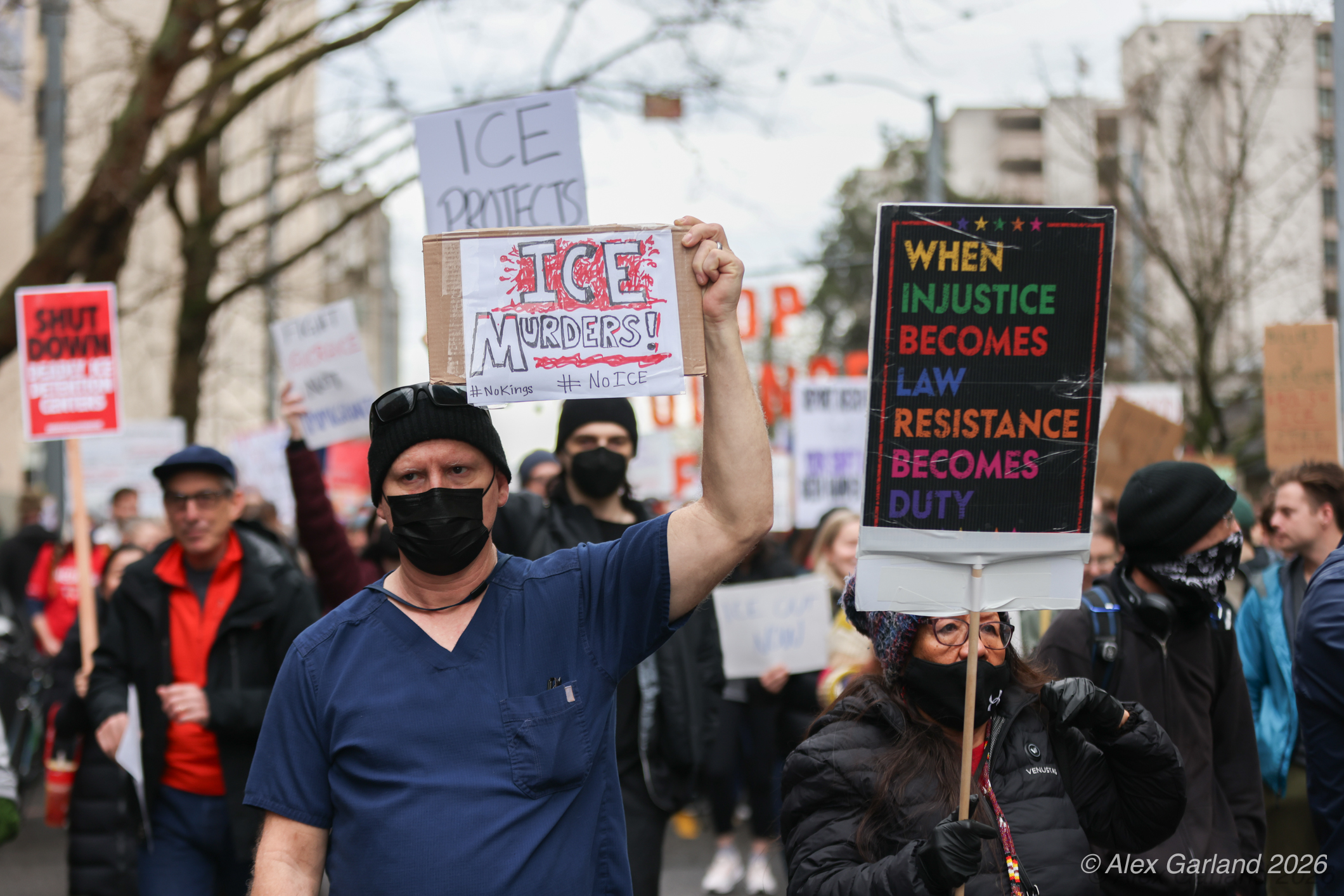
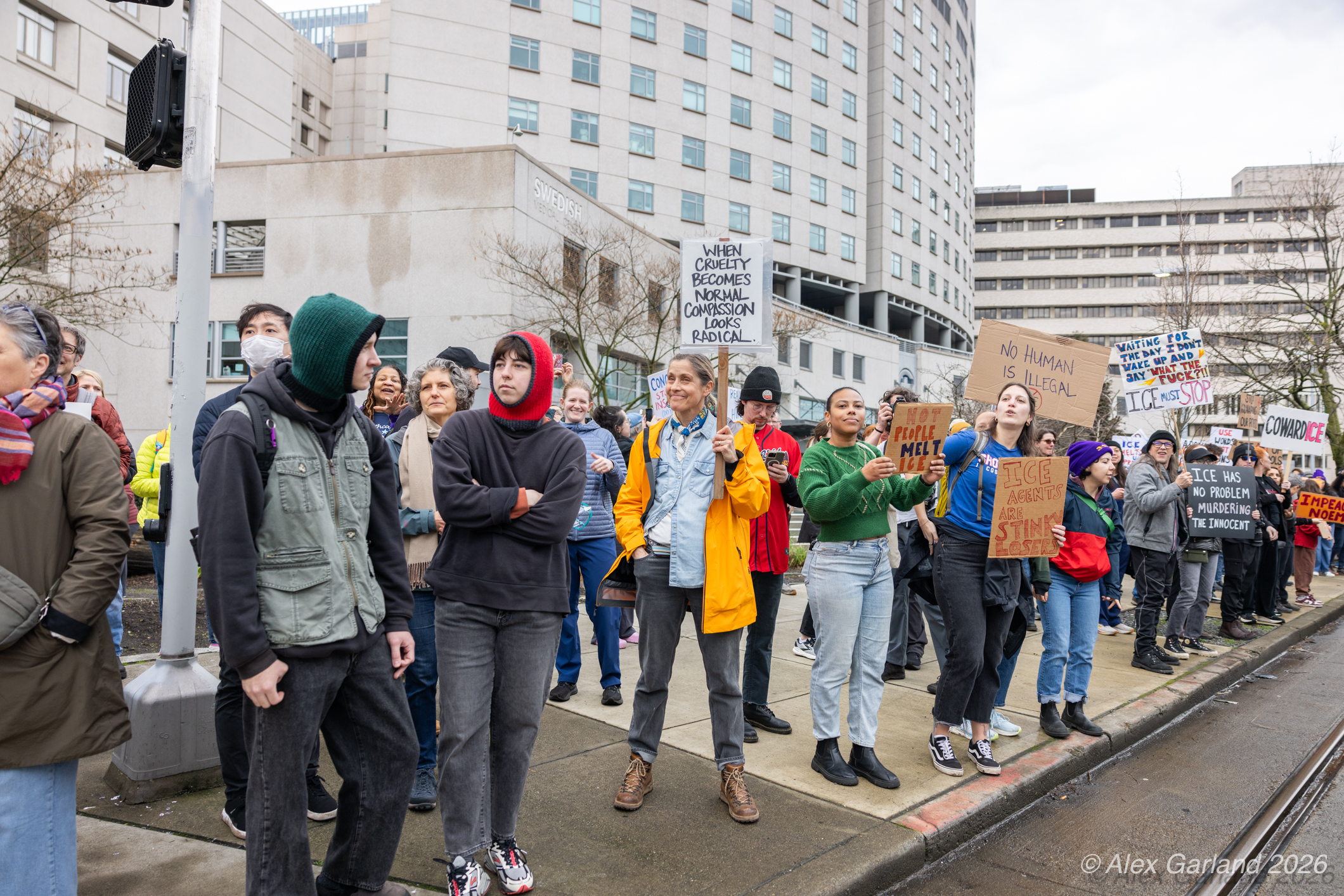
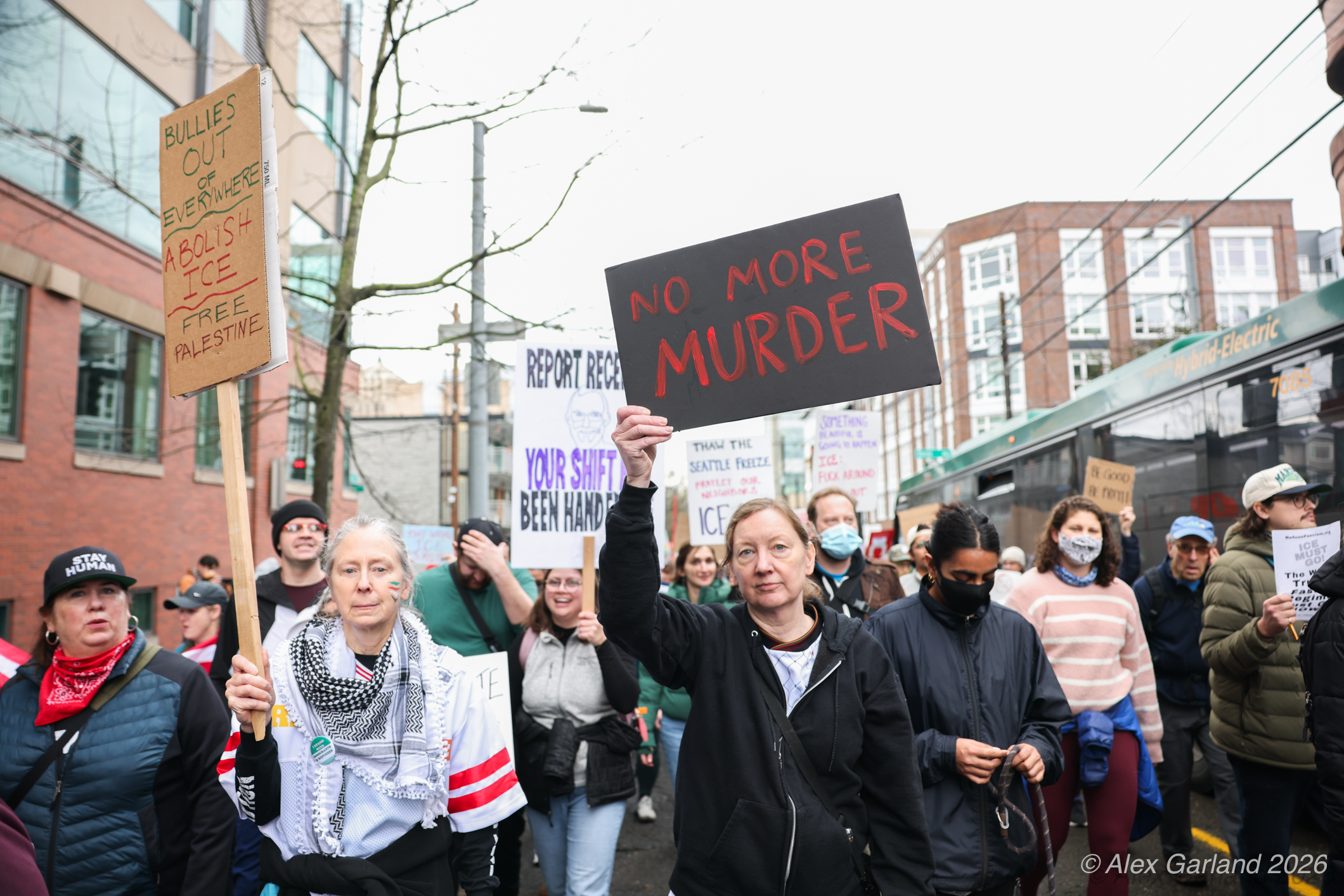
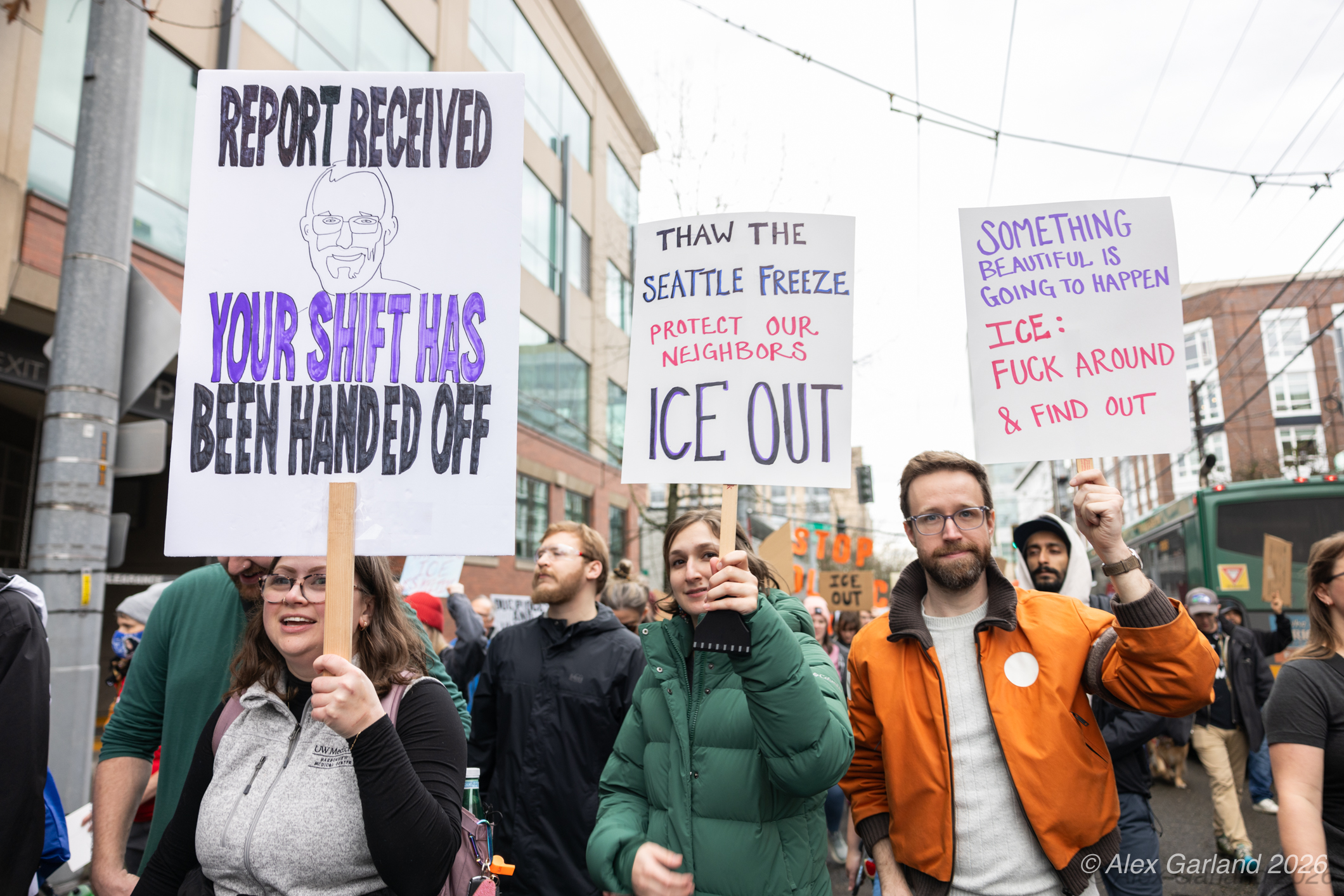
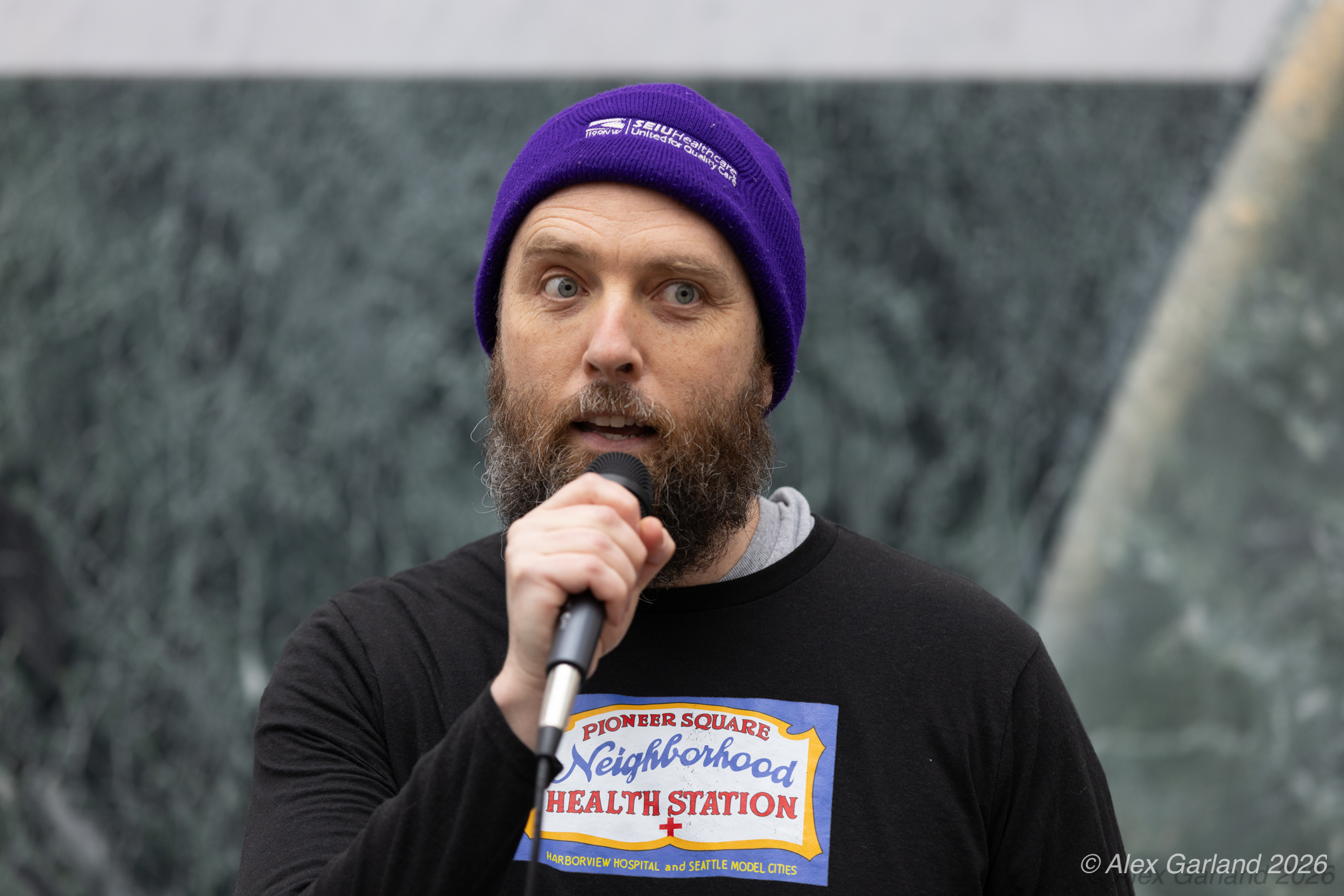
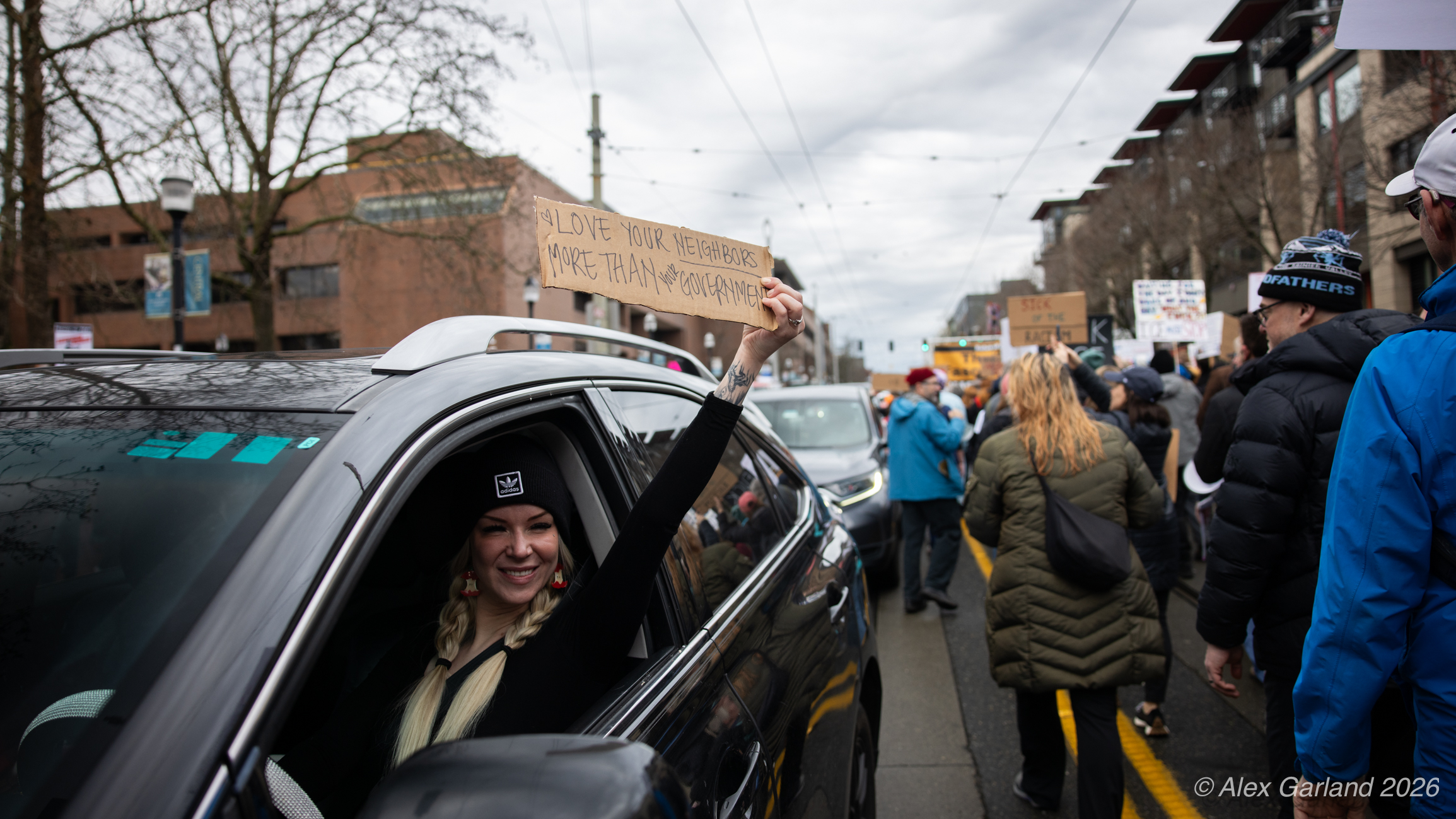
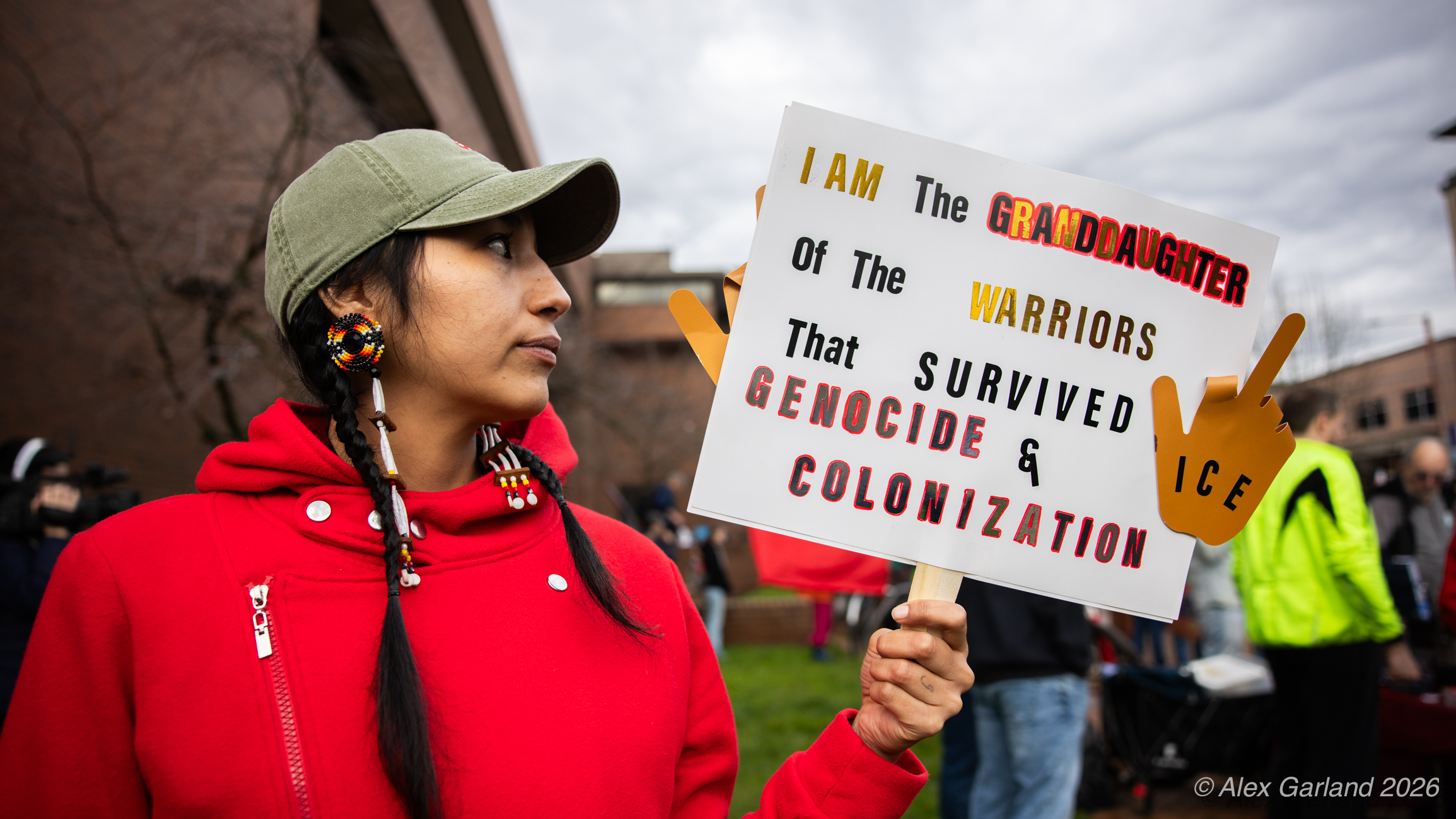
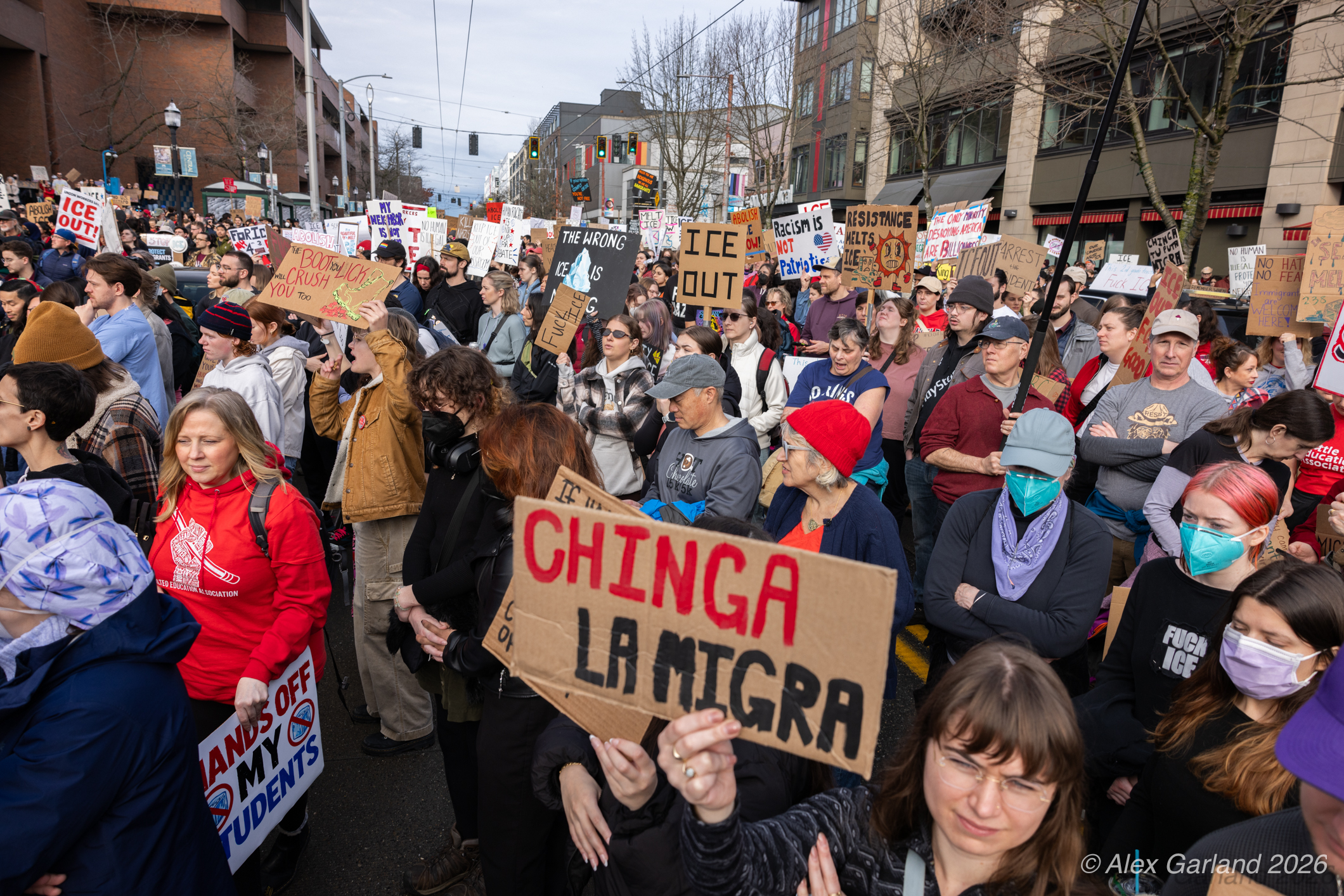
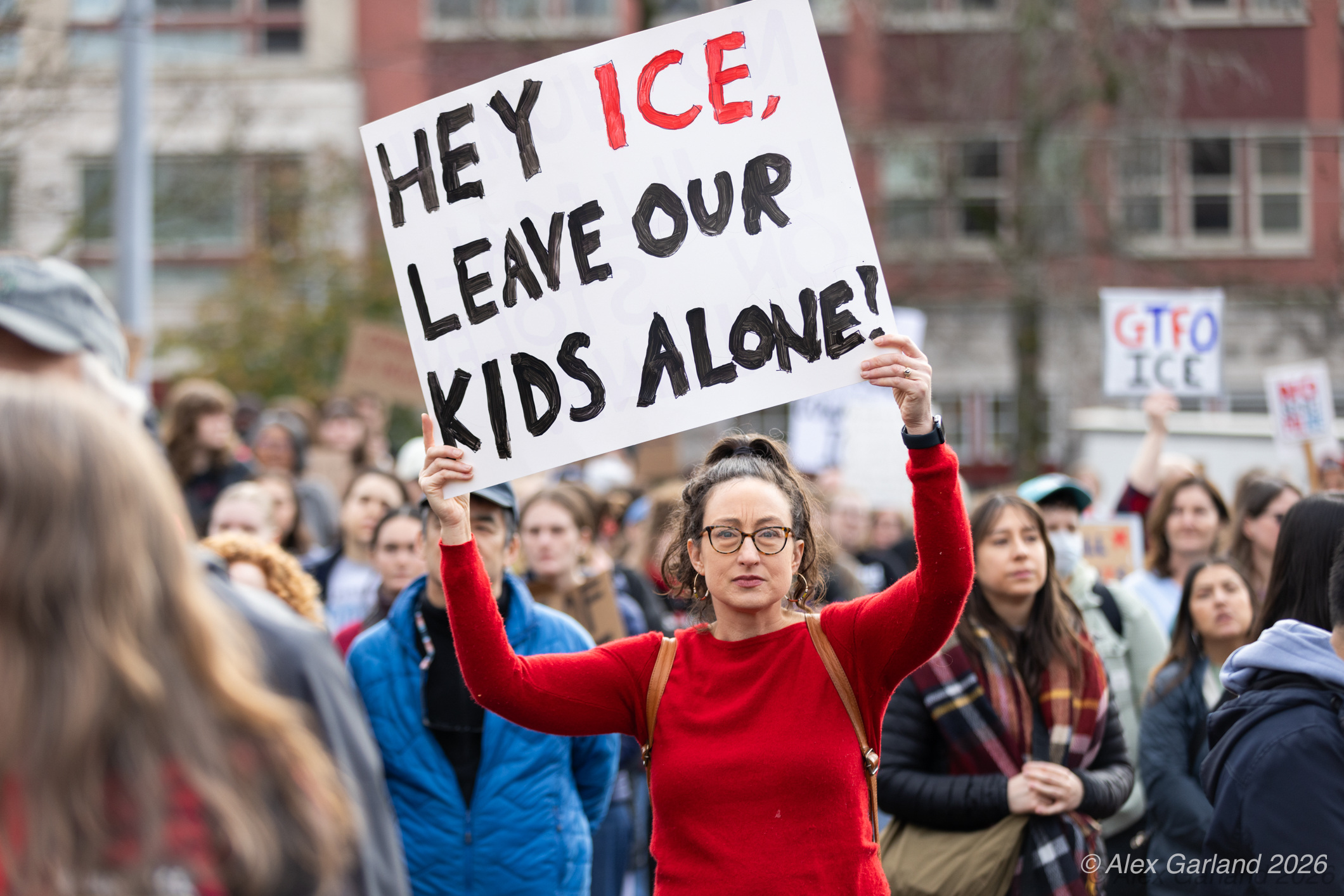
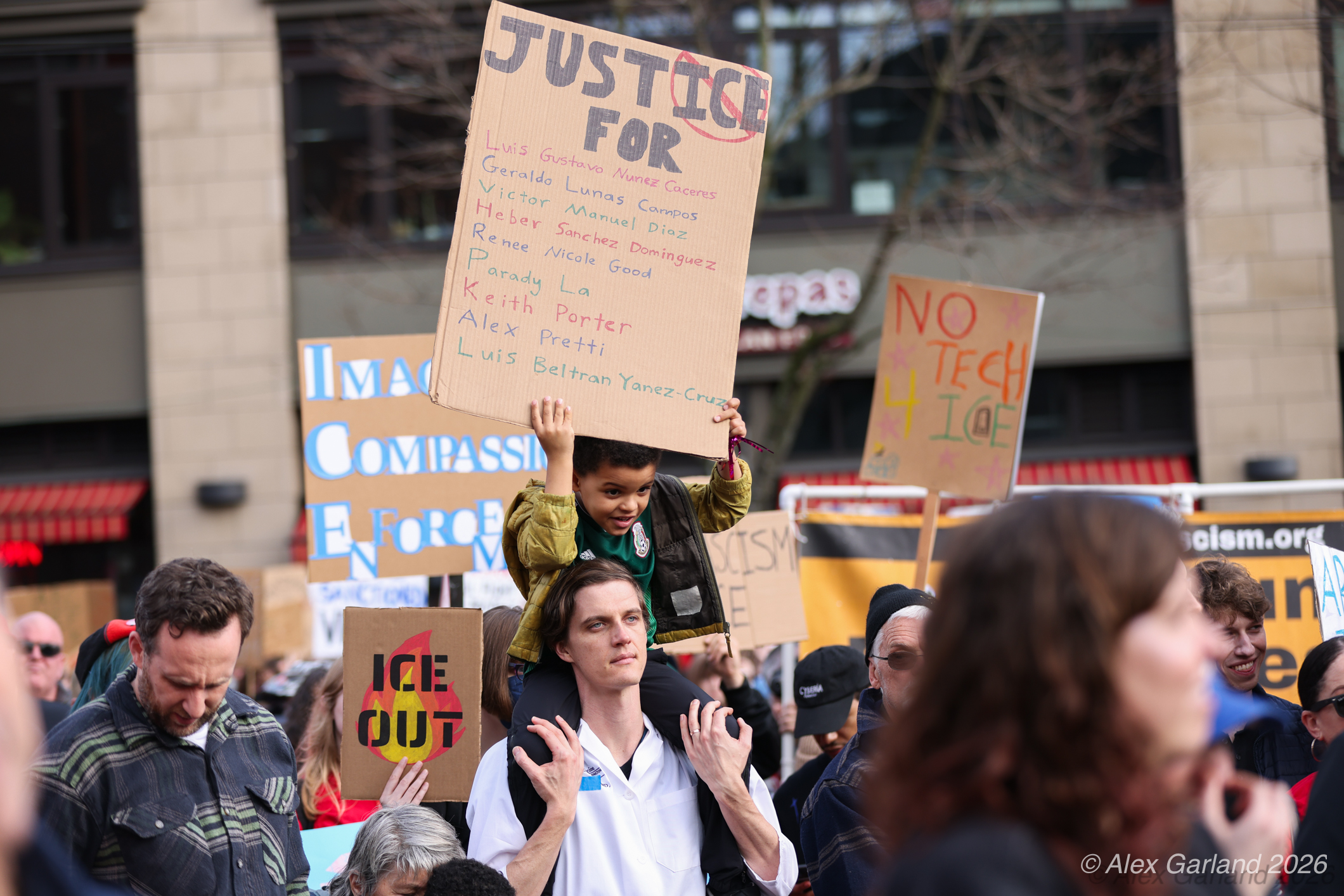
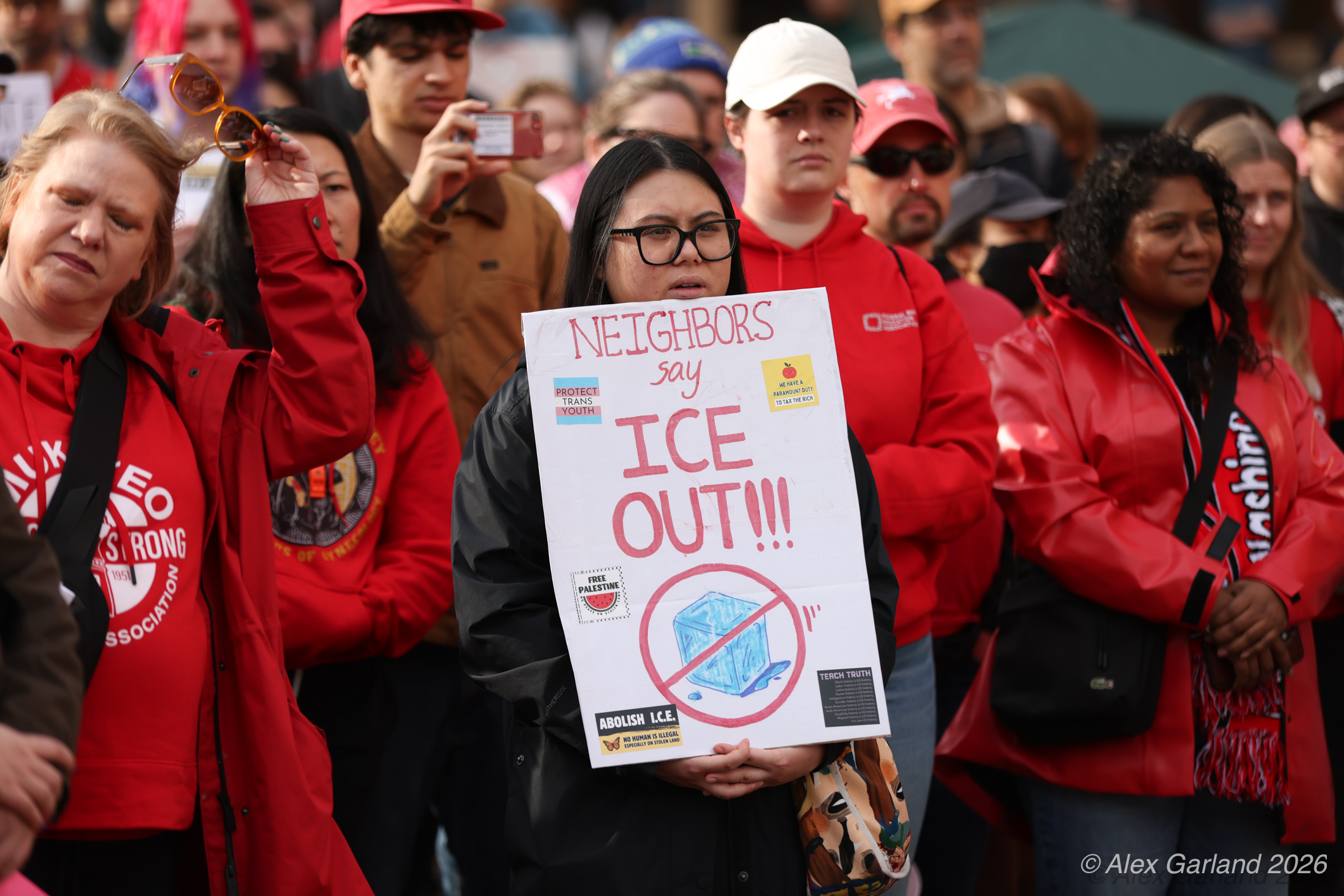
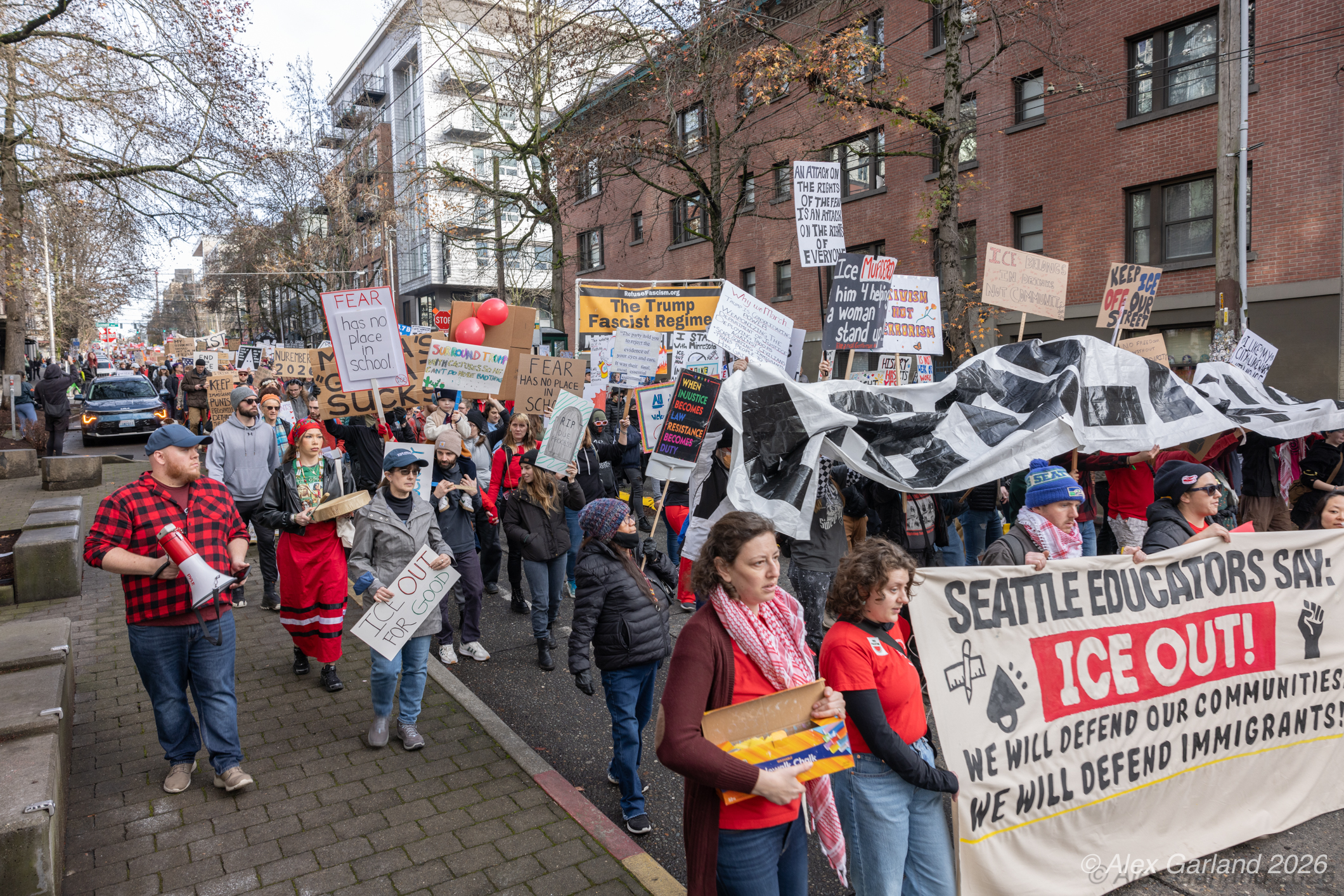
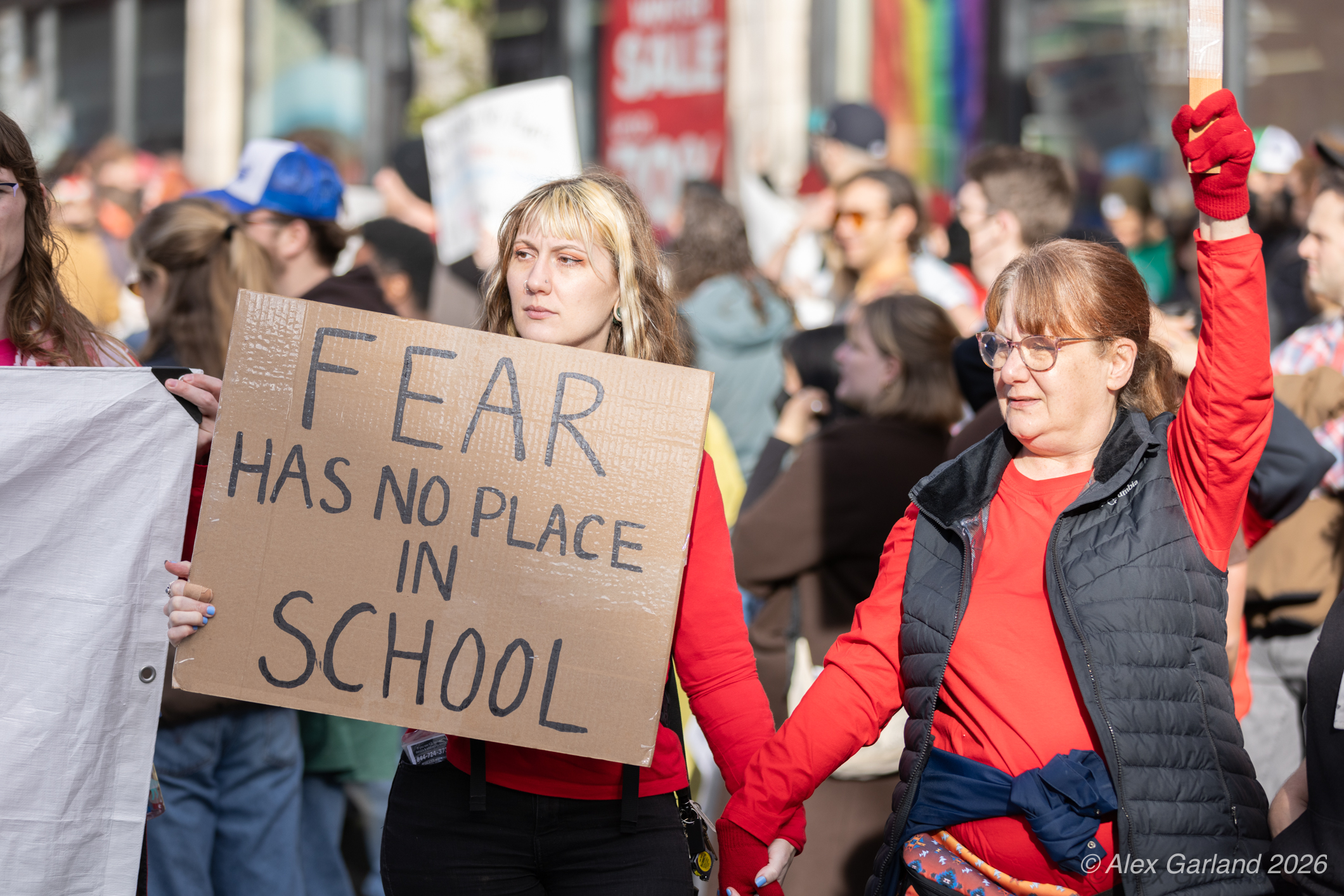
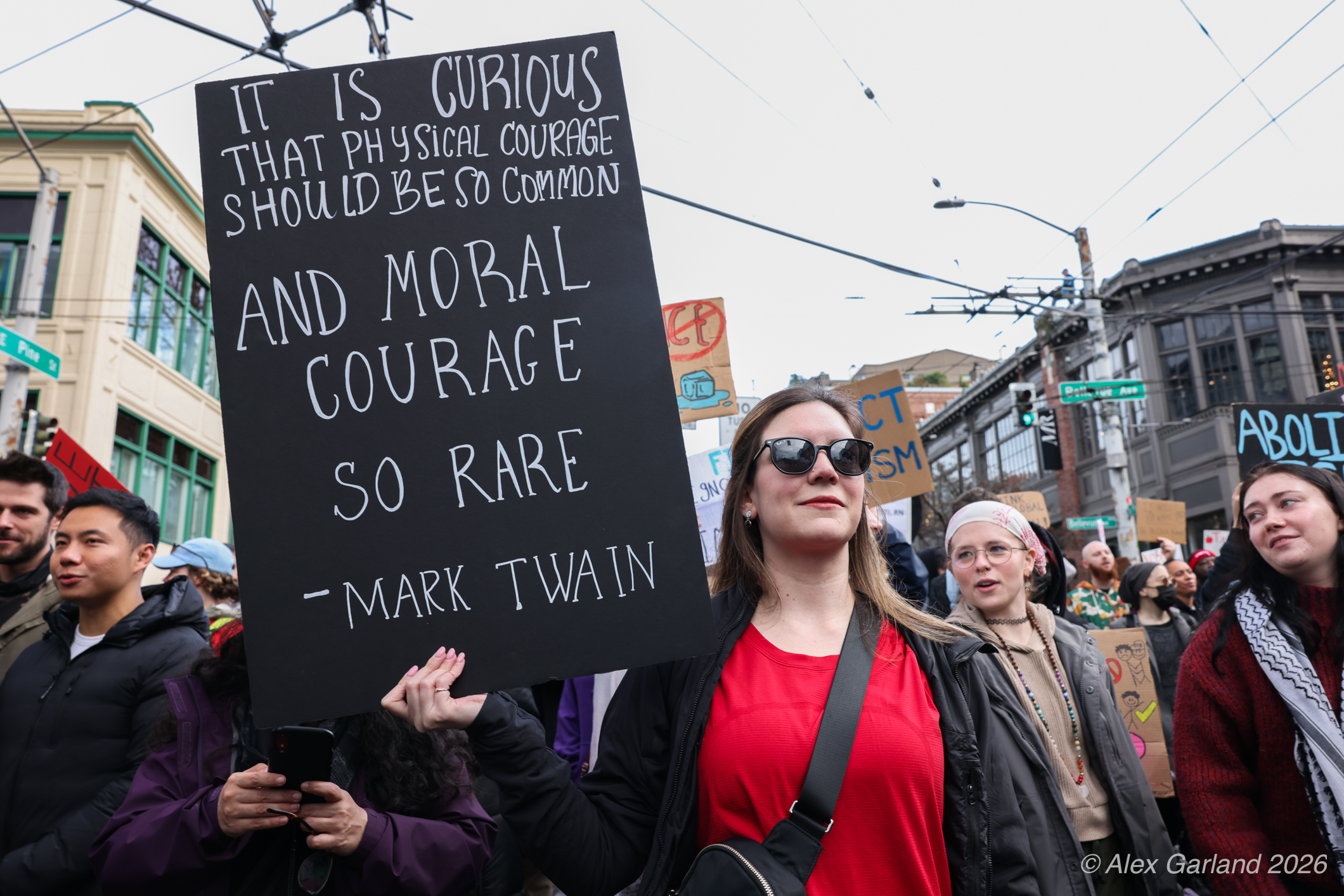
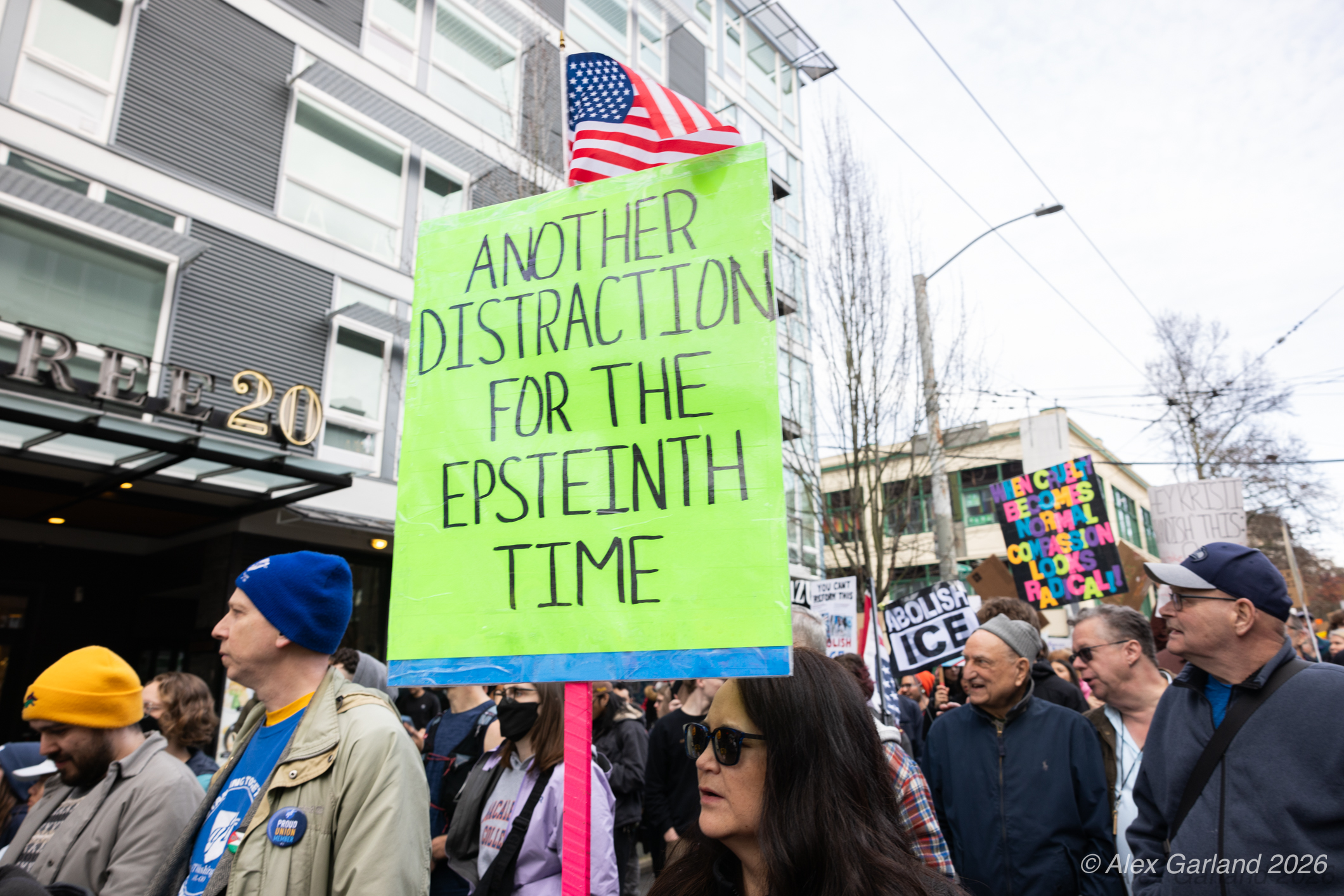
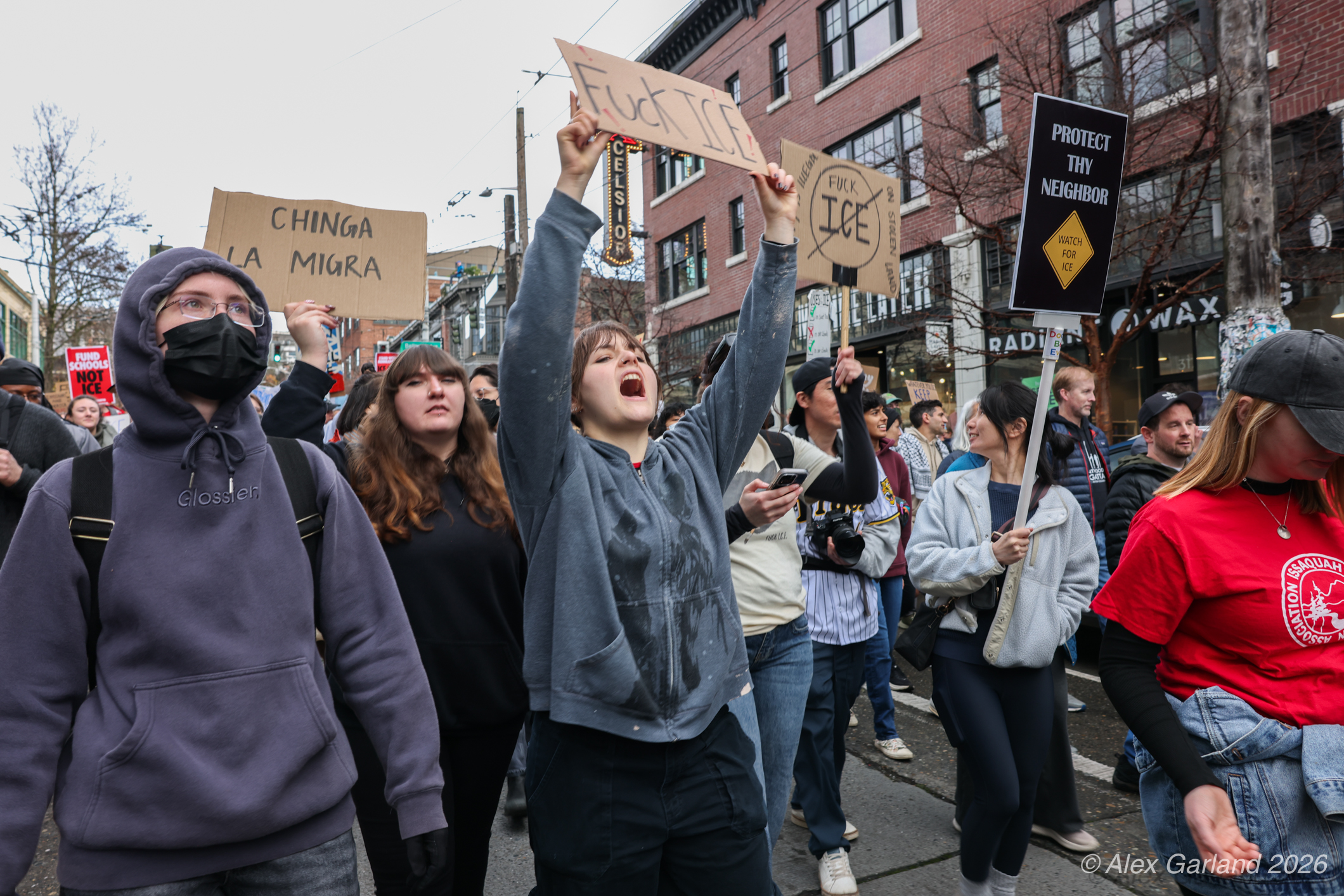
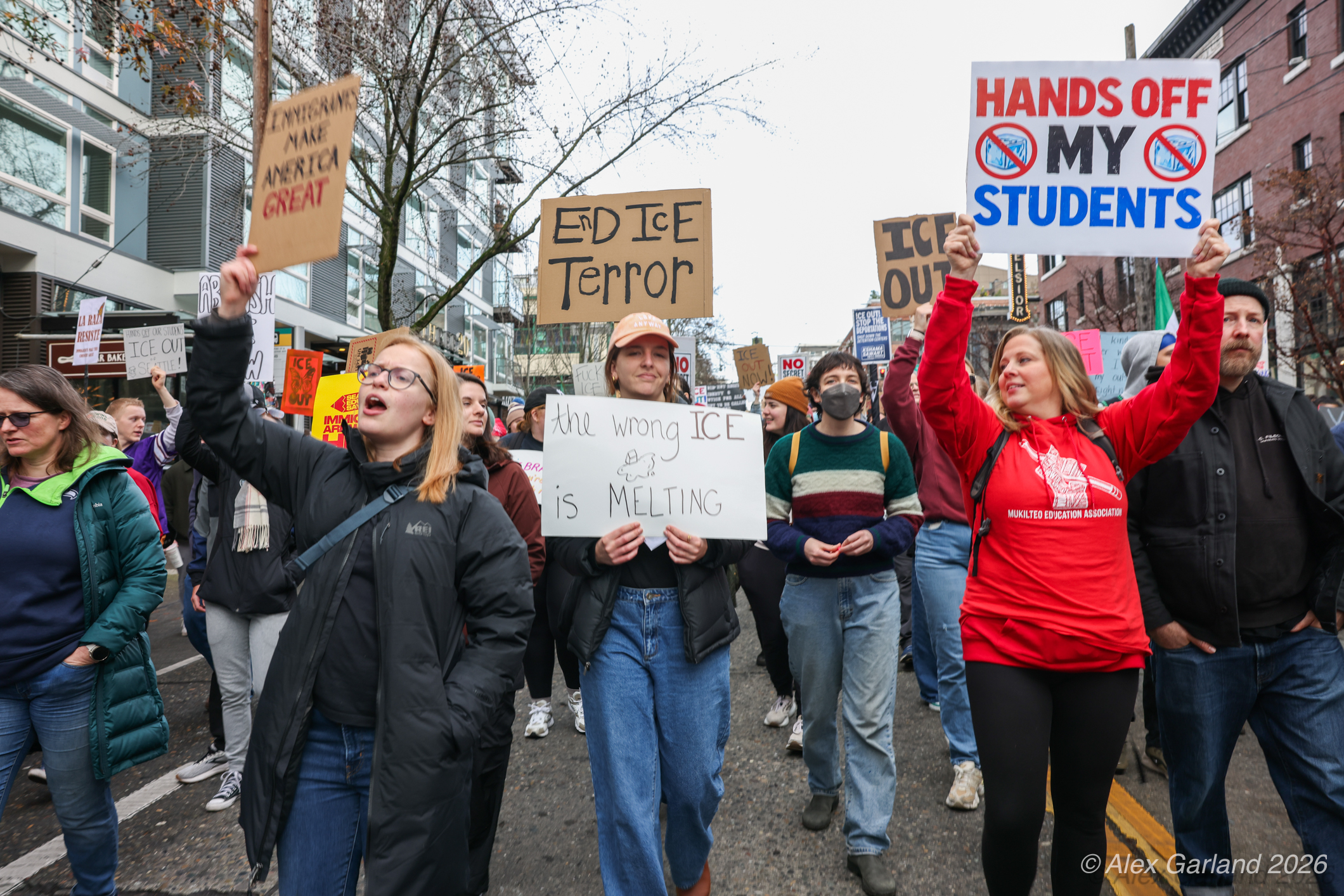
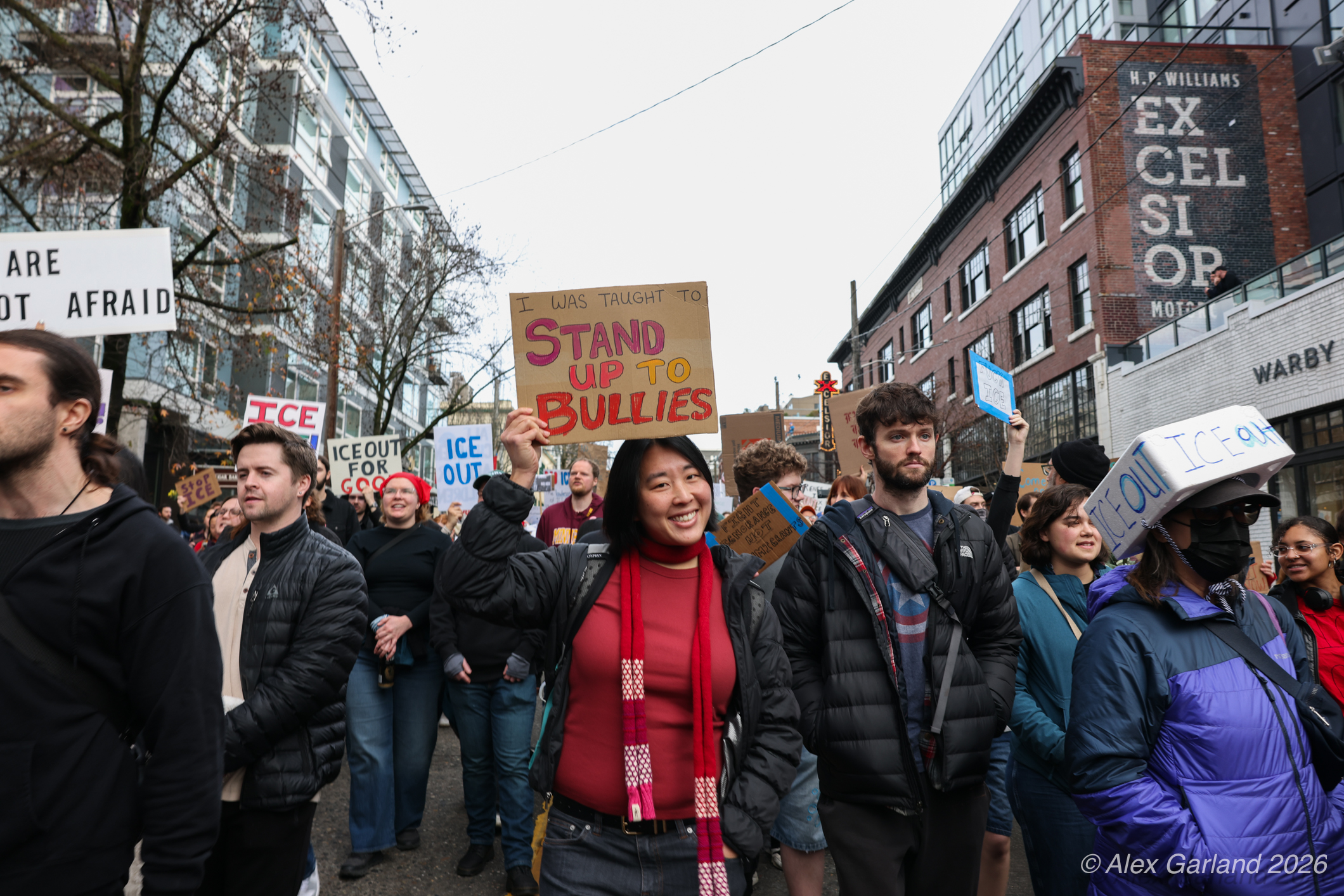
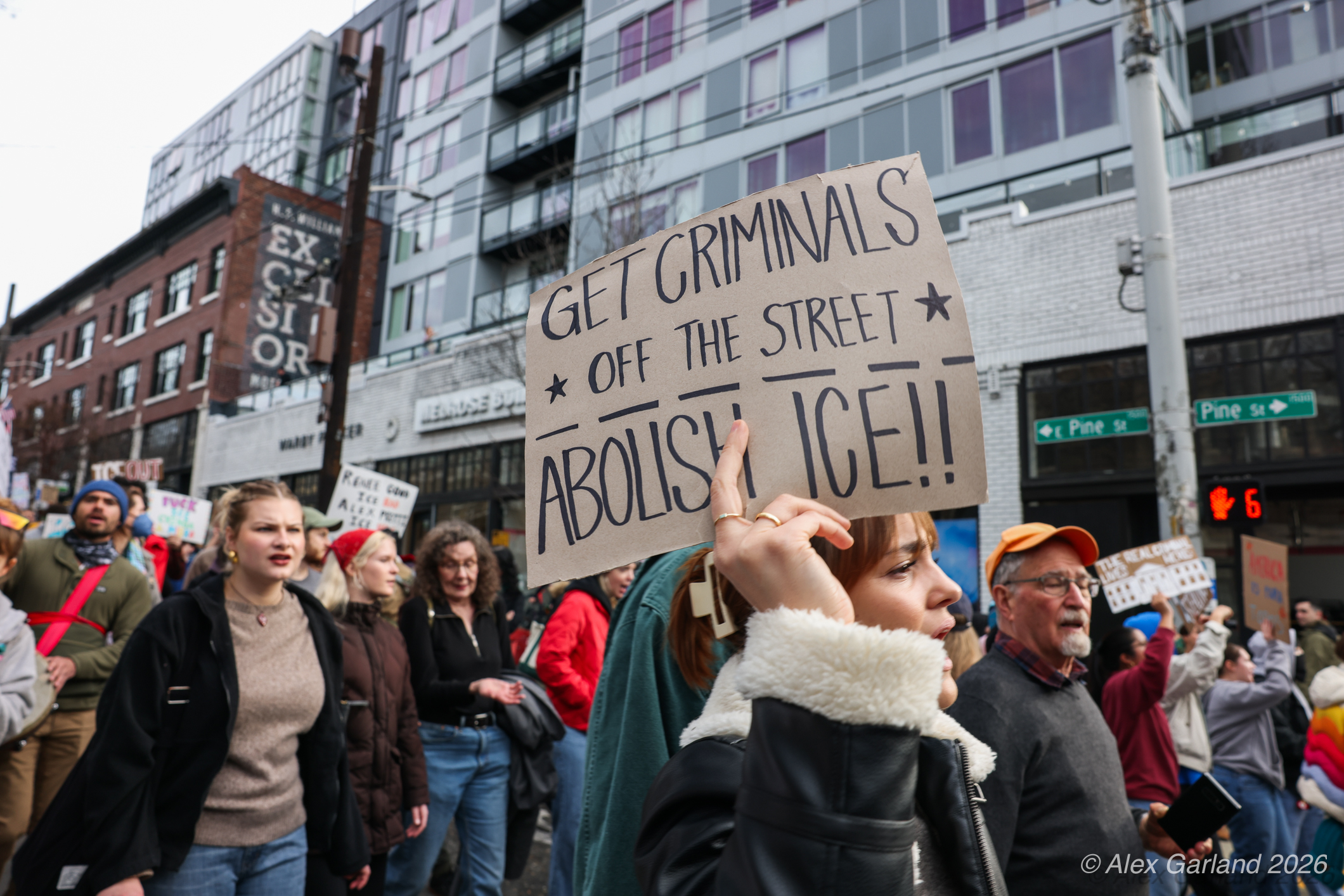
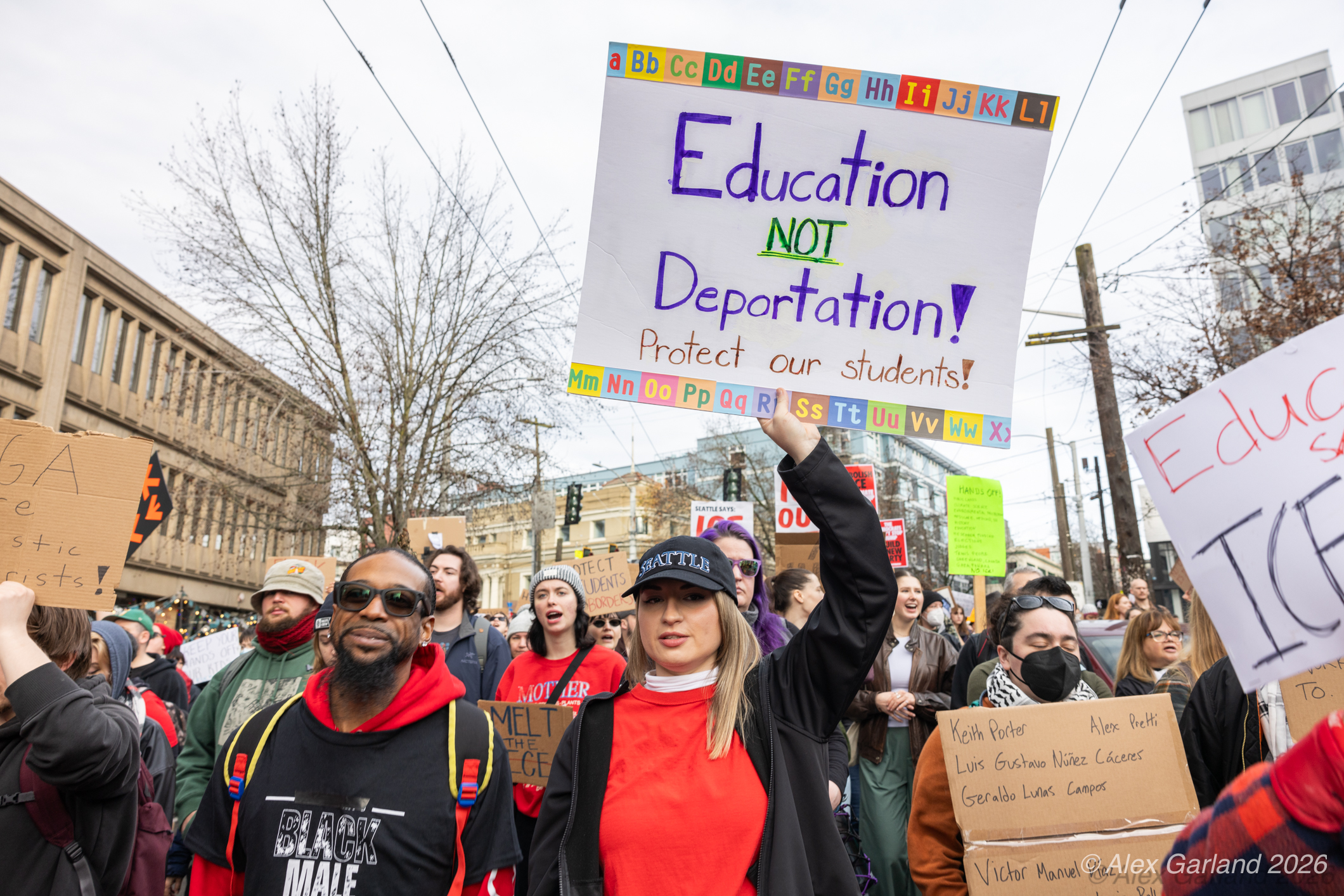
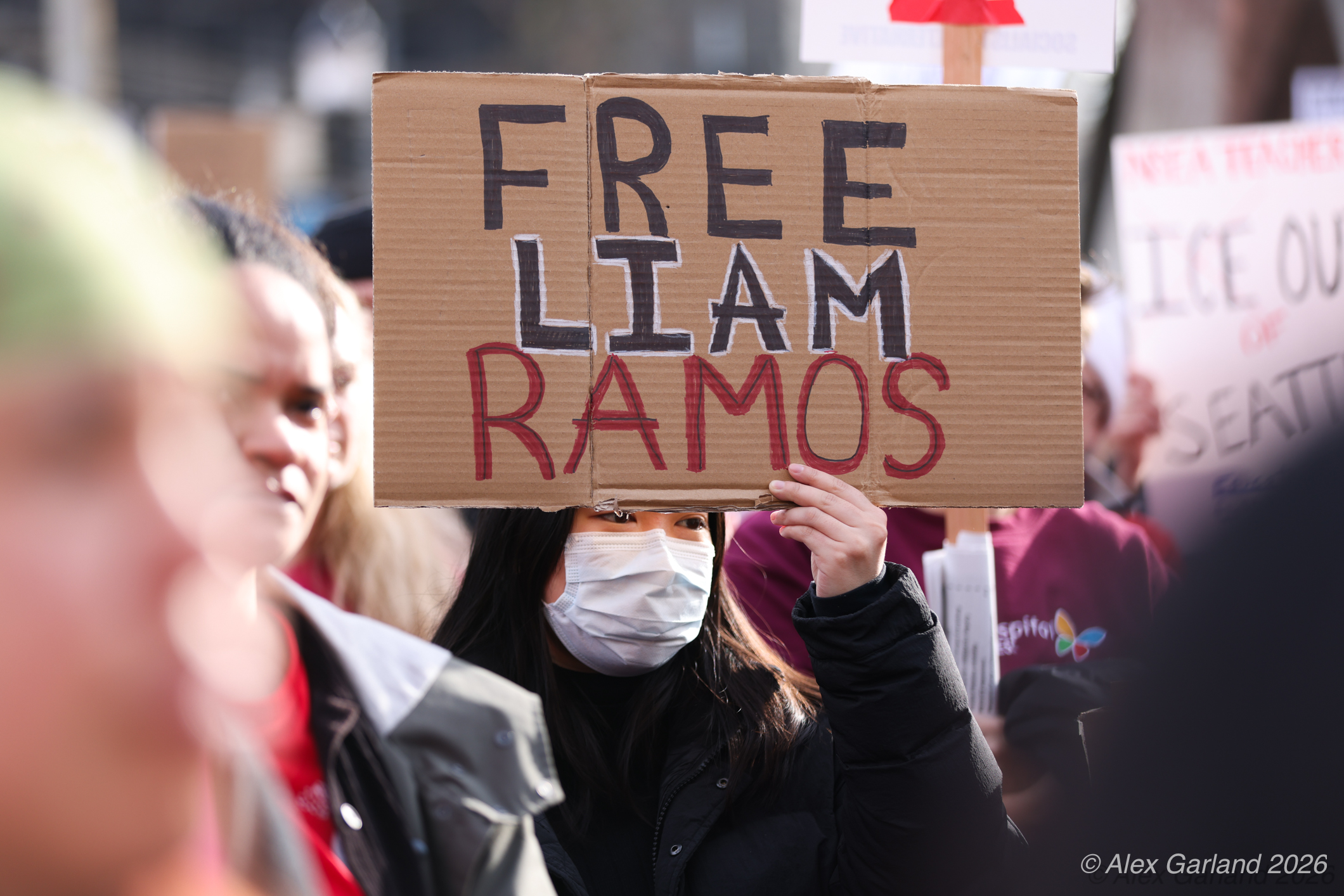
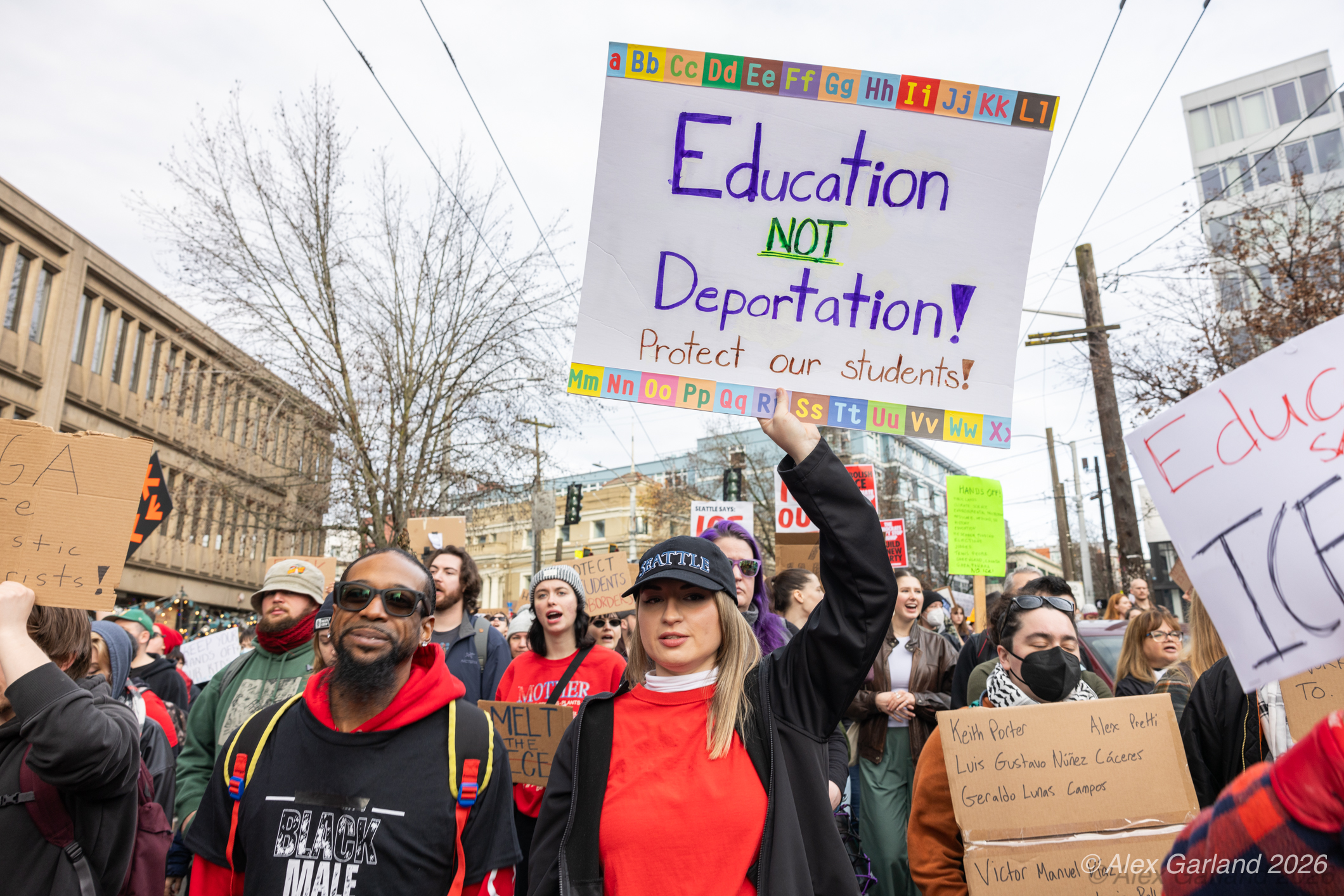
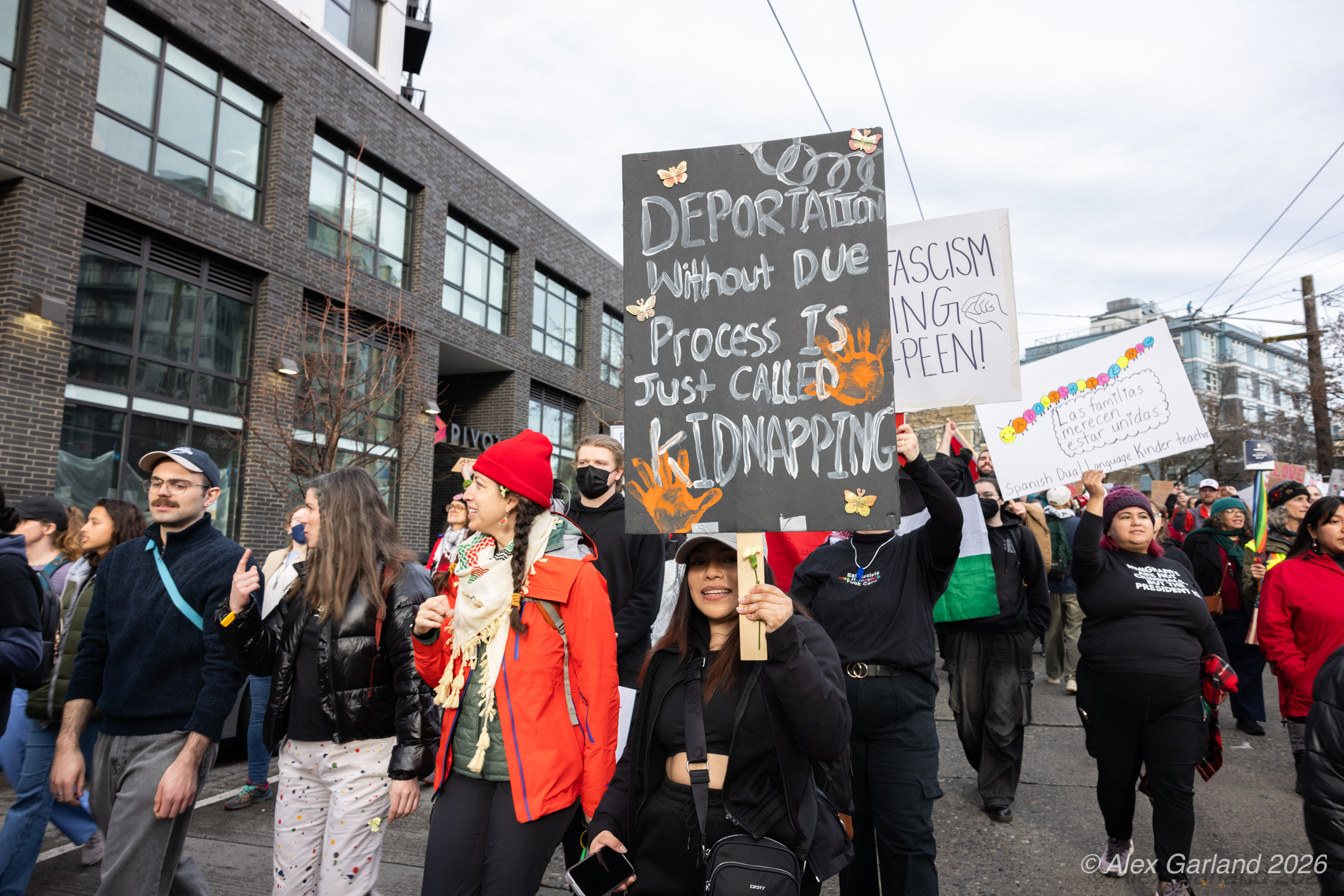
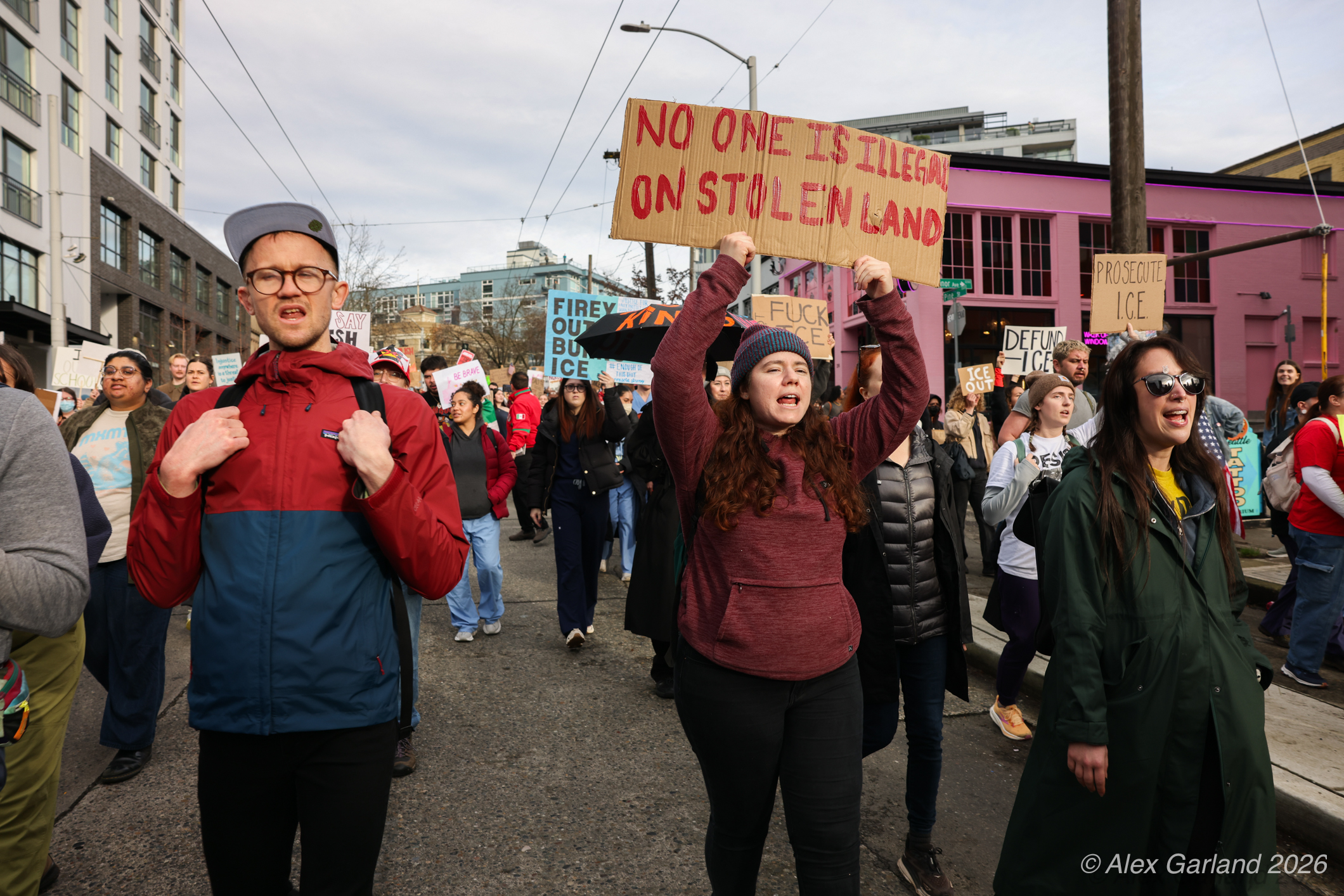
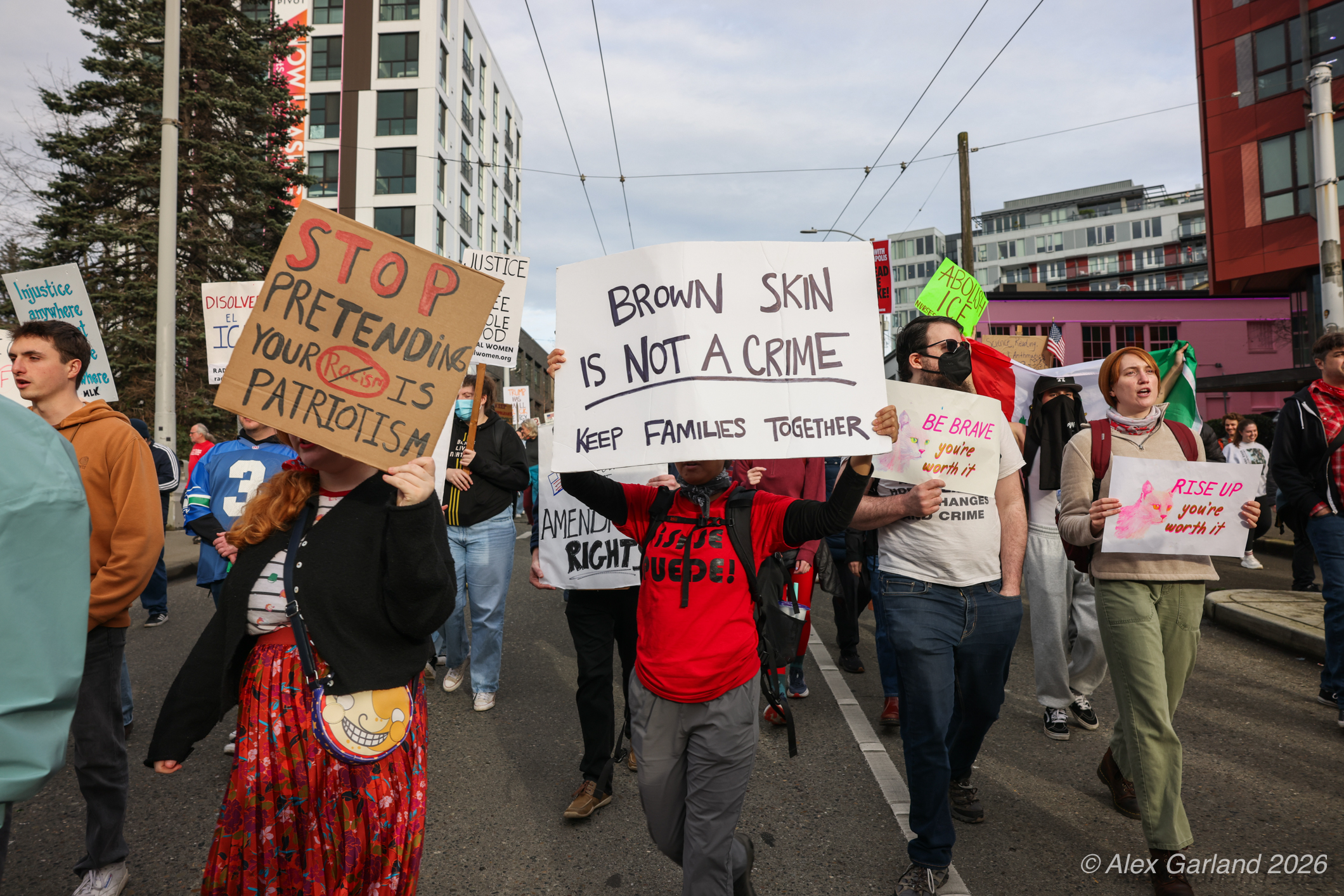
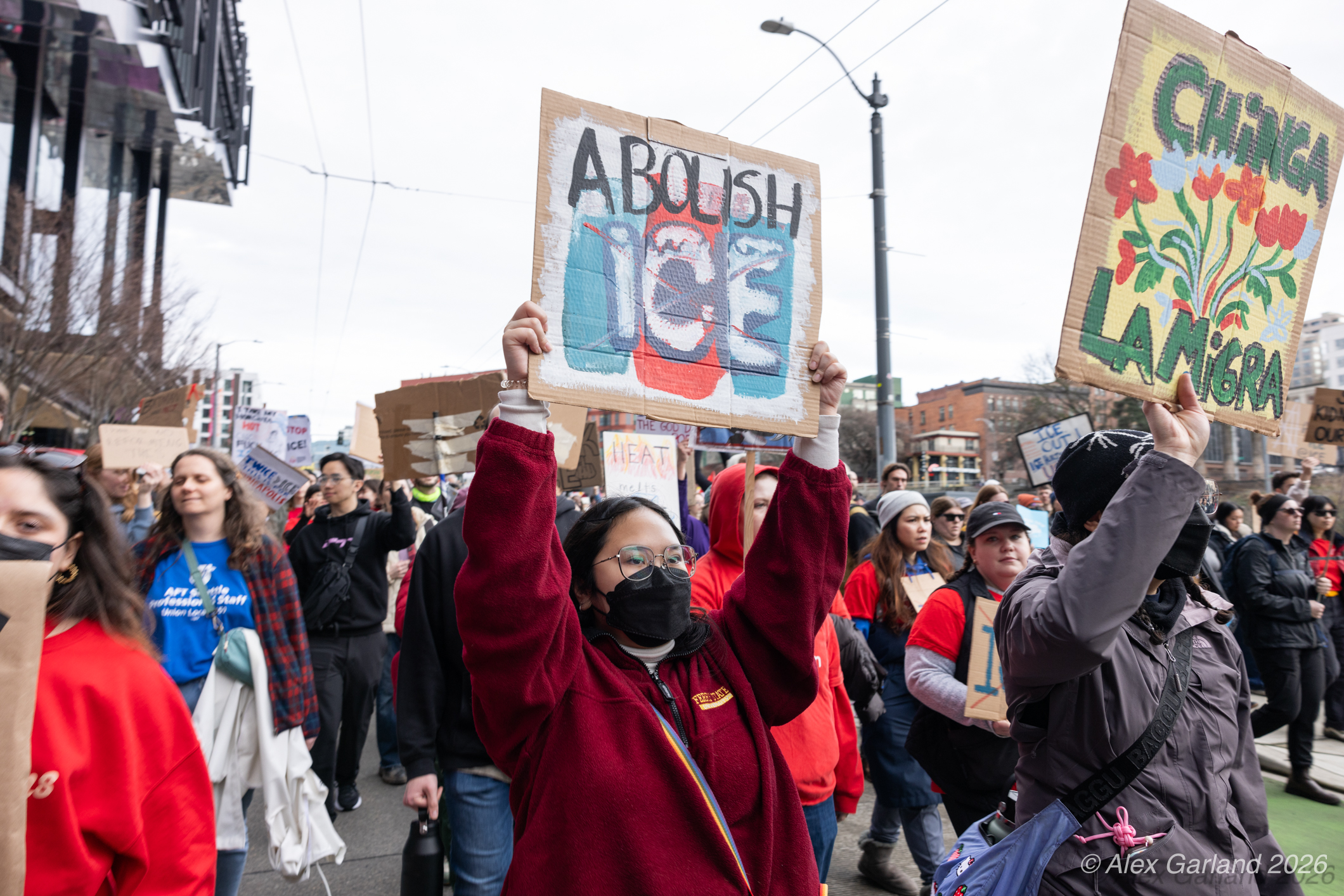
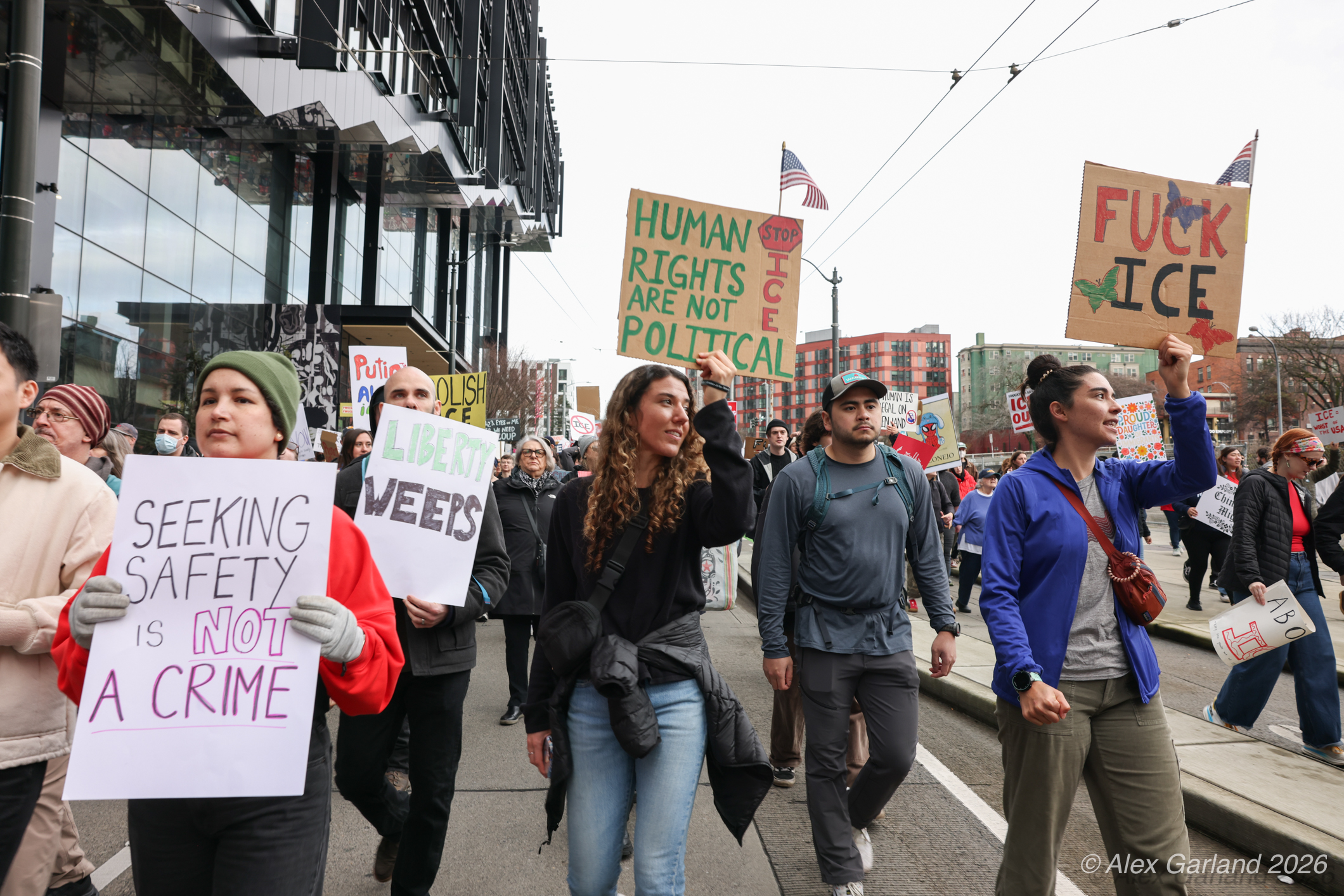
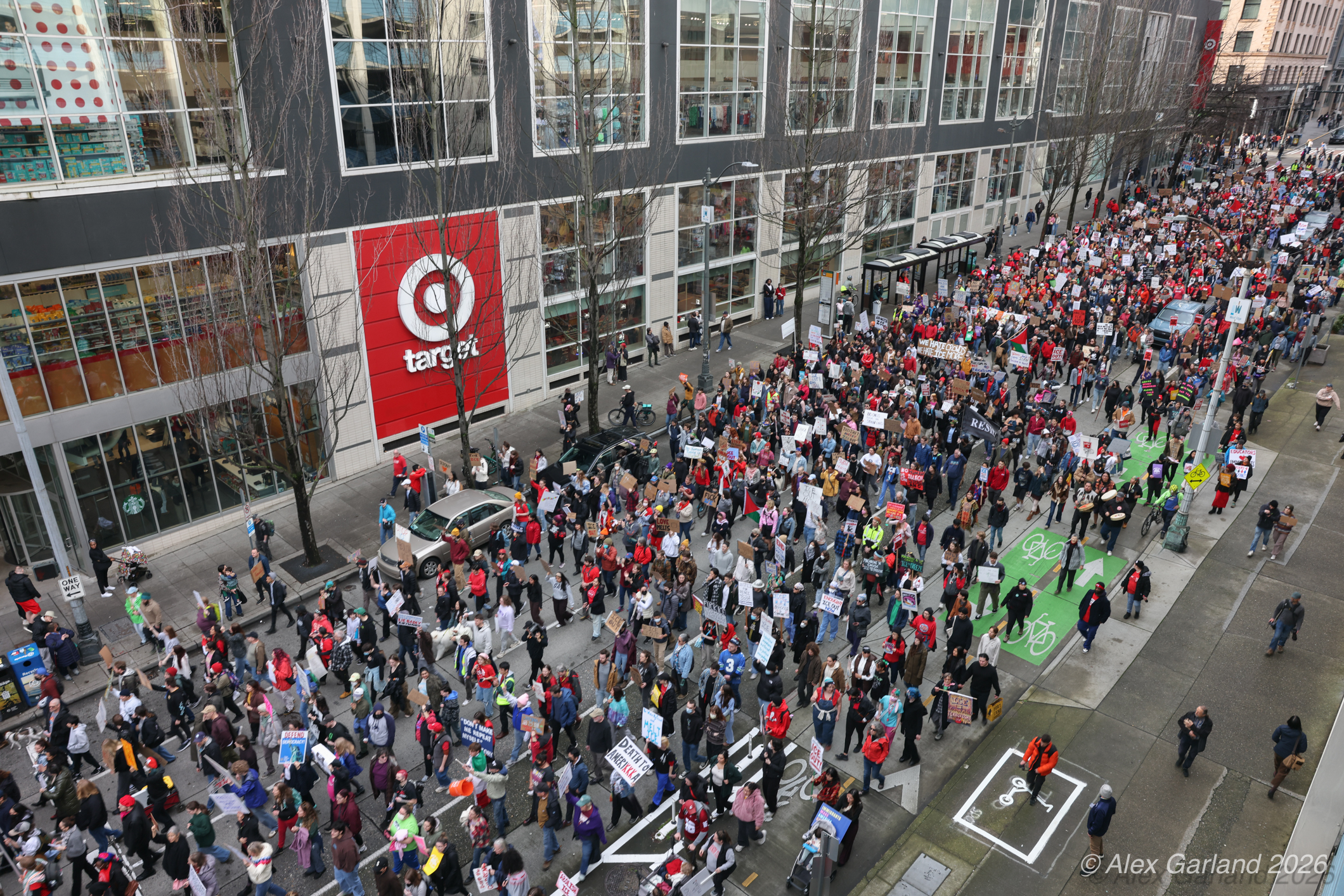
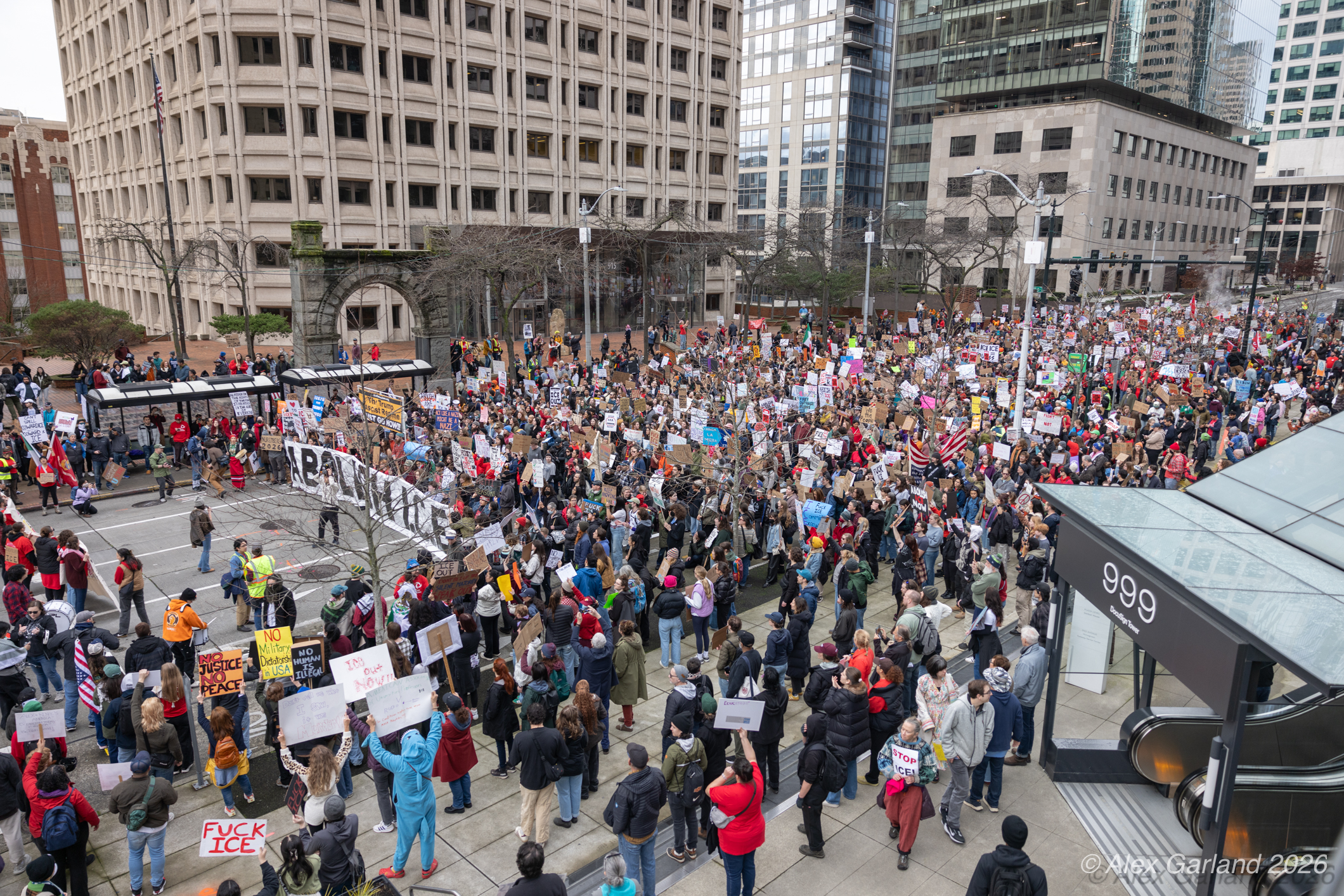
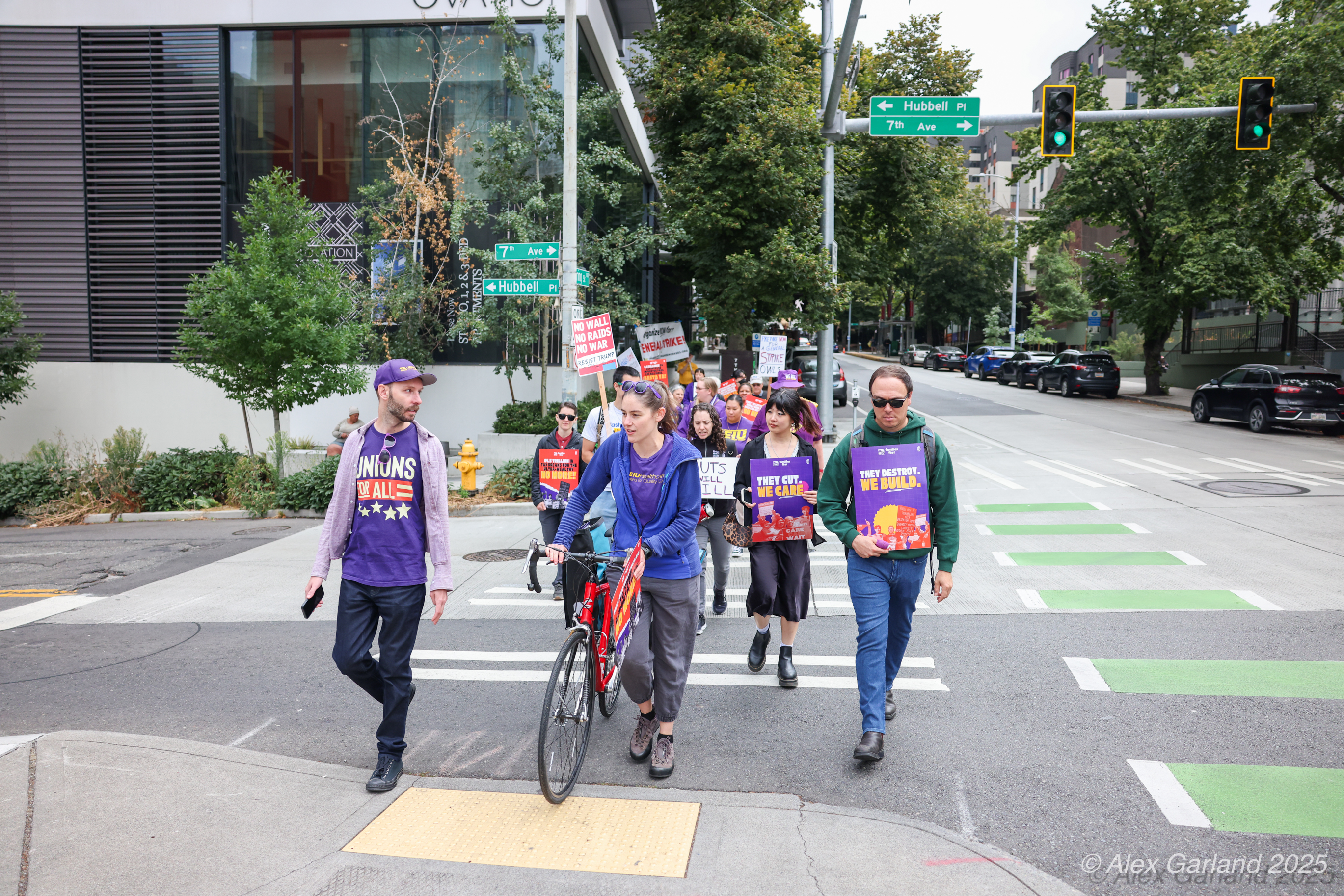
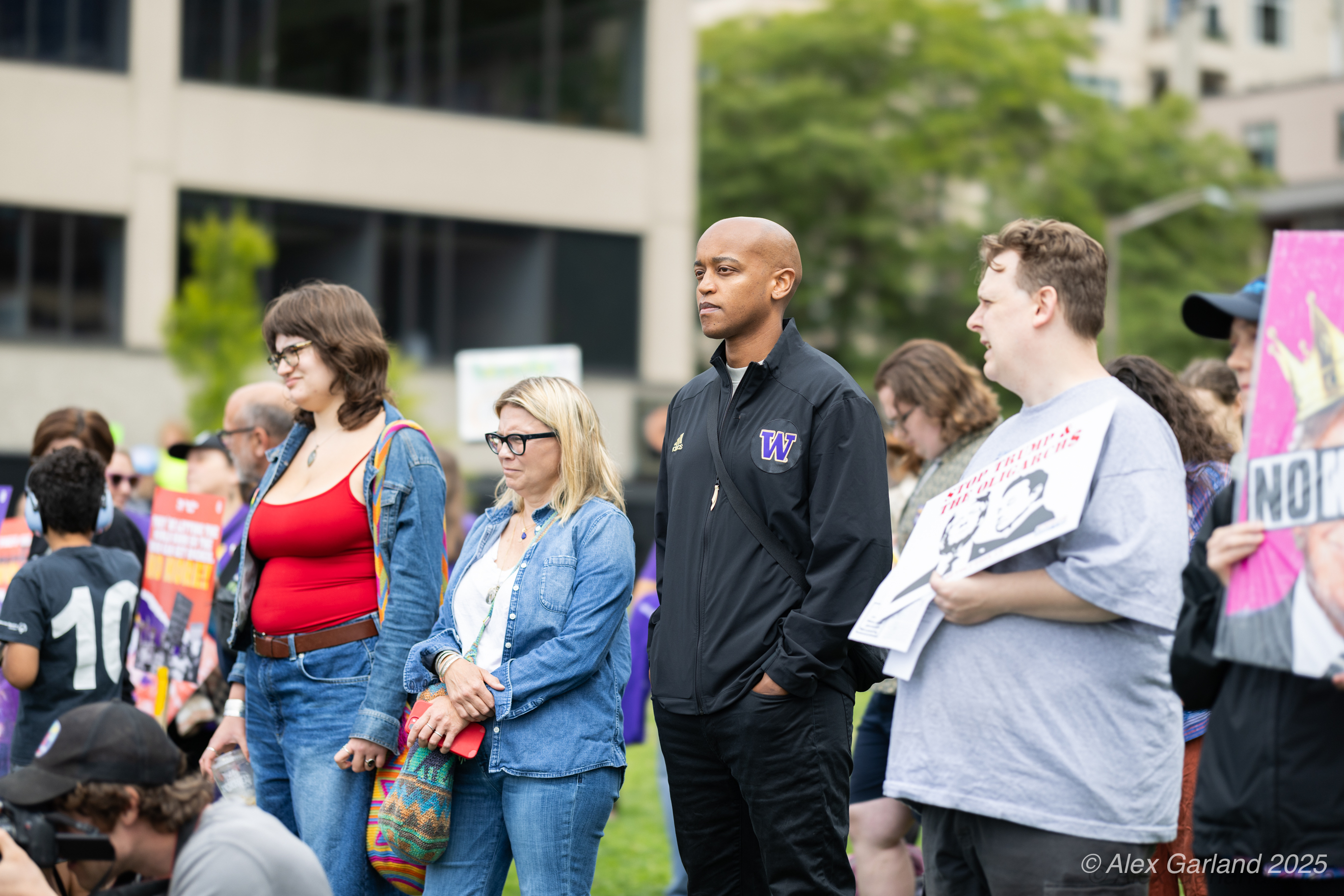
Nearly 1,000 healthcare workers and union supporters gathered at Harborview Medical Center on Sunday before marching north through Capitol Hill. The march drew approximately equal numbers of teachers, activists, and community members at Seattle Central, creating a coalition of public sector workers focused on immigration enforcement and gun violence concerns.
Lucas MacDonald, an advanced registered nurse practitioner with Harborview Mental Health and Addiction Services, spoke to the healthcare workers’ perspective during the rally. “Alex Pretti was one of the best of us. He was a leader in his ICU. He led them through Covid chaos, mentored younger nurses. As a former ICU nurse, I guarantee when the emotions ran high, he remained calm, and he is dead, killed by some gassed up ice goons who, in a panic, pinned a man down and executed him in the street. We can’t stand for this. We have to stand up against this darkness that descends on our country. We can’t let bullies and thugs define what patriotism is. We serve our country too. We put on masks to protect our patients, not to terrorize neighbors. We put on masks to protect our families, not to murder people in the streets.”
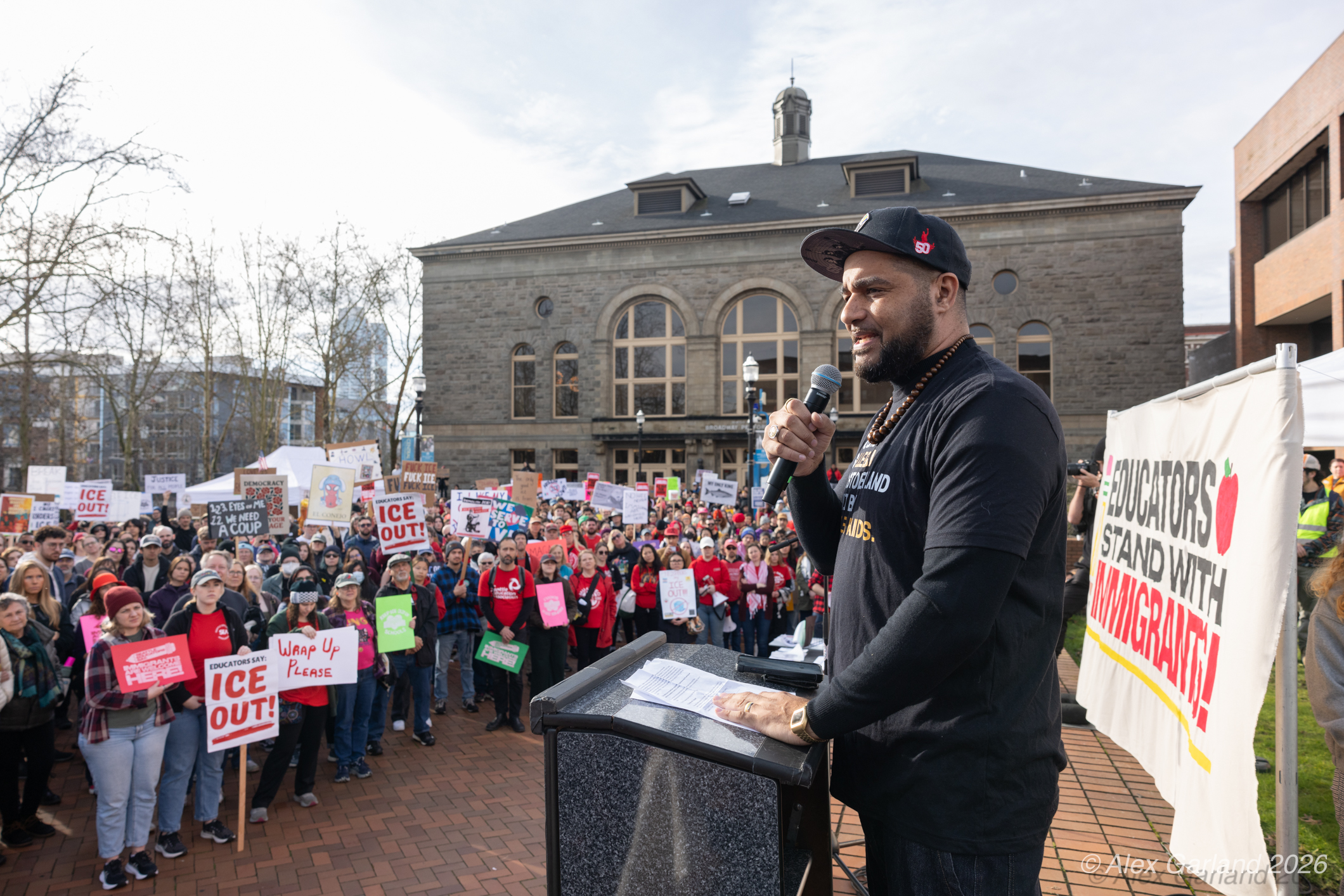
Jesse Hagopian, an educator, writer, and activist, addressed the crowd during the rally. “The world has grown cold and frost is spreading even throughout the places that are supposed to be there to nurture and support our kids and to shelter them, like our schools,” Hagopian said. “In a time when schools can be turned into perilous border crossing areas, when learning is paused by the threat of immigration raids, we are forced to confront a truth that we can no longer deny, that winter is no longer just coming. Winter is already here. The winter for democracy, the winter for justice, the winter for compassion, the winter for the vulnerable, the winter for truth is here. It is winter in America, and we are rapidly confronting an ice age.” He continued: “Yet as sudden as this cold frost is felt around the country, the violence of state repression did not just suddenly appear.”
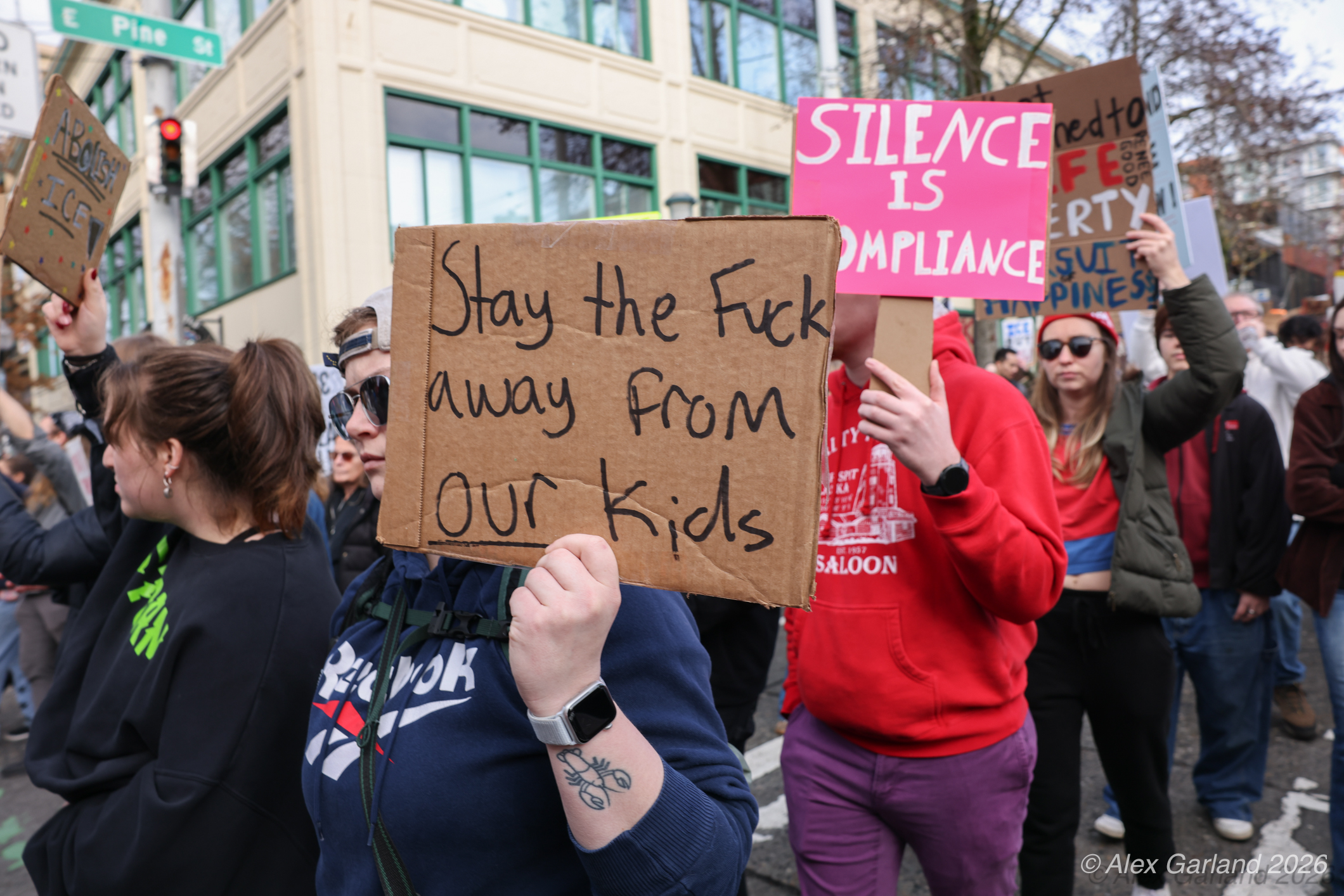
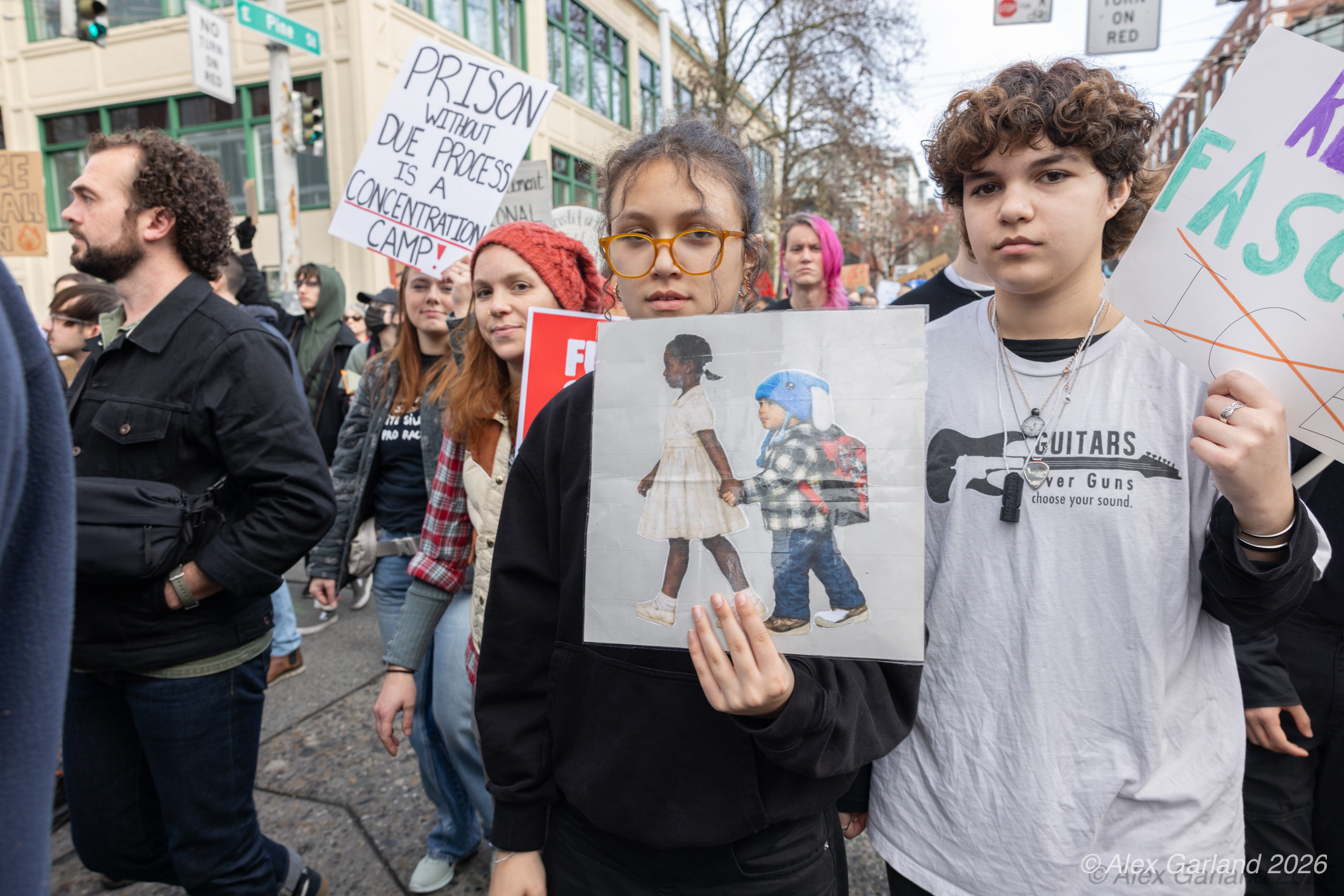
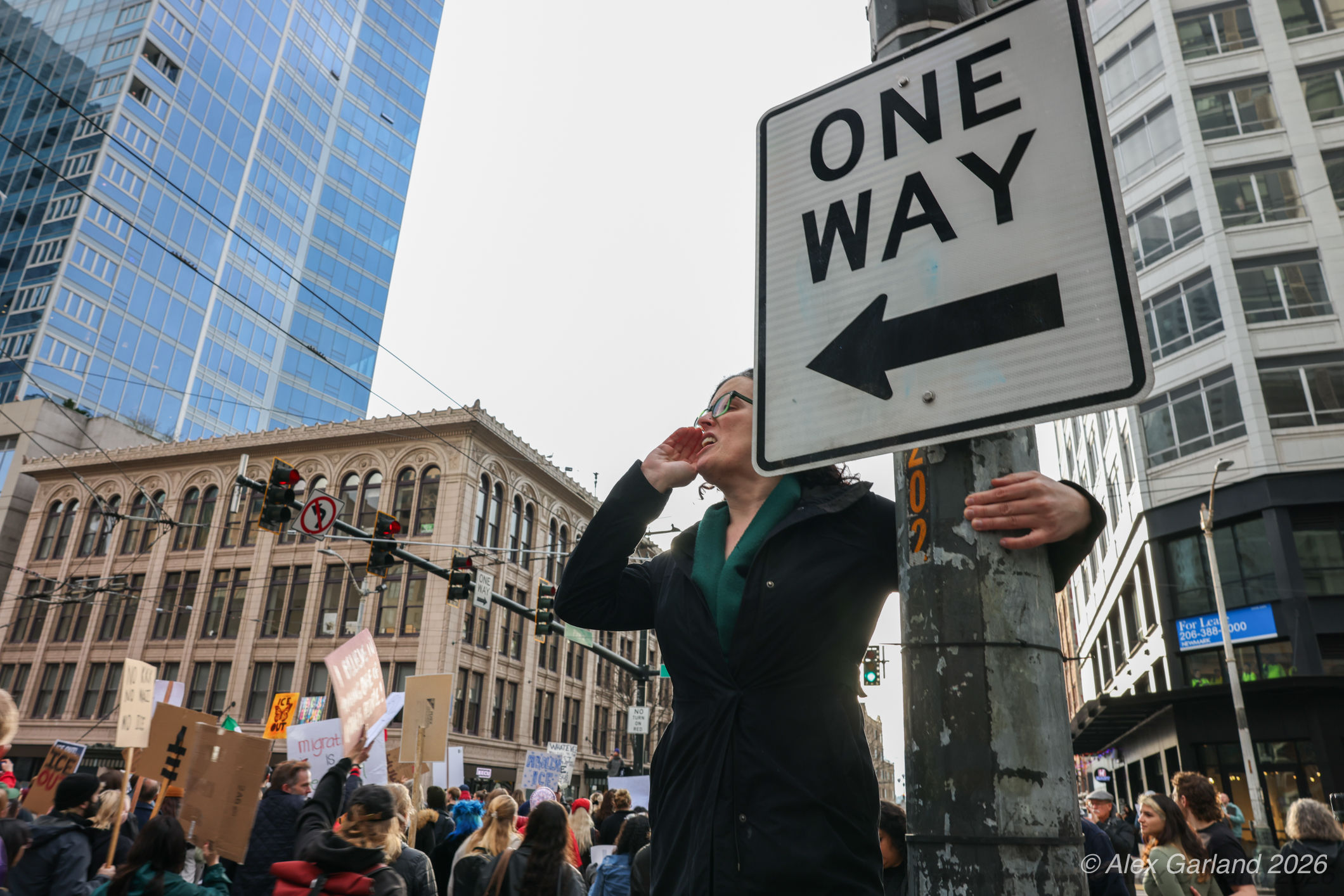
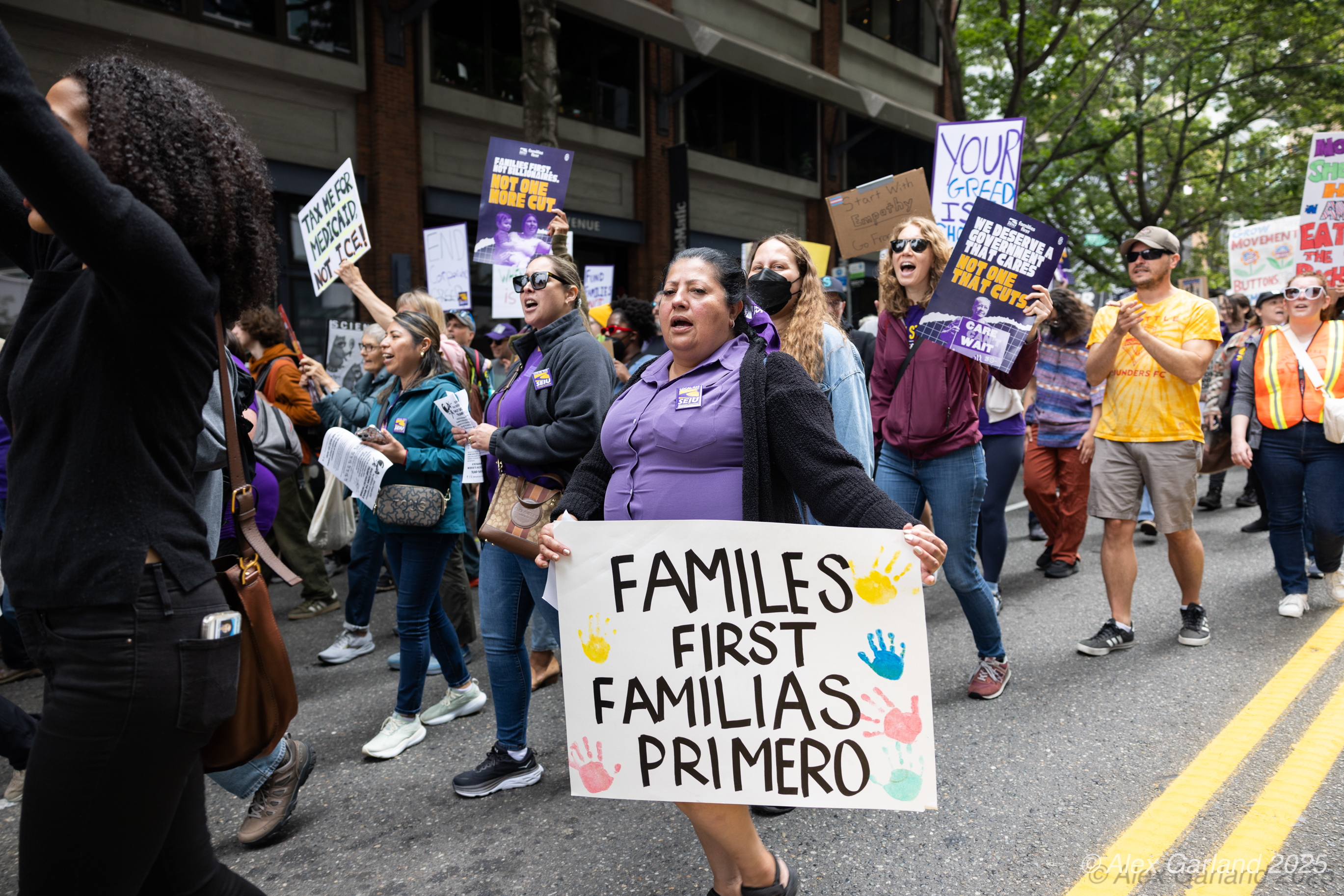
From Seattle Central, the march continued down Pine Street before turning left onto 2nd Avenue and heading into downtown Seattle. The procession moved through the commercial core as participants chanted “No justice, no peace. No ICE in our streets.” Hundreds of demonstrators gradually left the crowd along the route and the march concluded at the Henry M. Jackson Federal Building, where the remaining participants gathered for a short rally.
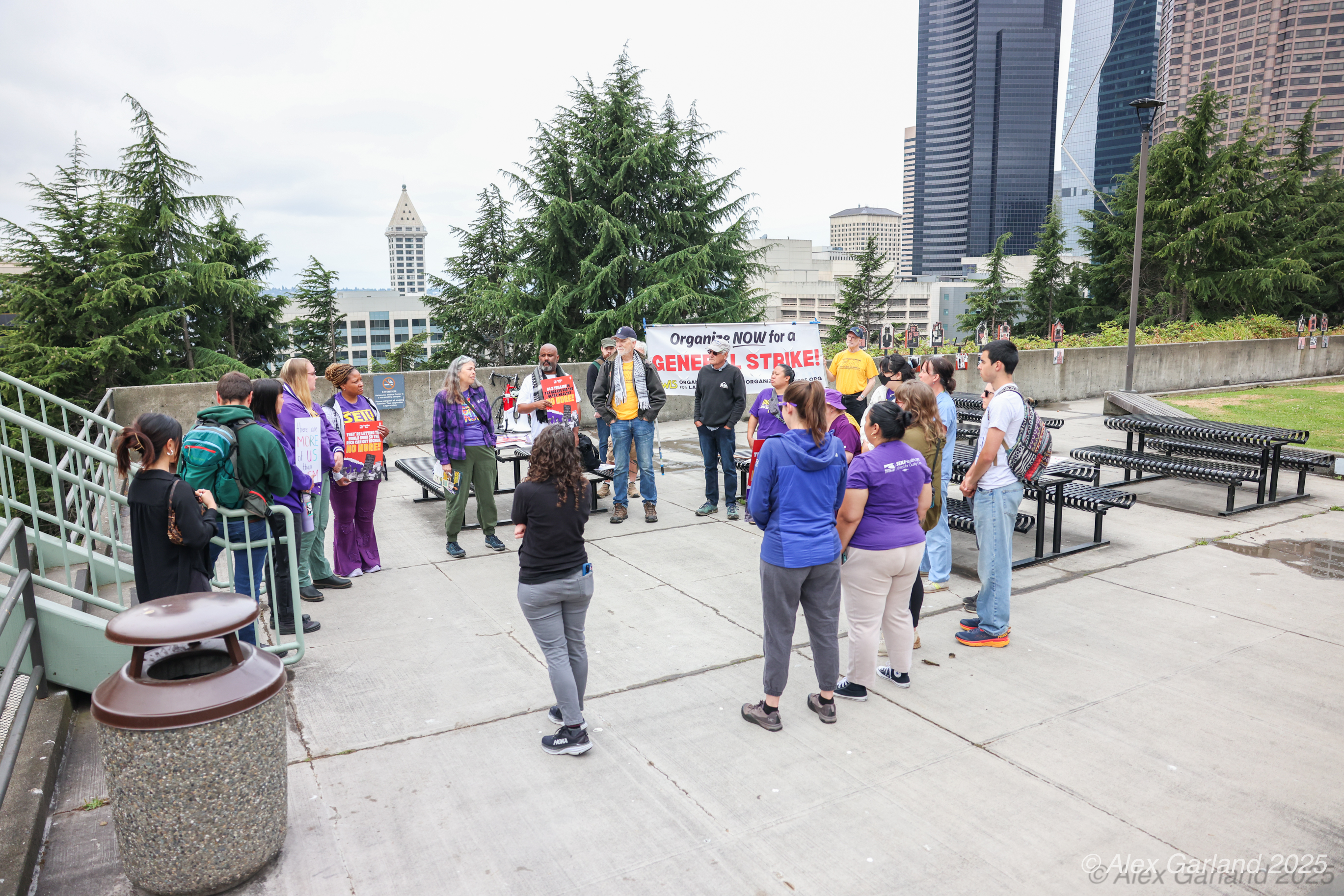
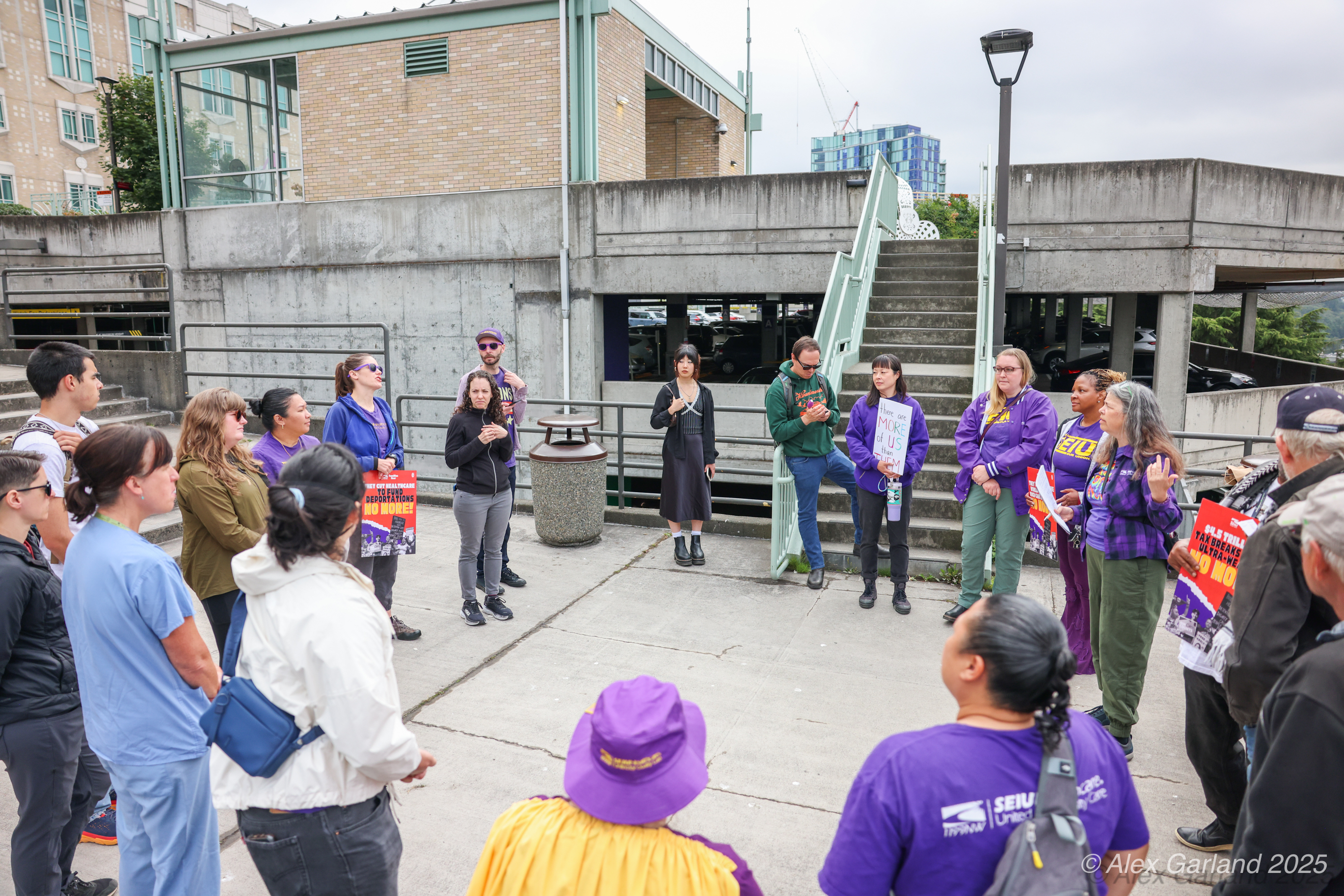
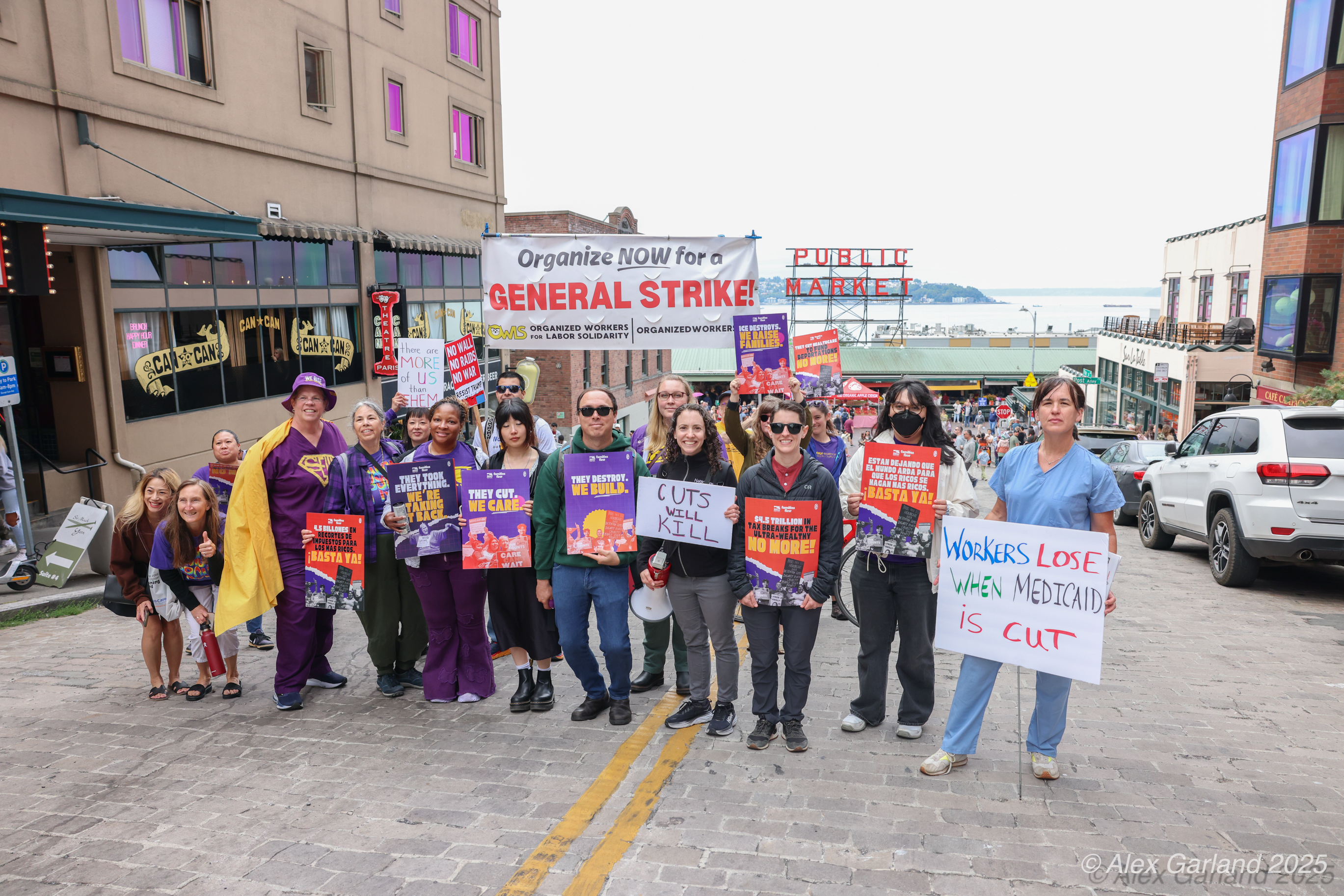
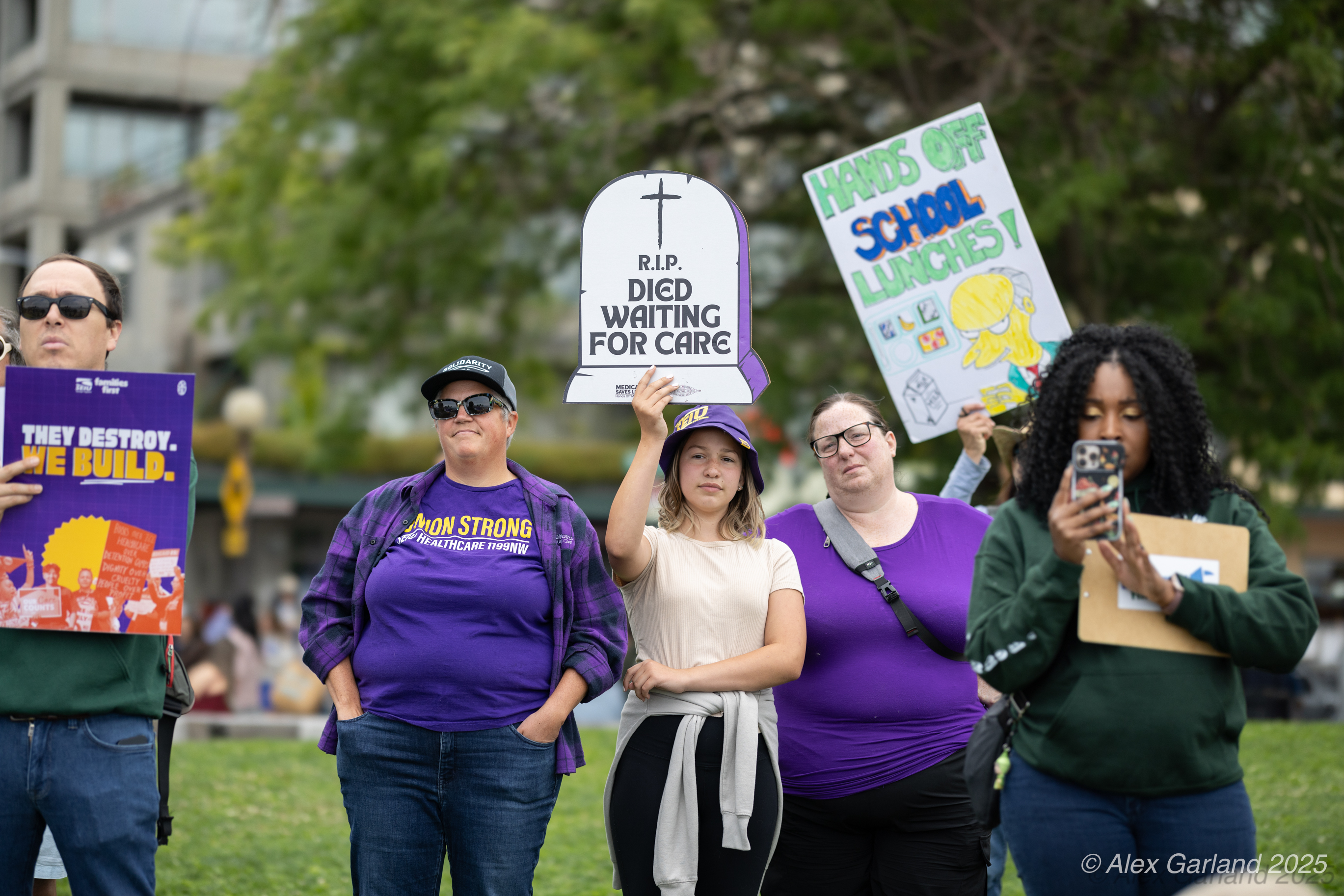
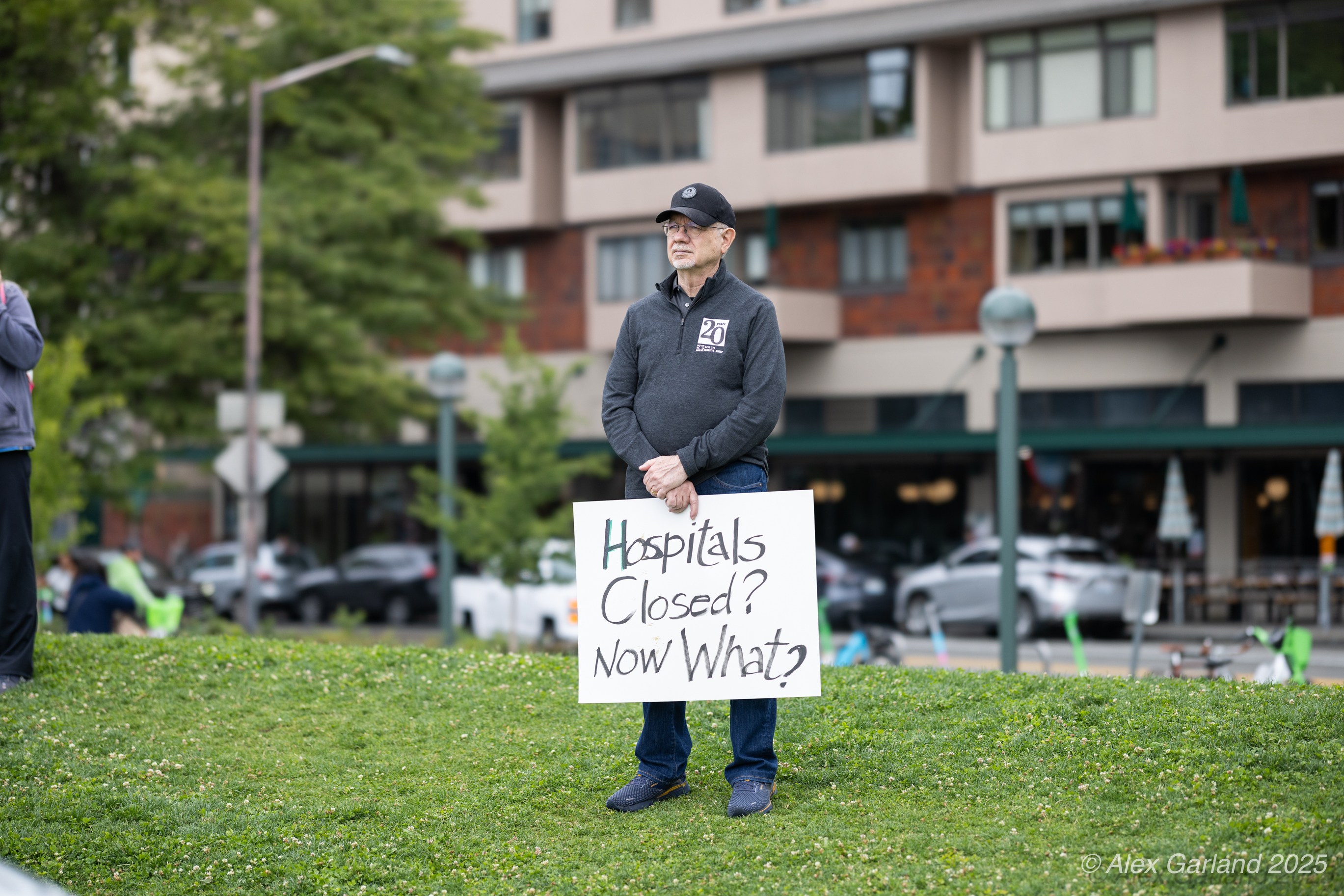
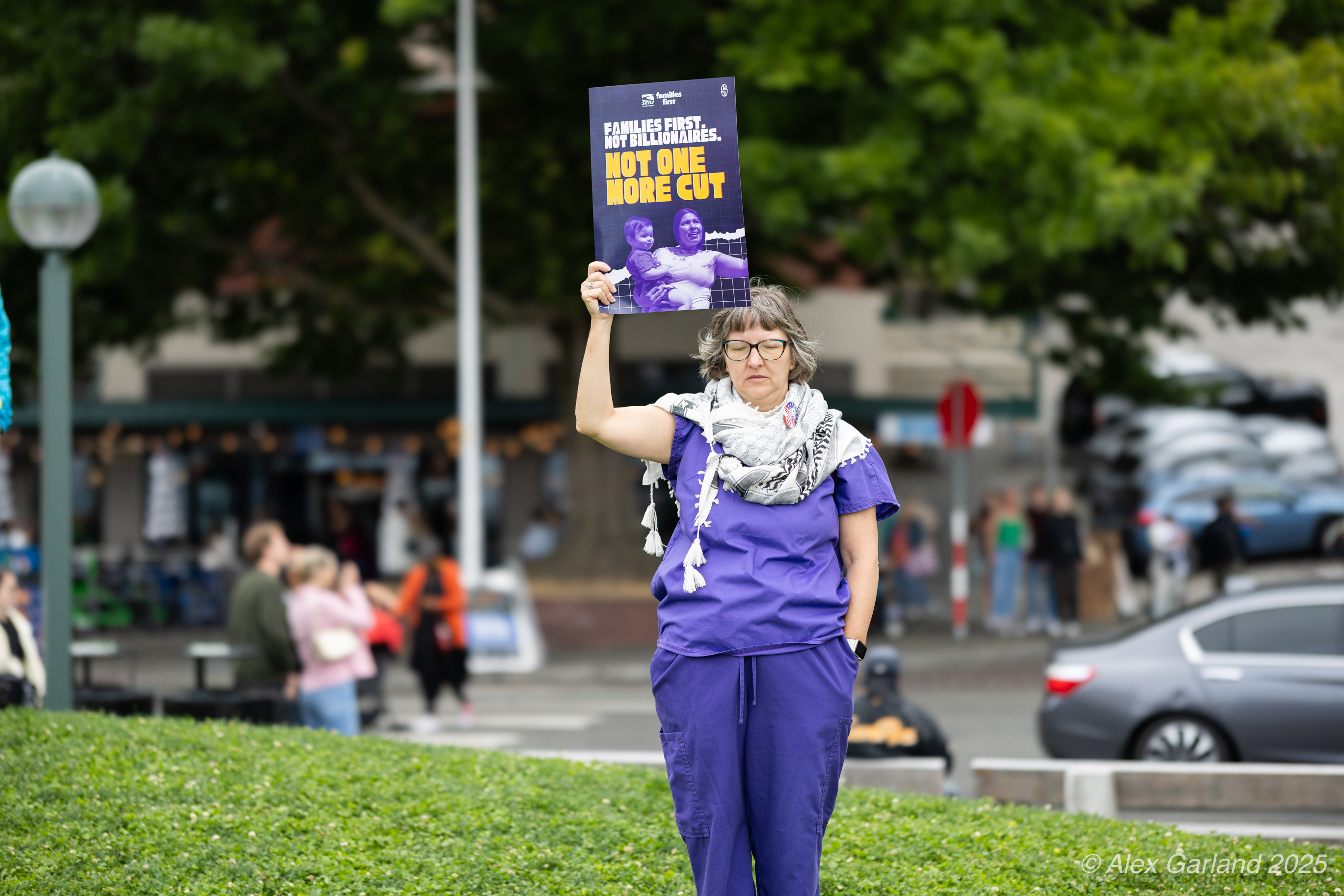
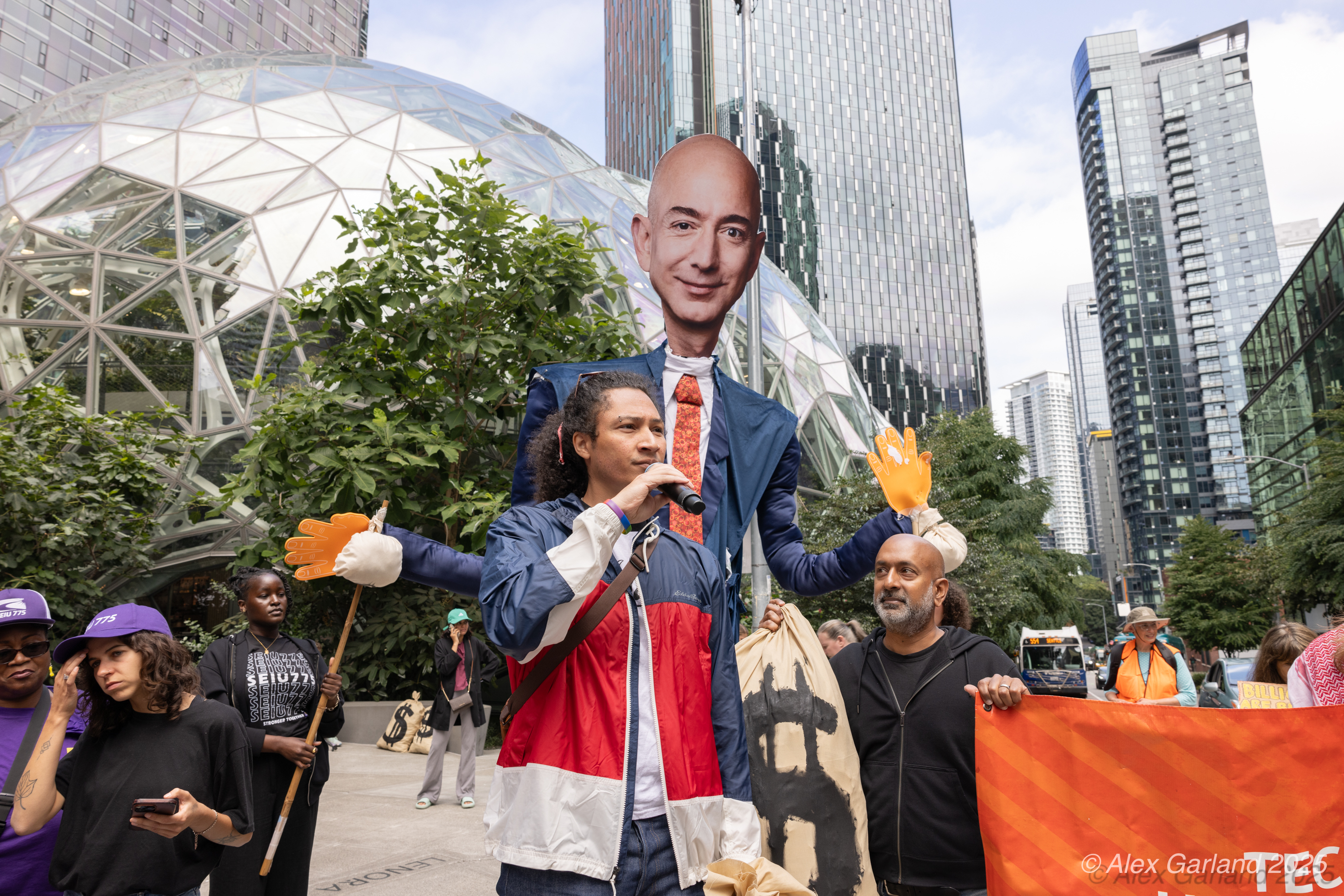
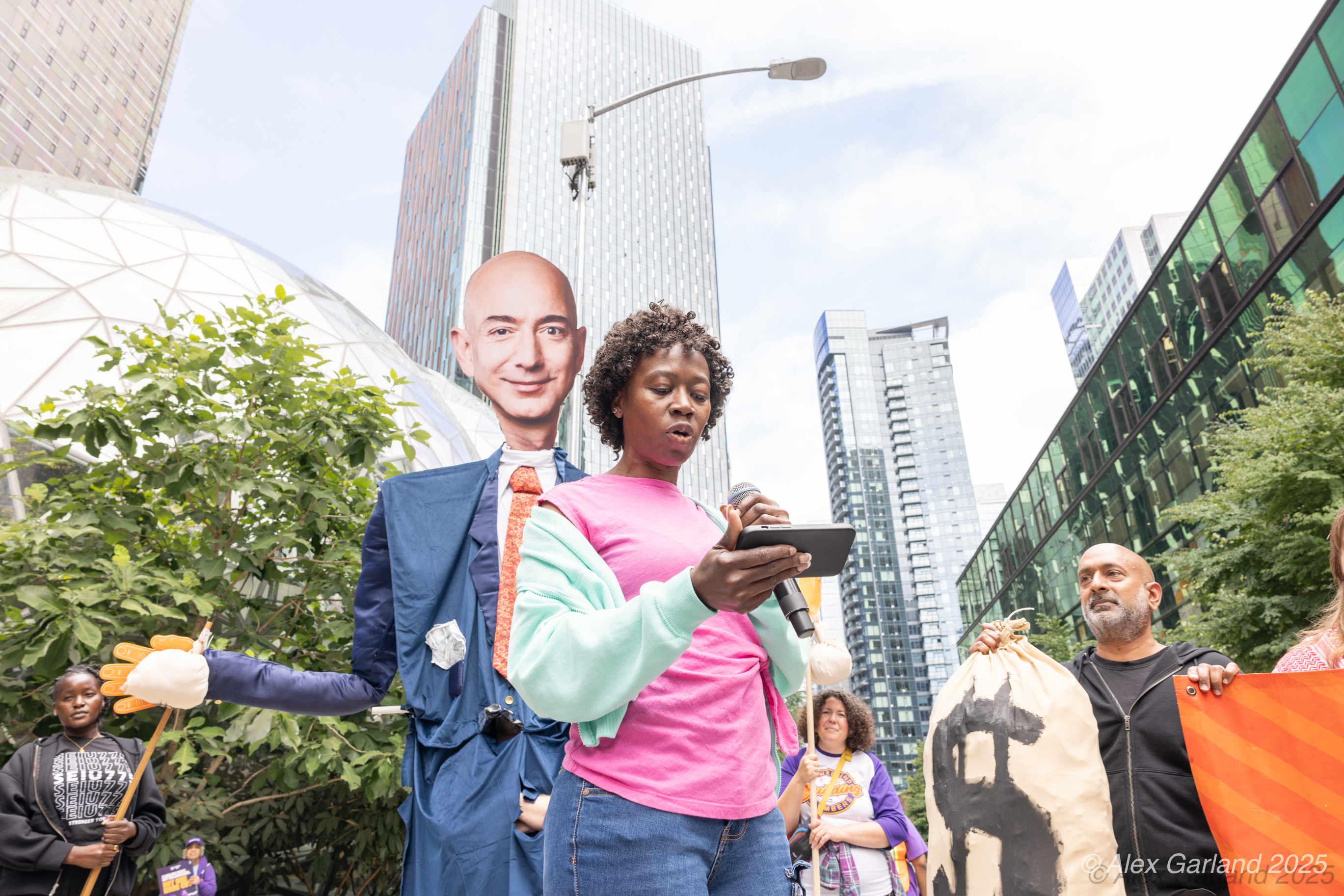
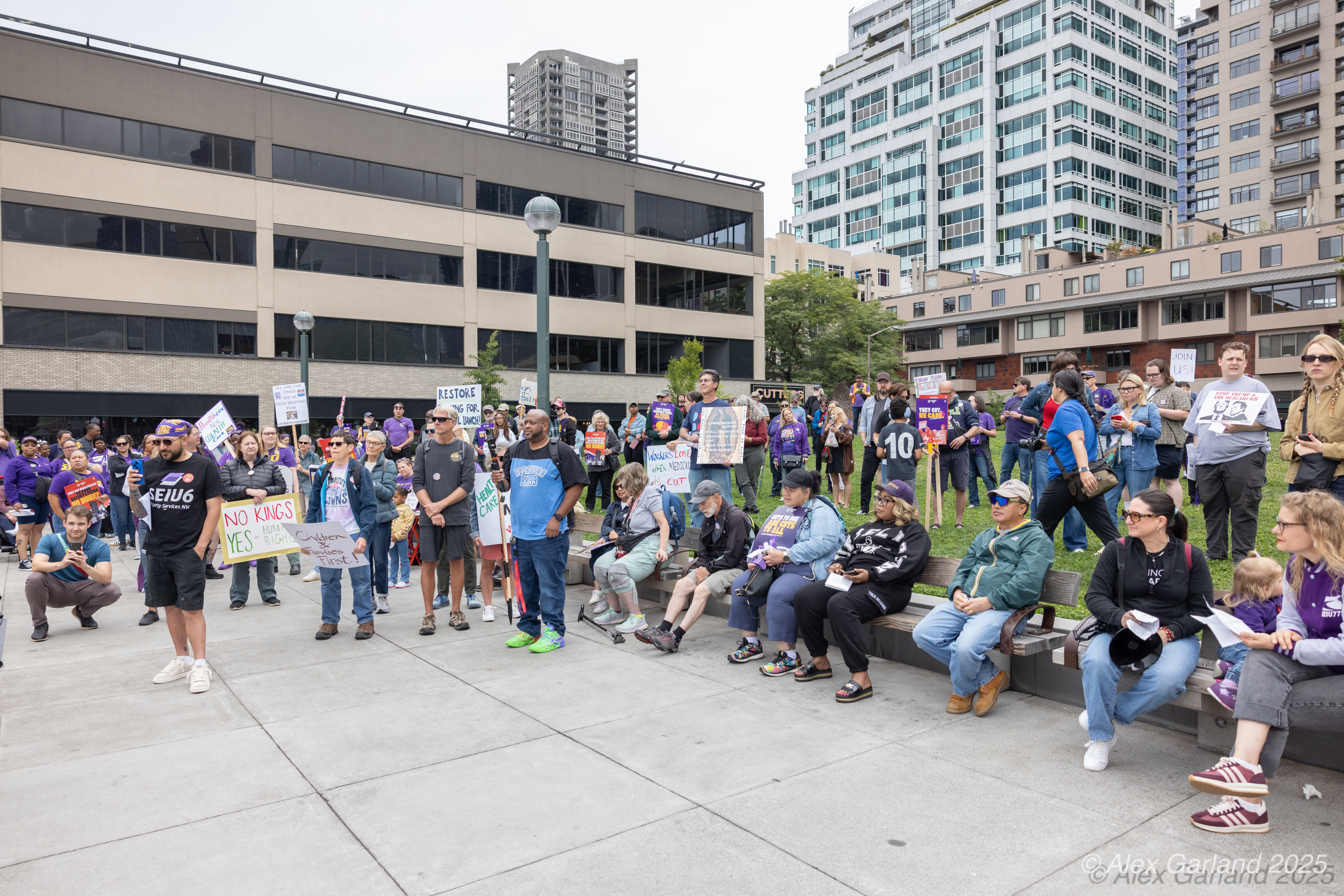
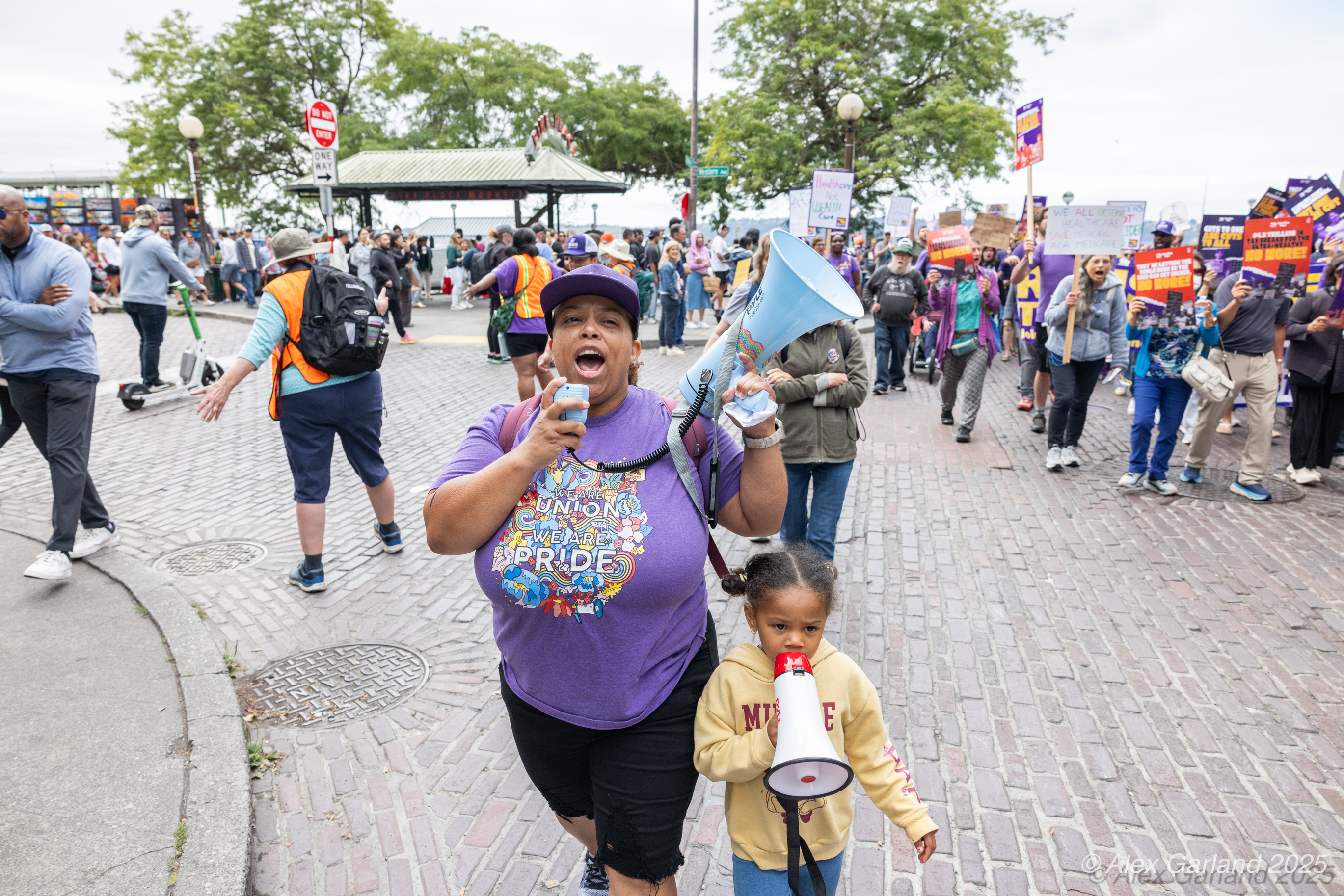
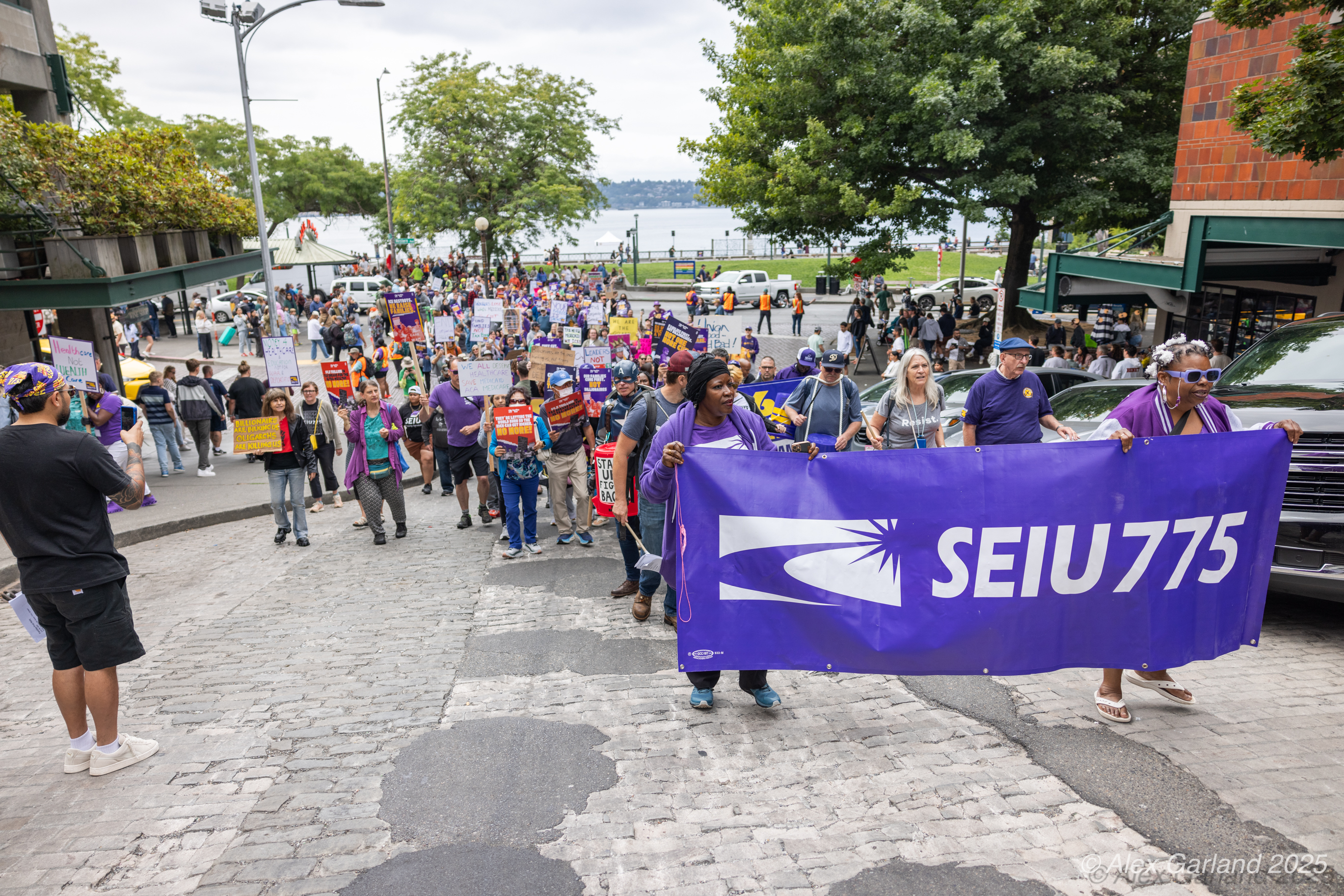
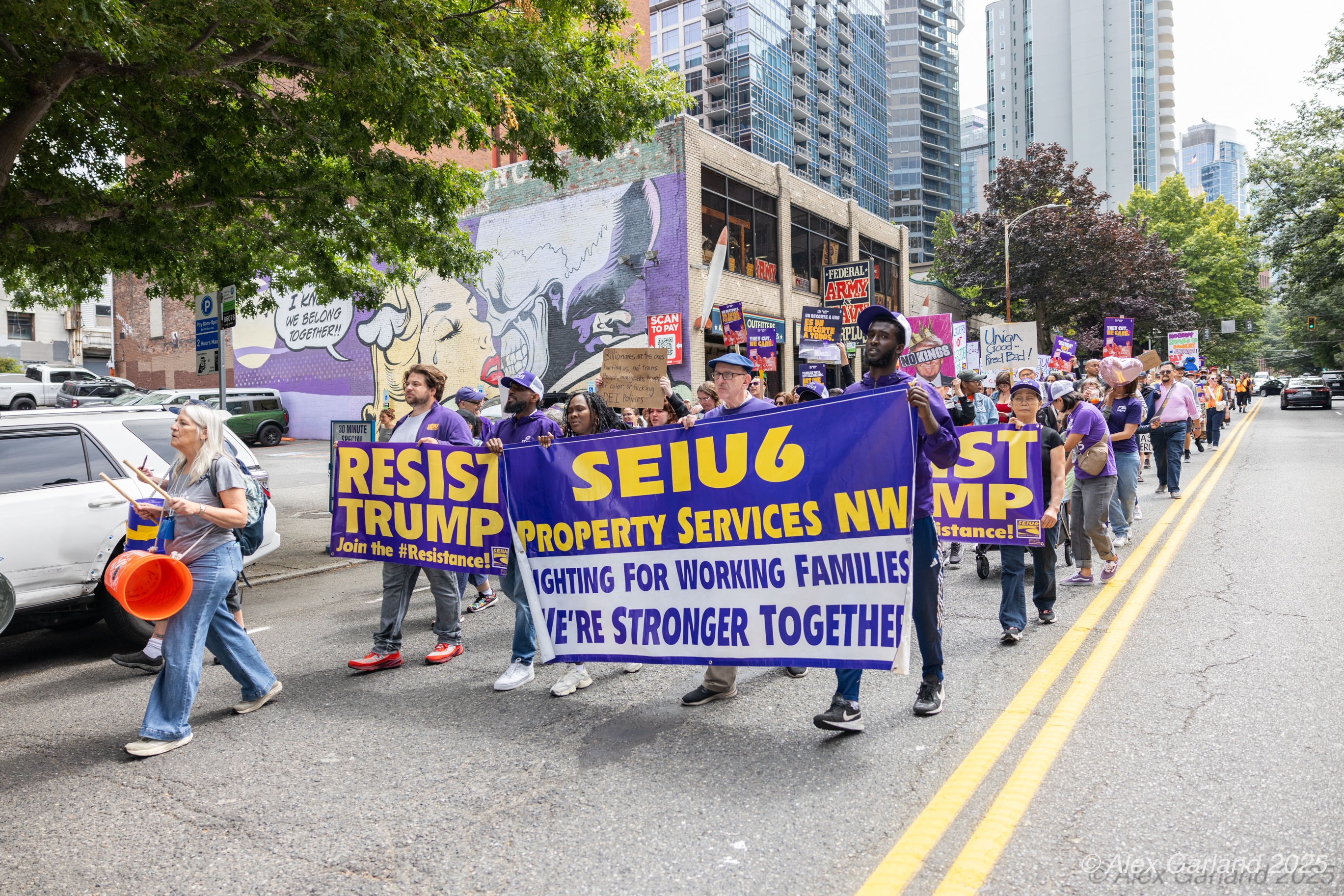
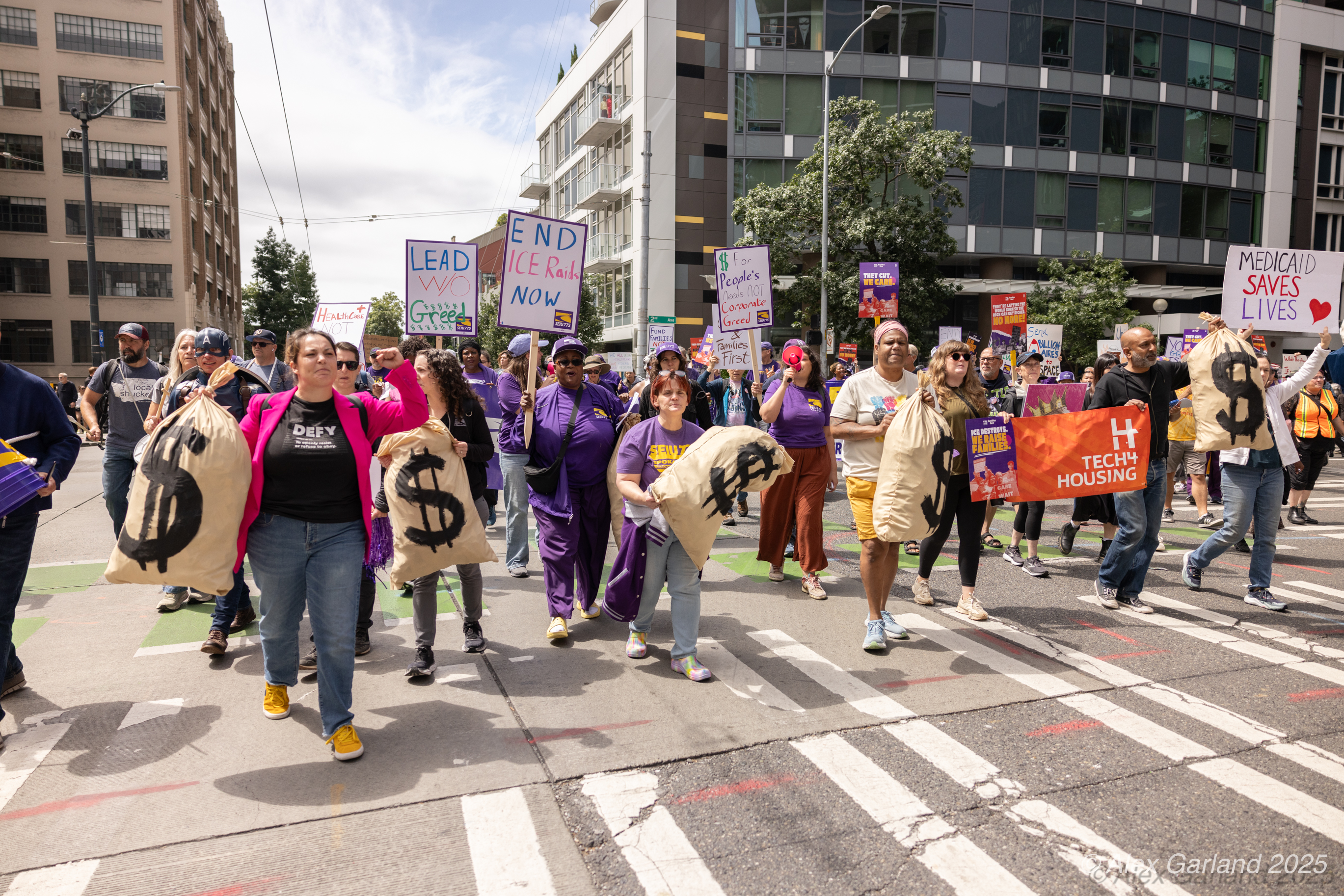
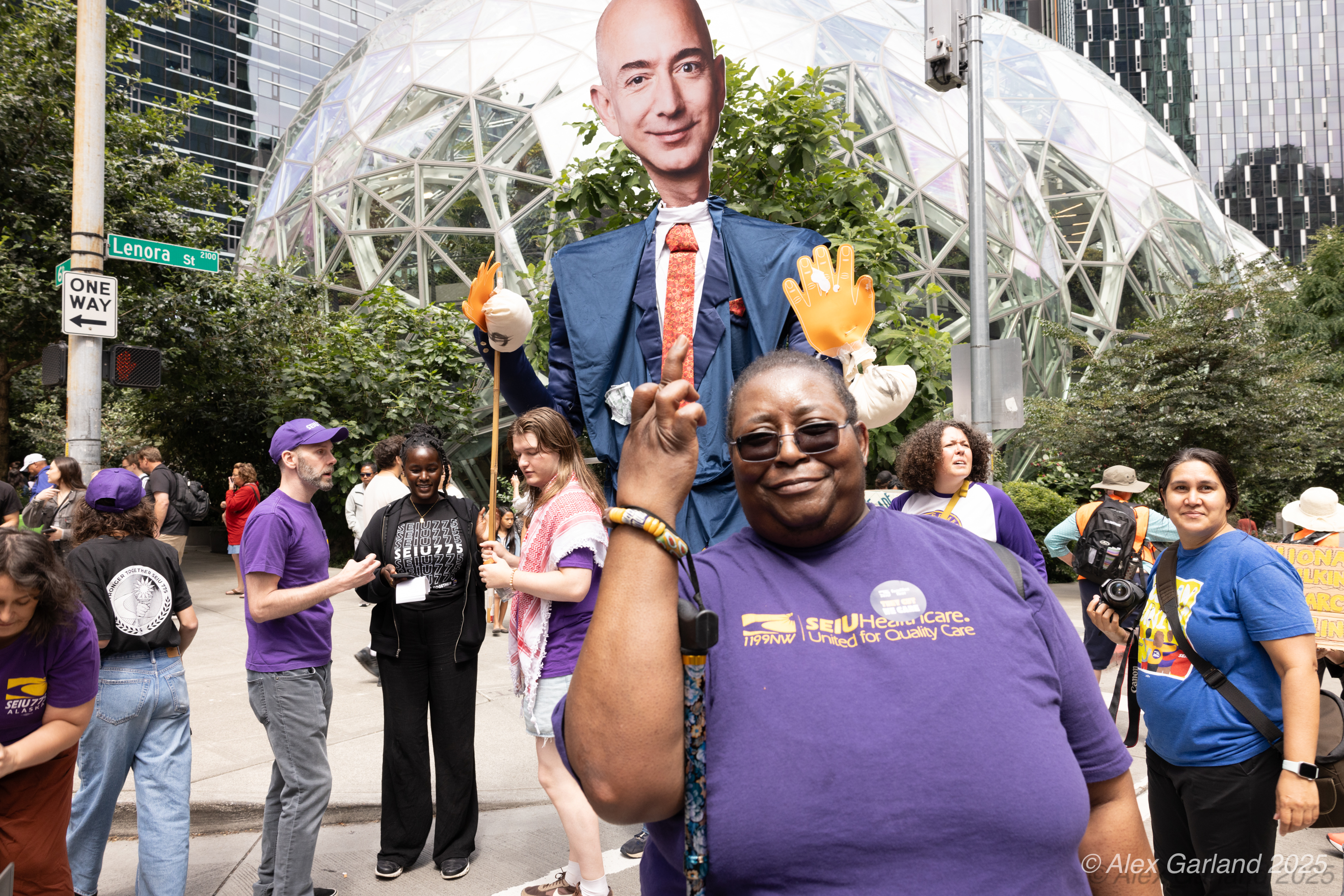
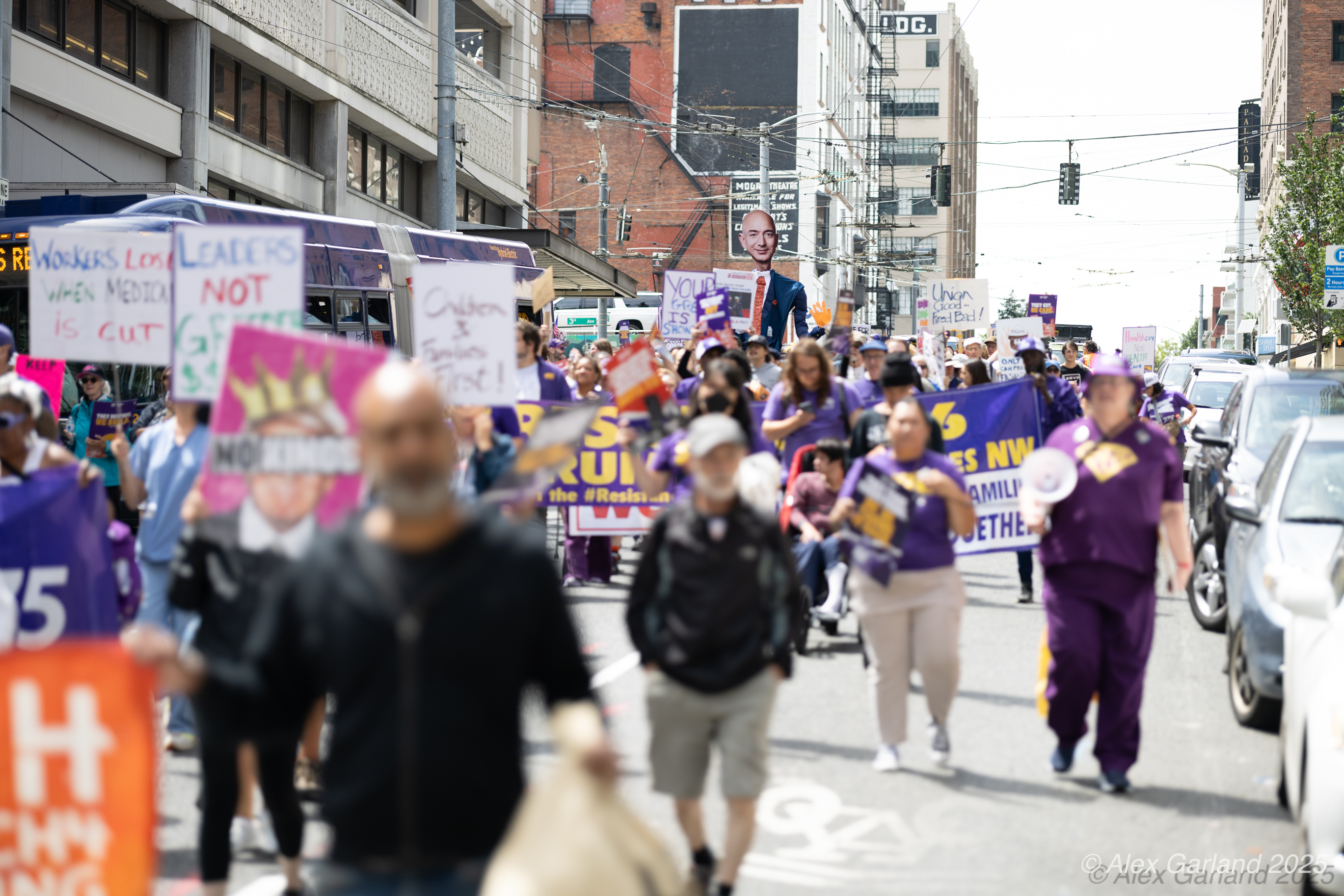
What began as a gathering of 15-20 healthcare workers and community activists quickly swelled to over 100 healthcare workers, union members, and supporters. The group first gathered at Harborview Park before marching through downtown Seattle. They made stops at Victor Steinbrueck Park and finally converged on Amazon’s headquarters.
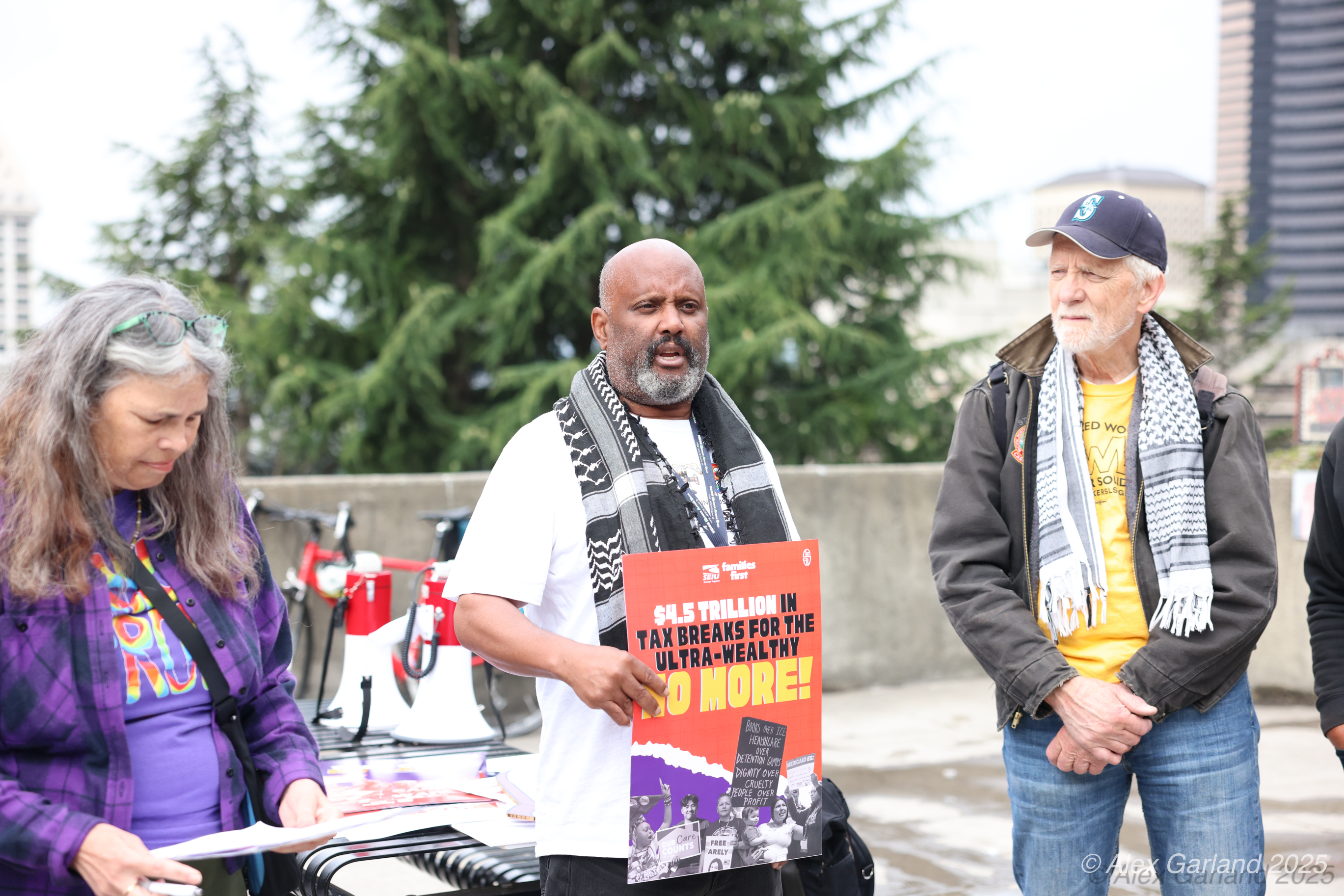
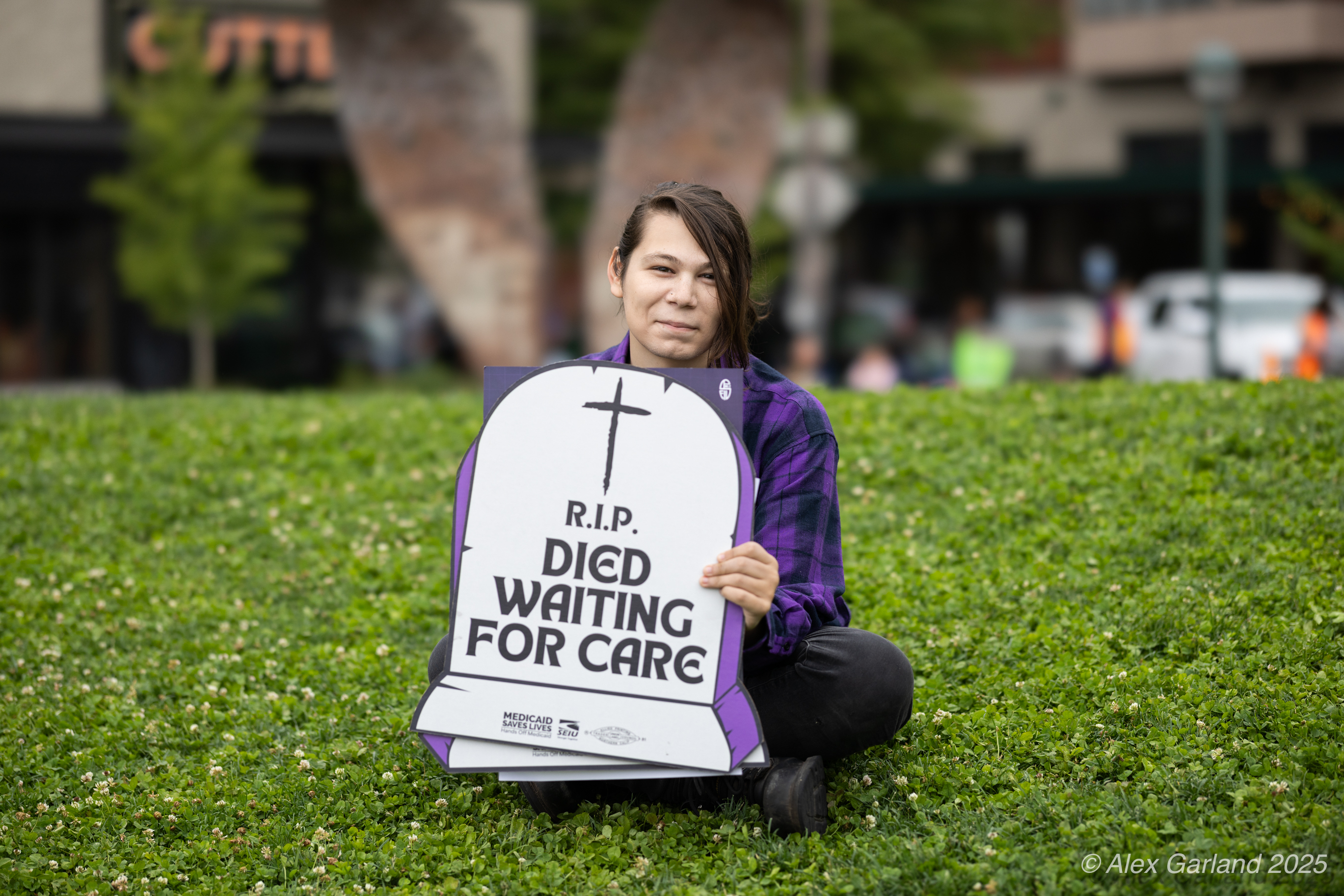
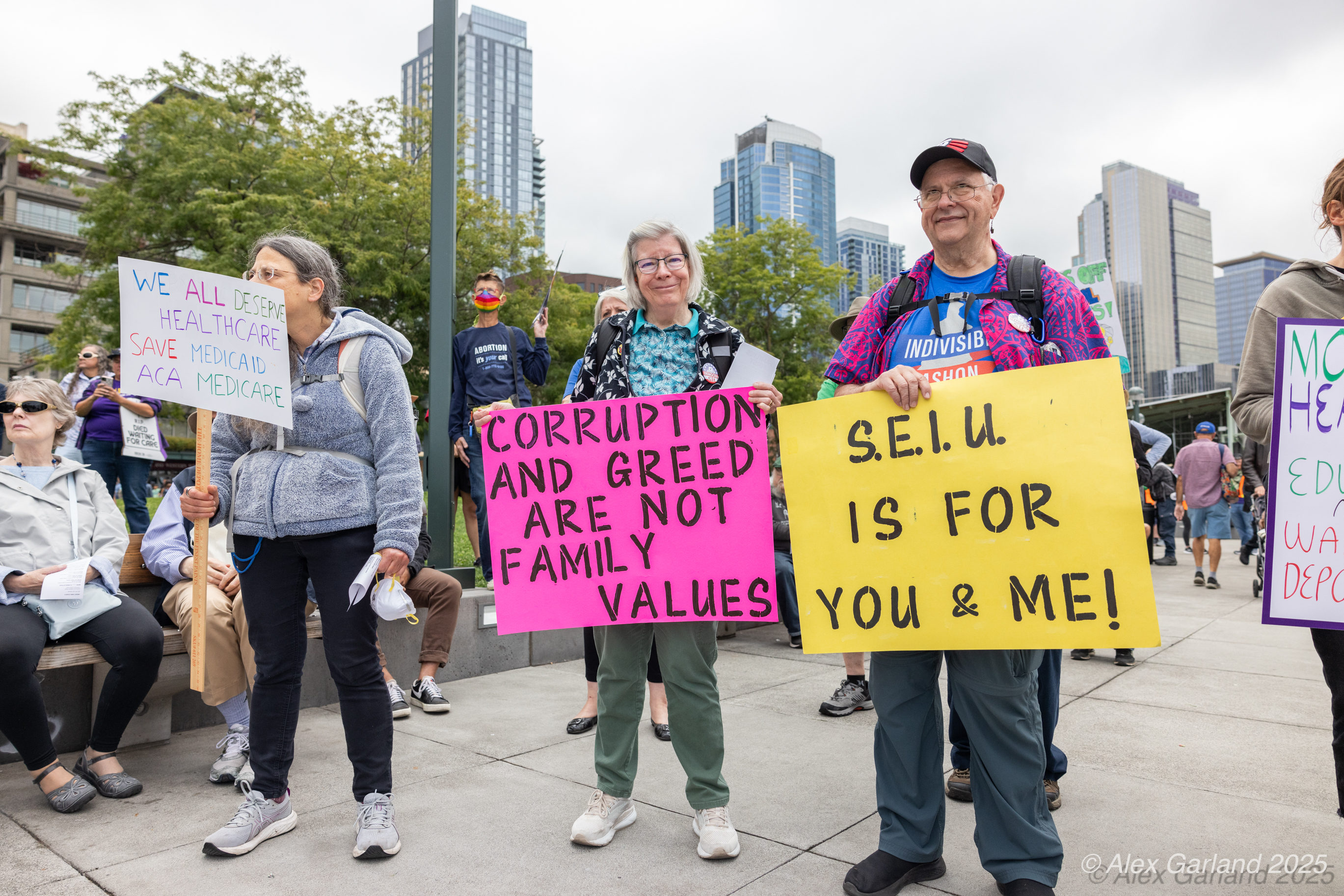
Their message was urgent: looming federal Medicaid cuts threaten to severely reduce healthcare access. At the same time, they warned, billionaires stand to receive massive tax breaks. Speakers denounced this as “the biggest transfer of wealth from the poor to the rich in U.S. history.”
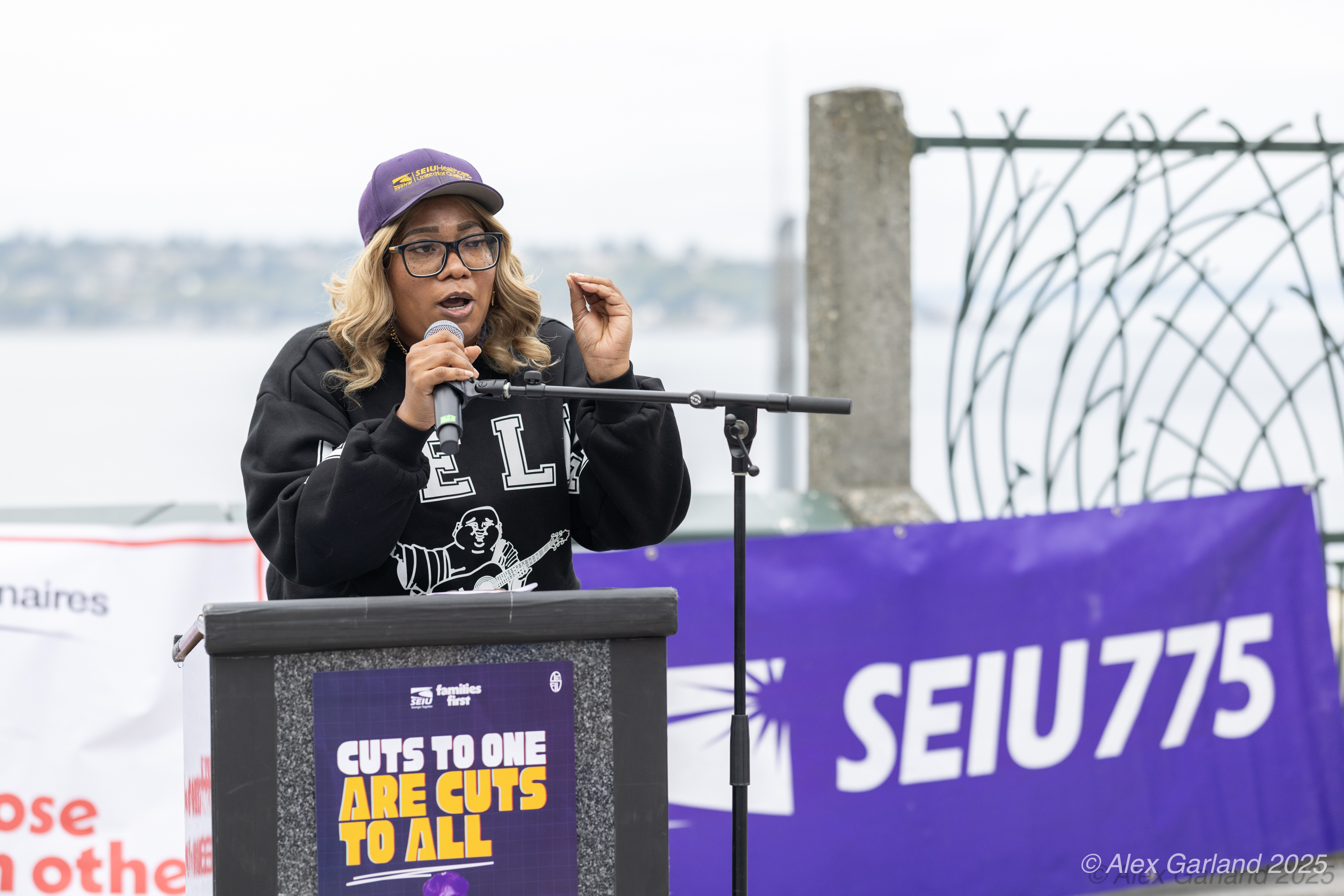
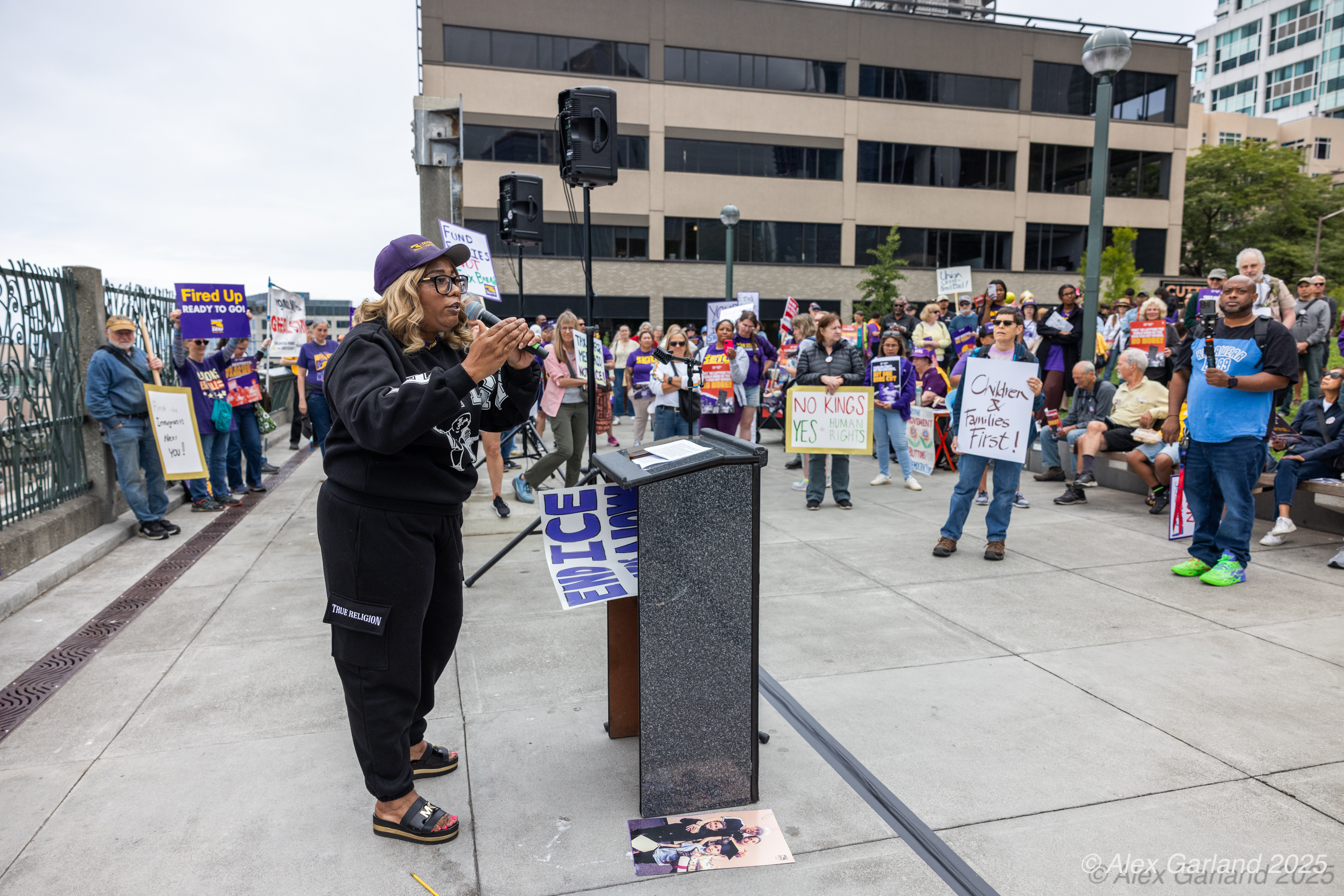
“We’re seeing billionaires grabbing everything they possibly can, leaving working-class and poor people to scramble for the crumbs,” said Kimela Vigil, a mental health practitioner and vice president of the Harborview Union. She linked the $4.5 trillion in proposed cuts to a broader agenda: “The dismantling of the legal system, attacking education systems, using the military to suppress free speech, all of those are the perfect formula for authoritarianism and fascism… We are in it right now… Our role is to resist, to not be complacent.”
The cuts threaten to reverse healthcare gains at safety-net hospitals like Harborview, where uninsured rates dropped from 12% to 3% under the Affordable Care Act. Now, Vigil warned, the hospital could “lose $8.4 million annually for every 1% of Medicaid patients shifted to uninsured status.” She accused lawmakers of deliberate timing: “They designed these cuts to kick in after the election so they won’t be held accountable.”
The human cost was made starkly clear by frontline workers. “Medicaid is not just for poor people, it is for everyone,” said Harborview RN Sam Conley. “When hospitals can’t get reimbursed for care, our whole system breaks down…When people can’t afford treatment, they don’t get better, they get sicker.” RN Naomi Morris shared a life-or-death example: “Right now I have a 13-year-old patient with diabetes. His care is funded by Medicaid. It’s the reason he continues to survive.”
The rally highlighted how proposed Medicaid cuts fit into a broader pattern of austerity measures, from the elimination of food assistance to reduced childcare funding, while corporations and enforcement agencies reap benefits.
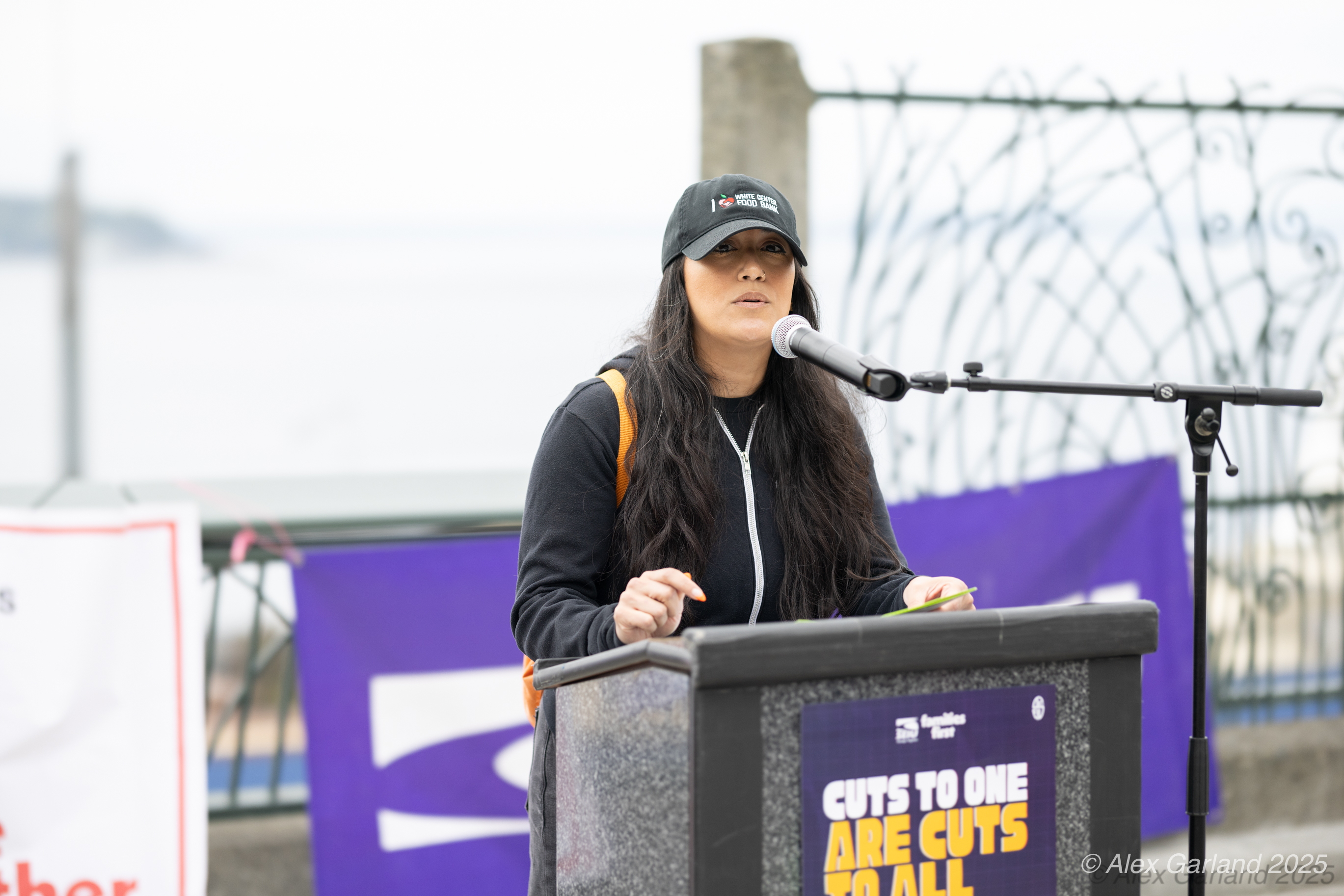
“SNAP cuts have already spiked food bank visits by 200% since 2019,” said Carmen Smith, Executive Director of the White Center Food Bank. “This is not unique to White Center Food Bank. It’s a trend we’re seeing across Washington State and across the nation.”
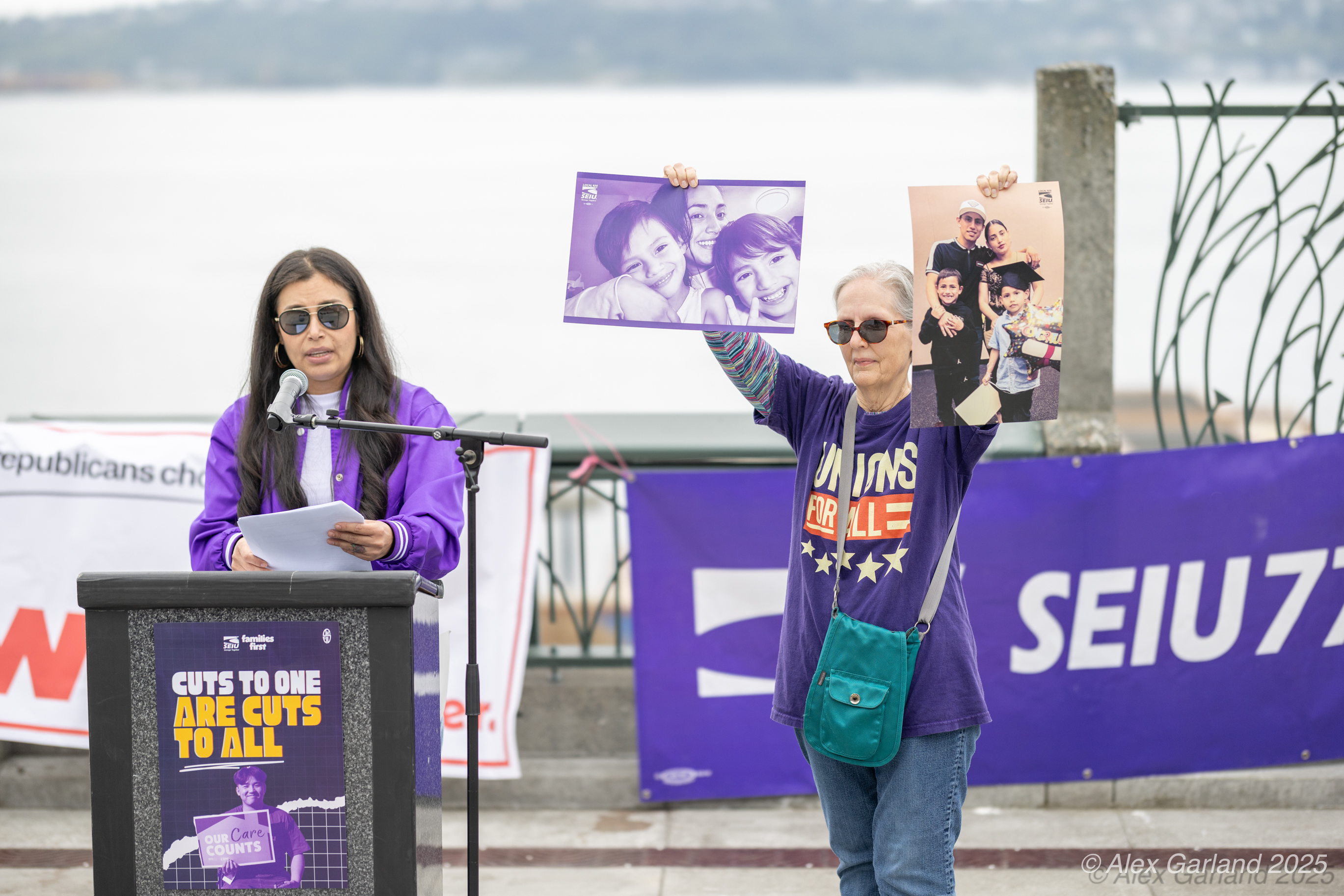
Meanwhile, the bill triples ICE funding while shrinking child care subsidies. SEIU 925 shared the story of Nicolle Orozco Forero, an asylum-seeking daycare provider detained and deported just days before opening her business—along with her entire family, including her severely ill son.
Corporate tax breaks, dubbed the “Big Ugly Bill” by critics, further fueled outrage. “…the biggest transfer of wealth in American history,” said Sterling Harders, President of SEIU 775, “and yet Amazon has more workers who rely on Medicaid than any other employer in Washington State.”
Yolanda King of SEIU 1199 invoked the spirit of civil rights resistance: “My grandparents stood with Dr. King. They understood that they’re not going to give it to us, we have to take it. Today we are saying that we are going to take back what is ours. This country belongs to us. We are the people, and we need to make a demand.”
Girmay Zahilay, a King County Councilmember, delivered a blunt assessment of the cuts’ local impact: “The budget director of King County told us, there is no way that King County on its own can backfill the scale of cuts coming from the Federal Government.” Zahilay outlined stopgap measures, pointing to the county’s allocation of $1 million to shore up reproductive healthcare clinics after Medicaid cuts threatened Planned Parenthood and Cedar River Clinics.
But he stressed the disparity in resources: “We can use the tools that we have from the state legislator,” he said, referencing a newly passed criminal justice sales tax expected to generate $90 million annually for homelessness and behavioral health services. The state has also authorized a new sales tax, but Zahilay admitted the choice feels wrong. “It’s either use that regressive tax or allow devastating cuts to happen in our community that we can’t stomach,” he said.
Planned Parenthood Alliance Advocates greater Seattle organizer Madeline Brown delivered stark projections about the Medicaid cuts’ impact: “These cuts to Medicaid are going to increase and are going to result in 200 clinic closures, 90% of which are going to be in access states like Washington.”
She warned of systemic consequences: “Our healthcare system cannot handle the influx of those patients…after the midterm election, we know that 17 million people are going to be kicked off of their healthcare.”
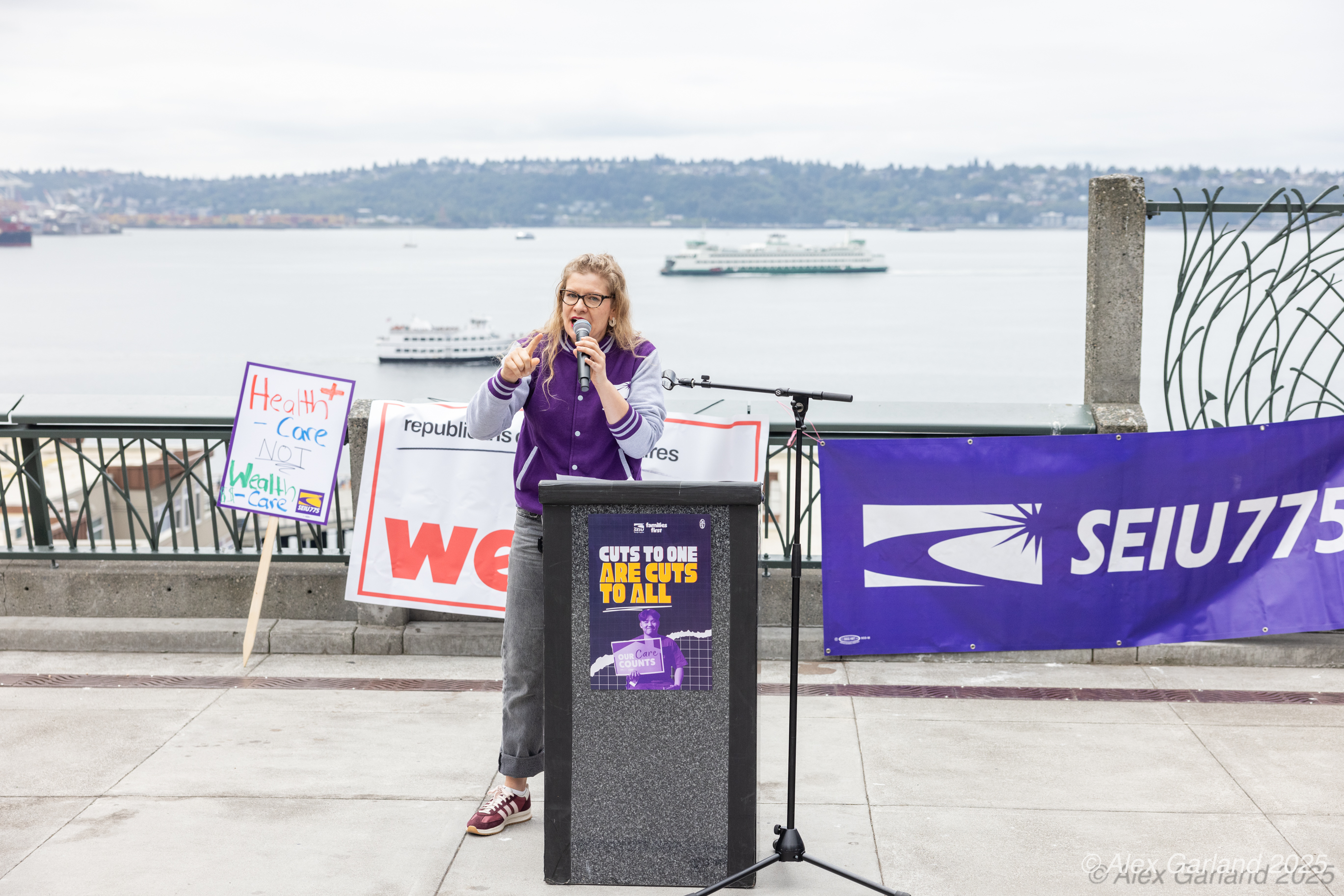
Brown concluded with the rally’s defining message, met with applause from healthcare workers in scrubs and union members holding signs: “When Republicans choose billionaires, we choose each other.”
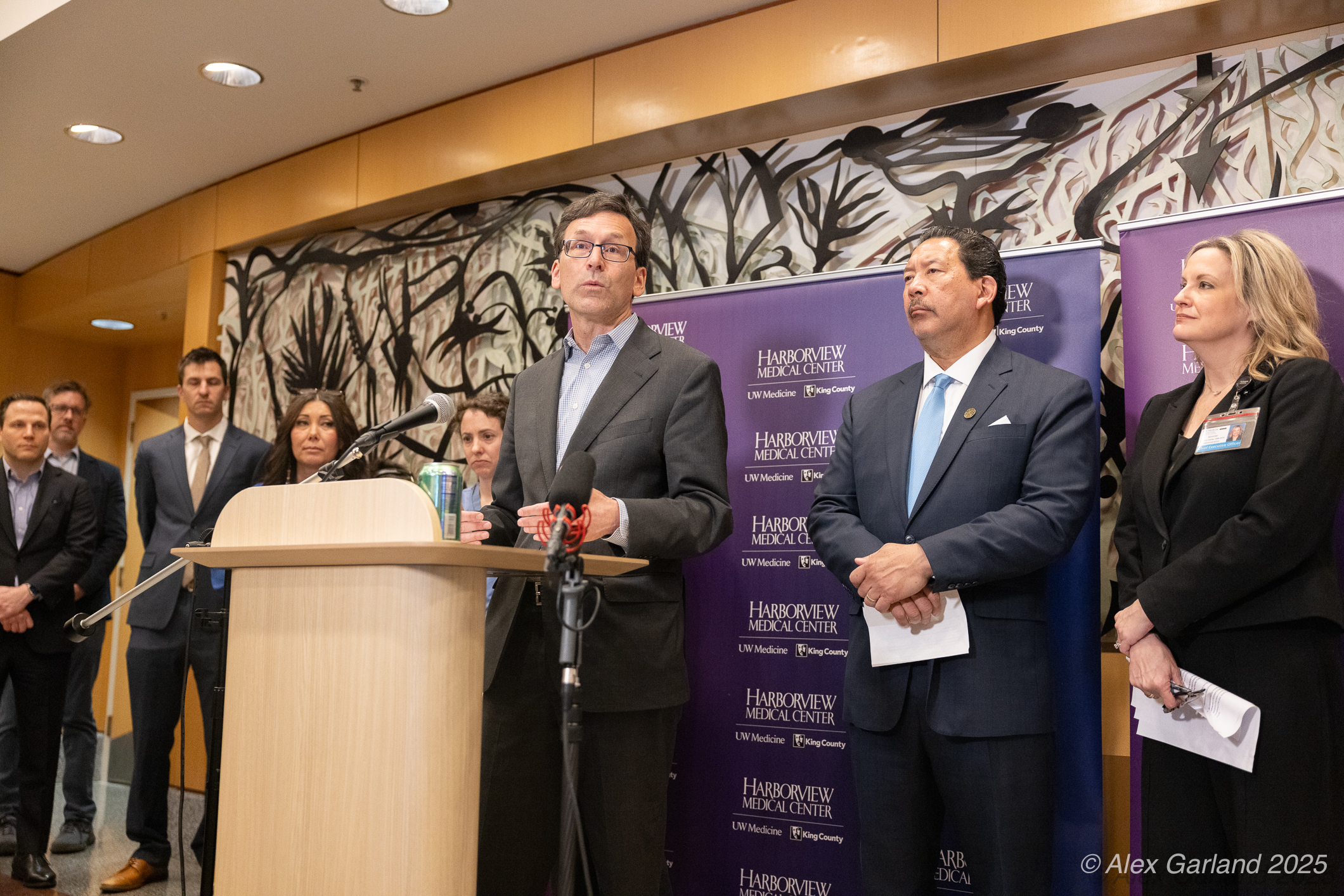
SEATTLE—Washington’s healthcare safety net is under threat as federal lawmakers consider drastic Medicaid cuts that could leave hundreds of thousands without coverage and force hospitals to slash critical services. At a press conference today at Harborview Medical Center, state officials, healthcare workers, and families who rely on Medicaid shared stark warnings about the potential fallout.
Harborview Medical Center
A Lifeline at Risk
Harborview, the region’s only Level I trauma center for adults and children, serves patients from across the Pacific Northwest, many of whom depend on Medicaid. CEO Sommer Kleweno Walley didn’t mince words: “Cuts under serious consideration by Congress could now result in an annual loss for Harborview alone of hundreds of millions of dollars. It’s impossible to overstate the crisis that cuts of this magnitude would mean for Harborview and this states entire safety net.”
Harborview CEO Sommer Kleweno Walley
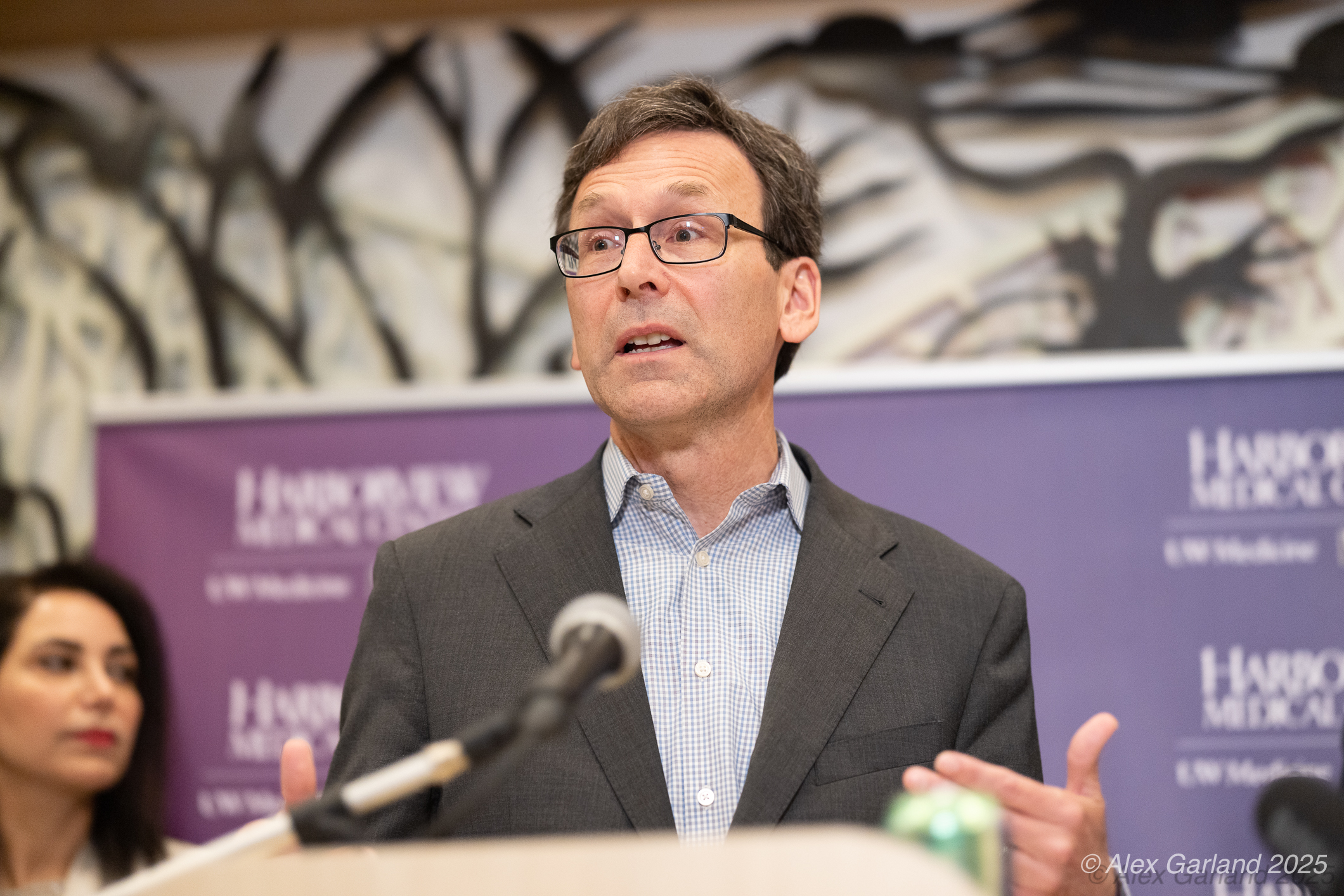
Governor Bob Ferguson laid out the numbers: Washington could lose $2 billion in federal Medicaid support over the next four years, leaving an estimated 200,000 residents uninsured by next year. Rural hospitals, already struggling, would be hit hardest. “There is no doubt that hospitals will close in Washington state, in rural and urban parts of our state. Nursing homes will close if this is approved by the United States Senate” Ferguson said. “Our state will change in fundamental ways if this goes through.”
Voices from the Front Lines
Jen Chong Jewell and son Gabriel
Jen Chong Jewell brought her son Gabriel, who relies on Medicaid for surgeries, therapies, and medical equipment. “Medicaid allows my son and so many other children and youth to live, be supported, and thrive in their communities.” she said, “We are more than a number or some data point, we are the expert on our own lives. “
Sam Conley, a nurse at Harborview for over a decade, described the real-world consequences of underfunded care. “I’ve already seen the consequences when patients can’t afford their care,” Sam said. “Diabetics who skip insulin wind up with thousands of dollars in emergency medical bills…Losing health coverage doesn’t make chronic health and illnesses disappear, it just forces people to go without treatement. Patients get sicker more often and stay in the hospital longer.”
Harborview nurse Sam Conley
A Political Fight Ahead
The proposed cuts, tied to broader federal budget negotiations, have drawn fierce backlash. Ferguson accused Congress of prioritizing tax breaks for the wealthy over healthcare for vulnerable Americans. “Last night Congress took an action that only be described as cruel and one that would harm many thousands of Washingtonians if approved by the Senate” he said. “We’re going to do everything we can to persuade the Senate to walk back from the brink of an action that would have truly dire consequences for many thousands of Washingtonians.”
Washington Governor Bob Ferguson
Seattle Mayor Bruce Harrell pledged solidarity, emphasizing Medicaid’s role in the city. “This is 73% of the funding for the Seattle Indian Health board, as an example. We anticipate that Medicaid cuts will affect 450,000 patients in King County.“
What Happens Next?
If the cuts pass, Harborview and other safety-net hospitals may be forced to eliminate services or even close departments. Walley warned, “Harborview board of trustees, and our King county elected officials will have to have some incredibly difficult conversations about what part of Harborview can stay open and what parts we have to rethink.”
For now, advocates are urging the public to contact lawmakers and share personal stories. As nurse Sam Conely put it: “Cutting Medicaid doesn’t reduce the need for healthcare, it just shifts the cost…In the end, taxpayers bear a larger burden and people face negative outcomes that could have been prevented.”
Reprints available with a $100 donation via Venmo @AlexGarlandPhotography — please include the story title in the note.
























































 The Dignity Virus